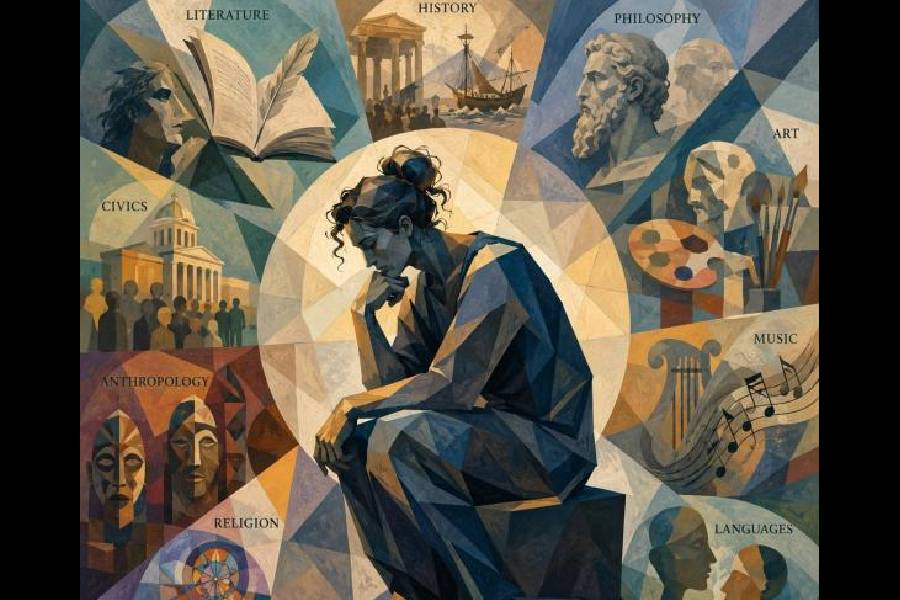
In 1979, I walked into a Calcutta college to study History. I had done well enough at school to invite the usual battery of well-meaning advice — why not Engineering? Medicine, at least? History, a neighbour said, as though diagnosing a mild eccentricity, was what people studied when they were hopeless at mathematics. I was not, in any meaningful sense, a rebel. I simply found the human past more interesting than the periodic table. I didn’t know, then, that I was stepping into a long argument about the purpose of education, especially humanities education — an argument that has now, nearly five decades later, acquired an urgency none of us could have anticipated.
The perception of a global crisis of the humanities has been around for quite some time now, fanned by the STEM boom, the defunding of arts departments worldwide, and the reduction of university education into a narrowly economic transaction. It was this crisis that the eminent American moral philosopher, Martha Nussbaum, anticipated with uncomfortable precision in her book, Not for Profit: Why Democracy Needs the Humanities (2010), written a decade before Artificial Intelligence had entered common conversation. The book described a “silent crisis” — a worldwide demolition job on the humanities in the name of economic growth, producing “generations of useful machines rather than complete citizens who can think for themselves, criticise tradition, and understand the significance of another person’s sufferings and achievements”. Nussbaum drew on Tagore, among others, and his Santiniketan experiment to argue that democracy itself depends on the kind of imaginative and critical capacities that only humanistic education cultivates. The profit motive, she warned, was hollowing out precisely the skills that free societies needed the most. Her fears have not diminished with time, not least in the United States of America where elite universities once regarded the humanities as indispensable to civic life. More than a thousand grants approved by the National Endowment for the Humanities, America’s principal public funder of humanities research, were abruptly terminated in April 2025 before a federal court restored them only last month.
What Nussbaum could not have anticipated, however, is that the humanities, even as they faced this institutional assault, have been quietly and remarkably reinventing themselves. Contemporary scholarship has moved decisively beyond canonical texts, Western epistemologies, and the sovereign human subject. The new humanities are planetary, posthuman, decolonial, and technological at once — questioning Eurocentric knowledge systems, foregrounding the Global South and indigenous thought, and examining how climate crisis, digital networks, non-human life, and AI are reshaping existence itself. Digital humanities, environmental humanities, medical humanities, energy humanities, disability humanities, memory studies — these are not dilutions of the tradition but urgent extensions of it, organised around the emergencies of our time.
In the age of AI, though, re-reading Nussbaum feels strangely disorienting. Though prophetic in everything she feared, she couldn’t have foreseen that the most telling blow of all would come not from market logic but from a technology that seems to render the humanist mind redundant altogether. If the first threat was that students would not choose the humanities, the second was that it would no longer matter whether they did — since a machine could write the essay, interpret the text, summarise the argument, and do all of it faster. The humanist, it appeared, had survived the market only to be ambushed by the algorithm. I confess having felt the force of this. But then, I read something that gave me pause.
A month ago, I read Maureen Dowd’s column in The New York Times, tantalisingly titled “What A.I. Kant Do”, describing something seemingly improbable — the tech world’s apparent change of heart. Daniela Amodei, co-founder of Anthropic, who read Literature in college, told ABC News that studying the humanities was going to be more important than ever. AI, she noted, was already very competent at STEM, but what it couldn’t do was the work of self-understanding, of historical consciousness, and of grasping what makes us human. Reed Hastings, a founder of Netflix, was suddenly advocating teaching emotional skills to children. The billionaire businessman, Mark Cuban, said that curiosity was the greatest asset in an AI universe. And from Stanford, of all places, arrived the striking report that computer science enrolment has fallen for the first time in two decades.
Wait, I thought — is this a marketing ploy? Is Silicon Valley discovering the humanities the same way a mining company discovers conservation, after the damage is done and with one eye on its public relations? Is the same industry that spent years building engagement algorithms designed to bypass critical reflection now telling us that critical reflection is what we need?
And yet, I found myself thinking against my own scepticism. A drama professor at Johns Hopkins University put it with elegant precision to Maureen Dowd — the cool reason of AI comprehends, but the seething imagination of art apprehends. Large Language Models perform extraordinarily sophisticated pattern recognition. But they don’t experience grief, guilt, shame, wonder, love, or moral conflict. They process meaning without inhabiting it, so they can’t feel the weight of responsibility, nor understand why a sentence in Literature can permanently alter one’s consciousness. This limitation may turn out to matter more than we presently imagine.
Indeed, some economic trends already point in that direction. The 55,000 AI-attributed layoffs of 2025 in the US fell overwhelmingly not on humanists but on technology workers — software testers, junior programmers, content moderators, and the like. Meanwhile, the World Economic Forum, in its survey of ‘New Economy Skills’, identified creativity, adaptability, emotional intelligence, and complex reasoning as the most valuable future skills. Those who still cultivate the difficult habits of reading, interpretation, judgment, and sustained attention may paradoxically become rarer and, therefore, more valuable.
For India, what Martha Nussbaum said in 2010 retains a particular sting. In this country, she noted, “a new conception, focused on profit, has taken over — sidelining the whole idea of imaginative and critical self-development …” That picture hasn’t substantially changed in the intervening fifteen years. The India Skills Report 2026 records that arts graduates show a 55% employability rate — rising, but still well behind computer science graduates at 80%. The National Education Policy 2020 makes positive gestures toward multidisciplinary education, but between the policy vision and the reality of coaching institutes, parental pressure, and the brutality of entrance examinations lies a vast and unresolved distance. The deeper problem is institutional. Perhaps we have protected the humanities from extinction without committing to their rigour or their application, treating them as an archive to be maintained rather than a resource to be used.
The Owl of Minerva, Hegel said, spreads its wings only at dusk — wisdom comes after the fact. But perhaps the dusk of the humanities’ long crisis is also, unexpectedly, a dawn. My neighbour in 1979 was not entirely wrong in thinking the world would make life difficult for someone studying History. What he couldn’t understand was why it mattered. It mattered then because democratic societies required reflective citizens. It matters now because a civilisation, increasingly surrounded by intelligent machines, may discover, too late, that the distinctly human capacities for judgment, imagination, ethical uncertainty, and historical memory are not ornamental luxuries at all. They are what democratic life — and now, it turns out, economic survival, too — actually requires.
Jayanta Sengupta is Professor, SHSS, TCG CREST, Calcutta