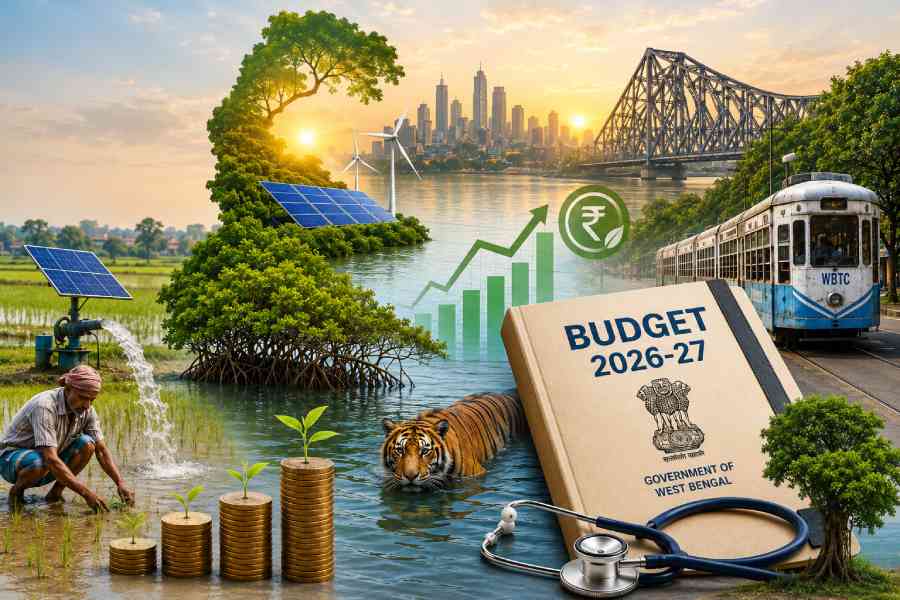
Bengal and eastern India are turning into a global climate “hotspot”. What cost it will extract from the economy of Bengal and the core development strategy to achieve the state’s transformative potential in the next five years are the key questions facing this budget.
The questions assume importance as finance minister Swapan Dasgupta had expressed his support for green issues and funds sourcing even before assuming charge on June 10.
In a discussion with environmental activists from the state on World Environment Day (June 5) as well as with The Telegraph earlier, he batted for the key environmental and climatic agendas of the state — from the Sundarbans to the East Kolkata Wetlands — with special focus on the conservation of Rabindra Sarovar and the rejuvenation of tramways in his constituency.
“We need to look at judicial verdicts on these agendas, and also explore appropriate technical solutions and funding, but I believe everything is possible as we have a political will to do that,” Dasgupta had pointed out.
He has now got the opportunity to implement the ideas while tackling a struggling economy that may need to continue with freebies and doles as a political compulsion. Despite time constraints, it is important to undertake steps in the right direction. Economy and environment need to go hand in hand, as far as possible.
Impact on GDP
Every year, Bengal loses around 1-3 per cent of its GDP to climate change, but the issue hardly finds mention in the budget document. A “winnable” climate-resilient economic policy is a good starting point.
We can’t change our natural geographic disadvantages. The state sits at the tail end of a massive hydrologic engine, the Ganga and the Himalayan rivers. On its coast, it faces a rapidly warming and slowly rising Bay of Bengal with periodic damaging cyclones. Given one of the highest population densities in India and the world, with very low incomes, this means much greater vulnerability to sharply rising climate shocks. What should we do?
The answer is to integrate effective climate adaptation and mitigation policies (energy efficiency and generation) into traditional departmental budgets. While mitigation means high funding and a major overhaul, adaptation means fewer changes to adapt to the situation and reduce losses and damage.
It is not simply about tagging “green” budgetary expenditures and making the budget “greener”, but about transforming the way we use our budgets to serve the larger goal of climate-resilient development. More intense community engagement is critical in all these areas to leverage our budget to achieve its intended effect.
In agriculture, the budget should support climate-resilient cropping systems and intensify solar irrigation and water control in winter. In river and flood management, drastic changes are necessary for using natural river flows to the state’s advantage. The planned Ganga upper delta and lower delta projects — the funding of which is likely to primarily come from Asian Development Bank and the World Bank — should follow this path.
In linked urban development and public health sectors, we should turn our attention single-mindedly to heat and water management, urban greening and addressing vector diseases exacerbated by climate change.
Drainage systems need a drastic overhaul. In industry, energy and linked finance, we need to turn our attention to diversifying and growing the “missing middle” of private enterprise. This will minimise our over-reliance on coal and steel and help us transition to low-cost solar energy and efficient cooling systems for “missing-middle” enterprises and dense urban settlements.
The state should also try to maximise mindful nature-based tourism in the Sundarbans and the Himalayas.
Instrument of change
The budget is a critical instrument of change. We need to fundamentally learn to leverage public resources to attract community-driven and private investment into the opportunities abundantly present in climate adaptation and mitigation.
Not everything has to be done by the public sector and the budget. Instead, we should “de-risk” private and community investments in a climate-resilient development strategy. That includes protecting our communities through innovative climate insurance, crops and disasters.
The next budget should start to systematically look at every single line item for such opportunities. Bengal can power much faster growth and jobs with fewer climate shocks that can be massively transformative. Gujarat, Tamil Nadu, Maharashtra, Rajasthan, Uttar Pradesh, Assam and Odisha are all starting to focus on climate-resilient development as the single-most important engine of development. Bengal can do even better.
Creative fund use
The draft version of the State Action Plan on Climate Change (SAPCC), which has been submitted to the Union environment ministry some time back, has earmarked a climate budget close to ₹2 lakh crore for the next five years.
While the figure looks imposing and very difficult to realise at first glance, an analysis under an UNDP and state finance ministry commissioned project shows that already a sizeable part of it gets spent by the state through combating disasters and other actions. The only hitch is that many of these expenditures happen without proper planning, with little monitoring. All these need to change now.
- Dipak Dasgupta is former principal economic adviser and founding member of Green Climate Fund
- Jayanta Basu is an environment journalist and academic