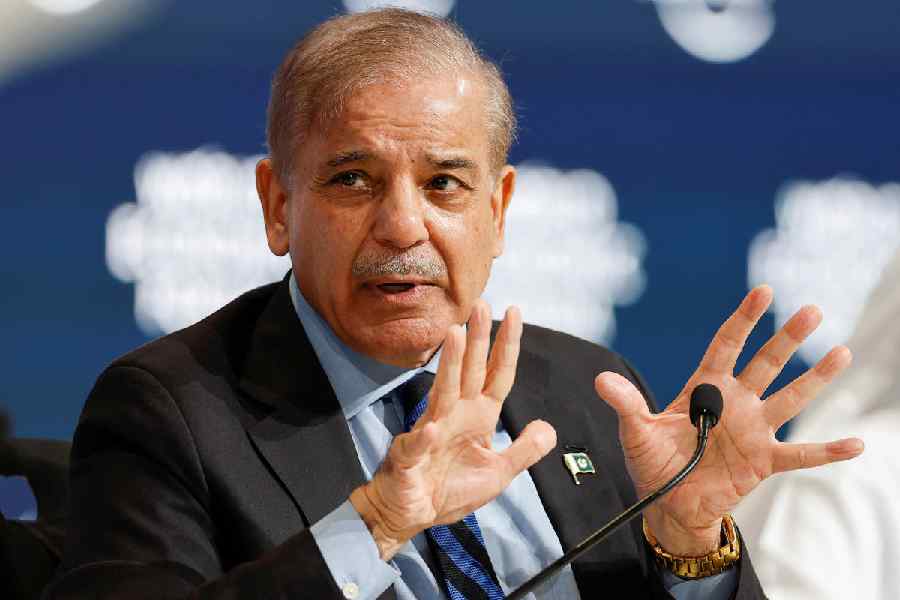
Pakistan Prime Minister Shehbaz Sharif on Sunday praised the Iranian delegation’s “cool-headedness, dignity and attempts at de-escalation” while speaking to the press in the Swiss mountain resort of Burgenstock.
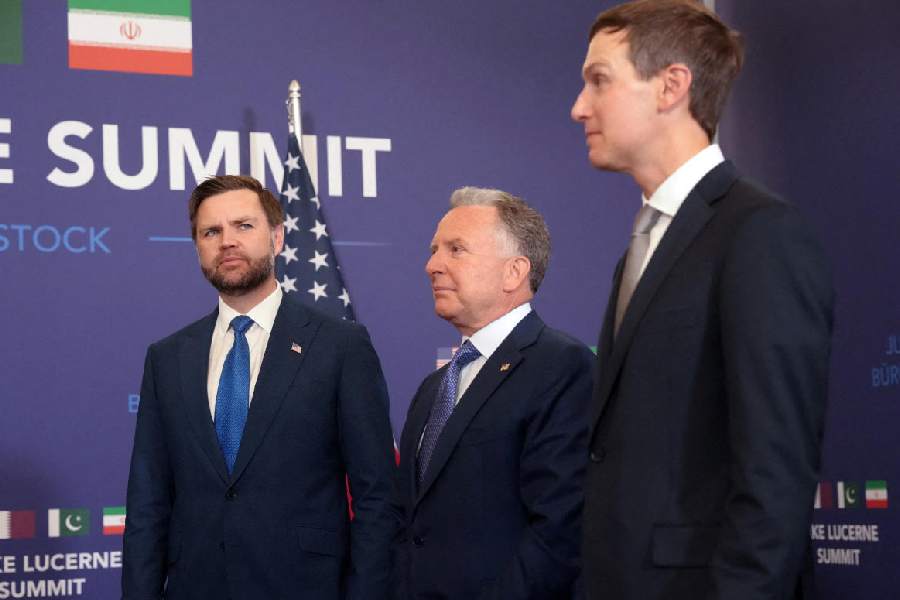
The quadrilateral talks between the US, Iranian, Qatari and Pakistani delegations – being termed the Lake Lucerne Summit – are focused on implementing key provisions of a Memorandum of Understanding (MoU) signed last week by US President Donald Trump and Iranian President Masoud Pezeshkian, with Sharif signing as a guarantor.
“I think they genuinely mean to promote peace in the region,” Sharif said of the Iranian leadership, adding, “So does President Trump.” Sharif further said he had “no second thoughts” about Trump being a “man of peace”. “He has demonstrated that during the war between Pakistan and India,” he said.
The US president has repeatedly claimed he stopped the conflict between India and Pakistan, since May 10 last year, when he announced on social media that the two countries agreed to a "full and immediate" ceasefire after a "long night" of talks mediated by Washington.
Sharif was optimistic about the “renewed friendship” with the US, and hoped it would grow into a relationship of close coordination and cooperation between the two countries.
While the US and Iran are the two main sides in the negotiations, Pakistan and Qatar are mediators.
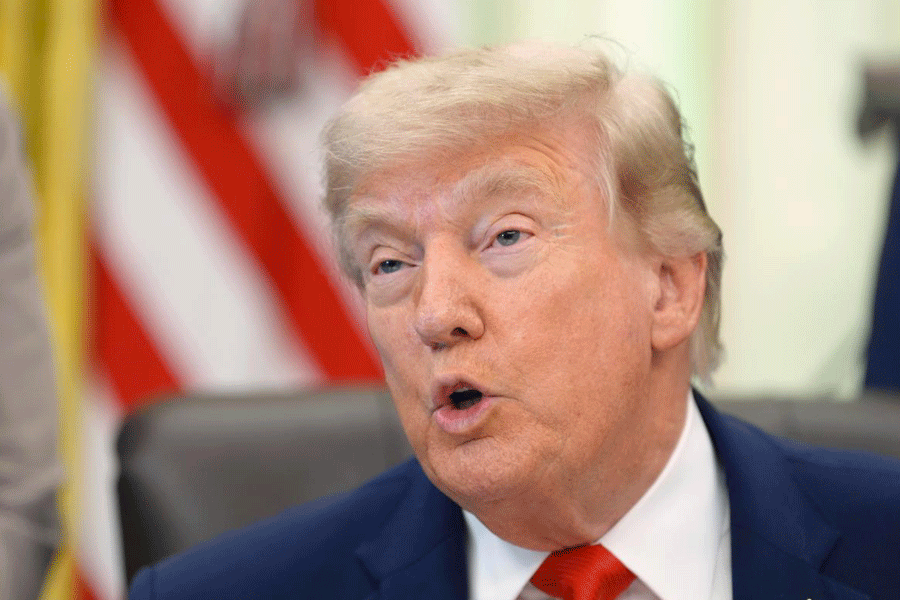
As the talks began, Trump in a post on Truth Social had threatened Iran over unrest in Lebanon, one of the key issues in the negotiations.
“Iran must immediately stop their highly paid PROXIES in Lebanon from causing trouble. If they don’t, we’ll hit Iran very hard again, just like we did last week, only harder!!!” he said.
The US president, in an interview with Fox News, issued threats over the closure of the Strait of Hormuz, claiming that he maintains “a variety of options” at his disposal.
Meanwhile, US Vice President J D Vance told the press that “peace requires give and take”.
“This is a historic meet. Never before have Iranian and American leadership met at such a high level outside of Islamabad,” he said.
“What today really represents is the beginning of a technical negotiation that’s not going to solve every disagreement, but is going to allow us to sit together as teams, for the first time really in history, to figure out what matters most to the respective parties, to settle those issues, to solve those issues, and get to a better tomorrow,” he said.
“The reason why the political leadership of the respective countries is here is because we wanted to, first of all, set up the structure for these technical negotiations, and second of all, make sure that our teams have our full support and know they can always call on us to break through any barriers.” Vance, thanking the US president, said a great deal had “already been accomplished” and the team looked forward to seeing “how much more we can accomplish together”.
“Can we change relations in the Middle East, or do we go back to doing things the old way?” he said. “Where Iran and the Gulf have had an unfriendly relationship, or Iran has been a driver of regional instability? We see a future where everyone can work together to promote peace and prosperity for everyone.” Vance said Trump is committed to a “full regional ceasefire”, including Lebanon. These kinds of ceasefires are always “a little bit messy”, but they had seen progress over the last few days, he added.
Vance also shared appreciation for PM Sharif and Pakistan Chief of Defence Forces Asim Munir, saying: “I have joked that I have two very, very important people in my life. An Indian and a Pakistani. The Indian is my wife, and the Pakistani is Field Marshal Munir,” he said.
Vance further said that he had “probably talked to Field Marshal Munir more than anyone else over the last few months”.
“If Iran is willing to give up nuclear weapon ambitions for the long term, the US is willing to transform relations with them,” he said.
The president, he said, had urged him to “turn over a new leaf to transform our relationship with the people of Iran, and to extend an outstretched hand”.
Qatari Prime Minister Sheikh Mohammed bin Abdulrahman bin Jassim Al Thani also speaking at the opening ceremony, thanked both the US and Iranian delegations for their efforts to make peace in the Middle East.
“I think that everyone of you has highlighted how important and historic this is, not only on the security of the region but also for the security of the world and for the global economy,” the Qatari PM said.
Earlier in the day, Sharif met negotiators from both the US and Iran separately on the sidelines of the talks.
While Vice President J D Vance led the American side, the Iranian delegation was led by Parliament Speaker Mohammad Bagher Ghalibaf.
Photographs posted on X by Sharif’s office showed him shaking hands with them in separate meetings.
Before the quadrilateral talks kickstarted in the evening, Sharif addressed the press in the presence of Vance and Qatari Prime Minister Al Thani.
He praised US President Trump and Iranian leaders. He also praised Pakistan’s Army chief Munir, who accompanied him to Switzerland, and could be seen along with him during the meetings with the delegations representing Washington and Tehran.
“I think here we are going to have wonderful discussions which will lead to, hopefully, very productive results in times to come,” Sharif said.
He further said, “Hopefully when we go back to our homes, we'll have some wonderful paper in our hand which will promote peace, progress and prosperity around the globe.” The MoU marked the beginning of a 60-day negotiation window to restore peace in West Asia with focus on key areas that include Iran’s nuclear programme, sanctions imposed on it and Israel’s offensive in Lebanon.
The discussions on the technical aspects of the negotiations were supposed to begin on Friday, but were delayed, primarily due to fresh rounds of firing between Israel and Iran-backed Hezbollah.