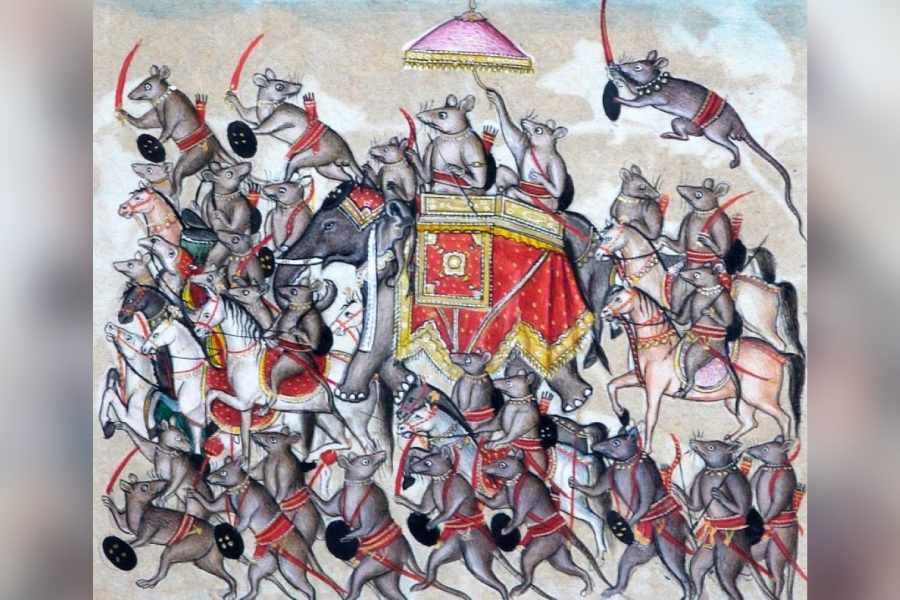
This column is not about that much despised and, in recent weeks, much discussed creature — the cockroach. But it has been inspired by the formation of a political organisation in its name following a remark said to have been made by the honourable chief justice of India.
Aneurin Bevan (1897-1960) is not a name that will ring many bells for the present generation in India or even in England where the Welshman, who had been a miner in his teens, grew to become a formidable — and hugely eloquent — Labour leader and, as health minister in Clement Attlee’s cabinet, architected Britain’s National Health Service. He has long been a favourite with me as has been a famous speech of his. Ever aware and never forgetting the miseries and ‘semi-starvation’ that he had known his South Wales community to have faced during his youth, Bevan held the Conservative Party responsible for those privations. On July 4, 1948, the eve of the NHS’s creation, the minister of health, Aneurin Bevan, spoke at a North of England Labour rally in Manchester. In a withering chastisement of the Conservative Party, said the 51-year-old Bevan: “No amount of cajolery, and no attempts at ethical or social seduction, can eradicate from my heart a deep burning hatred for the Tory Party that inflicted those bitter experiences on me. So far as I am concerned, they are lower than vermin.”
Vermin! Now that is about rats, no less. The speech has been described (Alistair Lexden, House of Lords, in The Spectator on November 19, 2016) as “one of the most famous and polarizing insults in British political history.” How did the Tory Party react? Winston Churchill fumed and urged action against Bevan in the courts. But many Tory supporters laughed and decided to react with great style — in scorching humour. They decided to form the Vermin Club. Complete with membership procedures and a hierarchy system, they even devised a bronze badge for members to be sold and worn at Conservative Party conferences where they proudly proclaimed themselves in a graded system based on how many others they recruited to the Order, as “vermin” and as “vile vermin”, and those who recruited more became “very vile vermin”, the future prime minister, Margaret Thatcher, an early member of the club, rising through its ranks to become a “Chief Rat”. The internet tells us that the grassroots organisation was “massive, boasting a peak membership between 105,000 and 120,000 before dissolving in 1951” after having served the cause of harmless but fearless satire in politics.
I do not know if Abhijeet Dipke, the originator of the initiative in the name of the reviled cockroach, knows of the Bevan and vermin story. But it would do him and his detractors good to see the searing possibilities of humour as an instrument of political activity.
This column has, at its core, not the cockroach but the rat.
Far less numerous and widespread than the ’roach, the rat has been described by Wikipedia as being one of “… medium-sized, long-tailed rodents… found throughout the order Rodentia, with the genus Rattus containing the most familiar rats”. It also tells us: “The best-known rat species are the black rat (Rattus rattus)… originated in Asia.” We may assume that India, constituting 30% of Asia’s population, has made a huge contribution to the origination and the spread of rats in the world — not its fault! Just a fact. A vermin fact.
The rat is largely disliked by human society, barring some segments of which that have accorded it a privileged, if not honoured, status. In India, the rat is the vehicle of the hallowed and hugely beloved deity, Ganesha. And as such, is looked upon in its adjacency to the Destroyer of Obstacles with benign indulgence. But even those who worship the divine figure with the rat portrayed prominently in the depiction will not be pleased if a rat, not to speak of a large number of rats, was to invade their home. Indeed, the good old wooden contraption, the rat trap (does the word, ‘contraption’, have something to do with ‘trap’?), is one of India’s most commonly-made domestic contrivances. The ingenious wooden design, with a spring that comes down khattack no sooner the rodent has bitten the bait, has also been available in the next stage of the contrivance’s evolution — in a cage made wholly of tough wire into which the hungry creature is beguiled. For the better-off households, it can now be bought as the steely state-of-art gadget that looks like an instrument of torture straight out of Guantanamo Bay detention camp. Vermin intelligence and human ingenuity have been well-matched through the centuries, individual rats getting caught and killed but the genera surviving grandly. And there are, of course, those organic-types who have pet cats with the express intention of keeping the rat population in their homes under check in classic Tom and Jerry fashion with the difference that they are firmly on Tom’s side. Such is the dislike of the rat that only the most fervent apostles of non-violence such as the Jainas — all honour to them — would refrain from deploying these devices to save themselves from the rat. Rats being rats, India will never boast of their ‘creation’ as one of the hardy perennials of life on this planet but there the zoological satya is, namely, that despite all endeavours at its hatya, the rodent can proclaim ratyameva jayate.
There are several collective nouns in use for rats, such as ‘a swarm of rats’, ‘a colony of rats’, ‘a pack of rats’. The best collective noun for them, in my view, is ‘a mischief of rats’. That makes them irritating rather than offensive, a trouble rather than a danger. The protagonist of this column is the rat whom the collective noun — a mischief of rats — captures most efficiently. And it brings to mind the greatest rat idiom in English. The reader will immediately guess it.
‘… like rats jumping out of a sinking ship’, says the internet, ‘… goes back to antiquity, with earliest variants appearing in Pliny the Elder’s Natural History (77 AD) regarding mice deserting collapsing buildings.’ But anyone who has read Shakespeare’s play, The Tempest, will remember Prospero’s lines from Act 1 scene 2: A rotten carcass of a butt, not rigged,/ Nor tackle, sail, nor mast; the very rats/ Instinctively have quit it.
Lexical references are ever useful to understand a phrase or an idiom and so the reader may find it interesting that Cambridge Dictionary gives as an example for it: “Former friends have deserted the couple like rats leaving a sinking ship.” And Merriam-Webster gives, as a sample: “Alas, like Rats, they forsake a falling-House, or a sinking Ship.” I have read most of Charles Dickens but not his collection of essays, The Uncommercial Traveller. I have only just, in the context of this reflection, learnt that this compilation has in “The Shipwreck” (Chapter 15) a reference to “an old nautical superstition and tale about a sailor named Chips who hears the ship’s rats conversing and predicting when they will have chewed entirely through the vessel’s hull, just before the ship sinks.” I do not know if in nautical and marine history rats, the real ones, have been known to abandon sinking ships. But I imagine that if they did, they would equally efficiently clamber onto ships that were not sinking. Ships’ captains need not lament their being abandoned by rodents for they, if they were not sinking, would doubtless look the other way if the four- legged swimmers were to return.
Shakespeareans might recall another ‘rat’ quote from the Bard of Avon, this time from King Lear (Act 5, scene 3) and infinitely sad, infinitely sublime: “Why should a dog, a horse, a rat have life,/ And thou no breath at all?/ Thou’lt come no more./ Never, never, never, never, never.” I bow my head to that deathless line. And will have nothing to say to that except two things: one, that we may not think too harshly of those that survive simply because they know in their very DNA the art of survival. Two, have sinking ships, have jumping rats; have sailing ships, have clambering rats.
Tell me, dear reader, who wouldn’t jump off anything that is drowning or burning to save her or his life? Wouldn’t you? Wouldn’t I? If there is in rats something akin to human intelligence, there also is in human beings something of the Rattus rattus. We may only try to keep that ‘something’ in relative check if we want to face our Maker in peace.