|
|

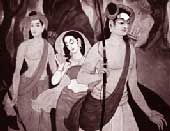
LEGEND OF RAM: Antiquity to Janambhumi Debate
By Sanujit Ghose, Promilla & Co., Rs 595
This well-researched work draws on numerous primary and secondary sources to examine the legend of Ram. The author visited several archaeological sites, religious institutions and mythological habitations in India and abroad to investigate extensively about one of the most popular figures in Hindu mythology. Myths relating to Ram, spread across continents over many centuries, may have found their way to India with the progress of the pastoral civilization. South and south-east Asia produced more than 200 Ramayanas besides thousands of folktales associated with the story of Ram. Sanujit Ghose refers to a number of maps which show the places associated with Ram.
According to the author, the traditional interpretation of the Ramayana is that it represents a poet’s vision of events that had actually happened and which involved an earthly manifestation of divinity. These events may have taken place in a remote historical time, but Ghose argues that there appears to be no genuine historical basis for the legend of Ram.
The author delineates three distinct sequences in the development of the legend of Ram. There are allusions to this name in the Rigveda, the Avesta (Iranian scripture) and some of the older transcriptions of the Boghaz Keui treaty and the Tell-el-Amarna letters. In the next phase are the Ramayana, the Ramopakhyana of the Mahabharata and the Jataka Tales in Buddhist literature and Paumacariya of the Jains. Besides, there is the literary masterpiece — Raghuvamsa by Kalidasa.
The third stage contains different versions of Ram in just about every language in India and in south-east Asia. The most famous among these is the Ramacaritamanas in Hindi by Tulsidas, Kamban’s Irumavataram in Tamil and so on, which are all very different from Valmiki’s Ramayana.
Ghose points out that poetry owes its inception to this famous epic. Barring the hymns in the Rigveda, no ancient myth, whether relating to Babylon, Egypt, China or any other ancient civilization, carries poetical compositions. Valmiki’s Ramayana ushers in the distinct poetical metre called anushtubha.
The author argues that for the last two decades, north India has mixed up religion, politics and chauvinistic Hinduism to shake-up the basic structure of society. Even if one agrees with this position, his claim that so sustained is “the push for and finalizing of the grand temple plan at the birthplace of Ram at Ayodhya that all other matters of governance have been cast aside” , comes across as an exaggeration.