Line crossed
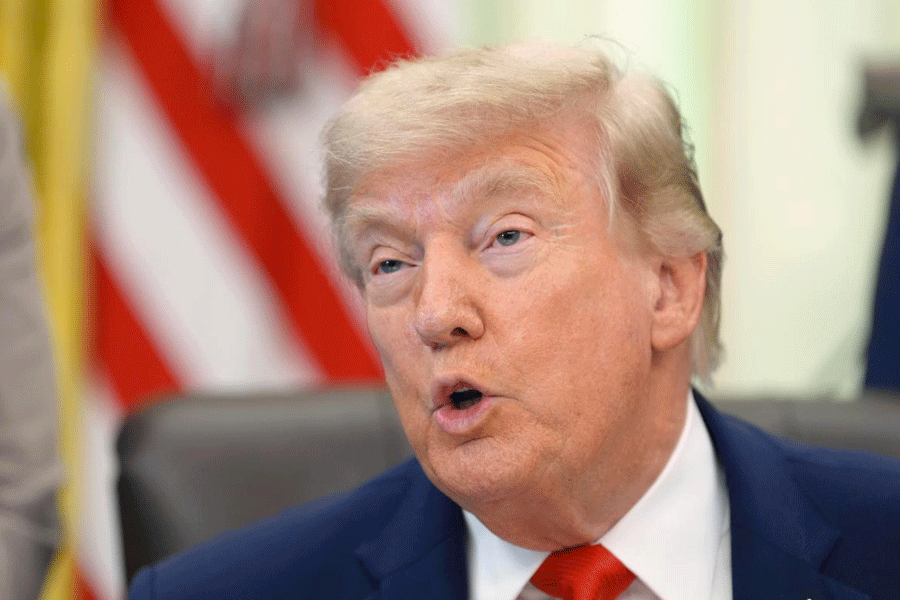
Sir — The president of the United States of America, Donald Trump, has posted yet another Artificial Intelligence post. Unlike his usual posts that one can simply laugh at, this one crosses a line. It shows fake versions of Rosie O’Donnell, Whoopi Goldberg, Edward Norton, Julia Roberts and Robert De Niro supposedly cured of ‘Trump Derangement Syndrome’. Public figures can be mocked but putting fabricated speech in their mouths is different. Political satire should be clearly labelled, especially when shared by the president of the US, during a presidency that clearly has many detractors.
Rushati Mukherjee,
Calcutta
Technical challenge
Sir — Many football supporters still struggle to understand how Video Assistant Referee decisions are reached (“Fair is foul, foul is fair”, Jul 3). The recent Croatia versus Portugal match highlighted this problem. A tiny touch detected by a sensor inside the ball changed the result, yet most viewers could not see it themselves. FIFA should explain such decisions more clearly during broadcasts and inside stadiums. Better communication would reduce confusion, improve public confidence and help supporters accept difficult decisions with greater understanding.
Indranil Sanyal,
Calcutta
Sir — The latest World Cup controversy shows how football is changing because of technology. The sensor inside the match ball detected a touch too small for anyone to see, leading to Croatia’s late goal against Portugal being ruled out. One assumes that the decision was technically correct, yet many supporters felt disappointed. Accuracy is important but football is loved for its natural flow and emotion. FIFA should ensure that technology improves fairness without making dramatic moments feel mechanical or delayed.
Annesha Ghosh,
Calcutta
Sir — Referees can make occasional mistakes. New technology has greatly reduced those errors which is a positive step. However, every incident does not require microscopic examination. Long reviews interrupt the rhythm of the match and leave players waiting before celebrating. FIFA should reserve the most advanced technology for decisive situations. The sport should remain fair while preserving the pace that supporters value.
Aditya Mukherjee,
Calcutta
Sir — The purpose of VAR was to correct clear mistakes. That principle seems to have been forgotten. The dismissal of Folarin Balogun from the United States of America, Germany’s disallowed goal against Paraguay and Croatia’s late heartbreak against Portugal have all sparked debate because supporters cannot understand why intervention occurred in one case but not another. Football requires consistent standards more than perfect technology. If similar incidents receive different treatment, confidence in the system will continue to decline.
Tathagata Bhattacharjee,
Calcutta
Sir — Technology should assist referees instead of replacing ordinary judgement. Germany’s disallowed goal against Paraguay depended upon a subjective assessment of contact with the goalkeeper. Croatia’s disallowed equaliser against Portugal depended on data from a sensor hidden inside the ball. Such decisions are difficult for spectators inside the stadium to follow. Football authorities should remember that supporters deserve explanations they can understand without specialist knowledge or complicated graphics.
Riju Ghosh,
Calcutta
Sir — Germany, Croatia and the US have each been drawn into major VAR controversies within days of one another. This suggests a wider problem.
Sudipto Ghosh,
Calcutta