The three language formula is back; this time, with a vengeance. English is now being celebrated as never before. It is, indeed, an integral part of the linguistic ecology of elite India. Even though the official language of the Union shall be Hindi in Devanagari script, English continues to be our Associate Official language. It is also the language of higher education, judiciary, medicine, technology, executive and the corporate world, all echelons of power controlled by the elite. This status of the elite needed to be formalised in education — this time emphatically. It is then not surprising that the Central Board of Secondary Education allowed English to function as R1 — First Resource Language of the learners. This takes the cake. No noise about the mother tongue here: English is the mother tongue! Even though only about 0.02 % of the people in India claim to have English as their first language. So, for the English-medium elite schools in urban India, English is a legitimate first language to be used as the language of all education. After over 190 years, we should stop blaming Macaulay’s 1835 Minute for the dominance of English in India. These students indeed have to learn R2 and R3 as well to fulfil the lofty ideals of NEP 2020; the obvious choices in North India are Hindi as R2 and Sanskrit as R3. This will continue to be so despite transitional guidelines issued for the current batches. The story in South India is, of course, different.
English is also simultaneously recognised as a foreign language! Just as well because for millions of underprivileged students of this country, it is a foreign language. However, when one undertakes to teach a foreign language, one ensures good teachers, outstanding materials, optimal exposure to the target language, positive attitudes and strong motivation on the part of both learners and teachers. Our education system ignores these fundamental requirements. Students from the margins never acquire any significant level of proficiency in English and are hence denied entry into the elite world. South India is happy with its regional languages and English. R2, according to NEP 2020, can be either Hindi or English. South India chooses English as R2 and stops. In fact, TLF has never been successful anywhere. Unfortunately, despite its repetition in various policies, it was never accepted in its true spirit. Misconceived right from the outset, it stays as a malady with us. TLF is an unfortunate imposition on the linguistic diversity of India where variability in communication facilitates language behaviour.
The story of the origin and the perpetuation of TLF is well-known. It first showed up in the early 1960s as a convenient consensus among the chief ministers of North and South India. It seemed obvious to them that if people in the North agreed to learn Tamil, South India would readily agree to learn Hindi. Why should students in the North learn Tamil or any other South Indian language and why should South Indians learn Hindi? The second language in all cases would be English; the first being the mother tongue/ regional language of the students. TLF was then sanctified in the Kothari Commission report, 1964-1966. In the interest of multilingualism, national integration and communication across India, the first language was to be the mother tongue/ regional language, the second generally English/ Hindi in South India, and the third a Modern Indian Language, with a suggestion that students in the North would learn a South Indian language and in the South Hindi. The fundamental dichotomy is always between the Hindi-speaking and the non-Hindi-speaking states as if languages of the Northeast or of the tribal belt of India or of the Andaman Nicobar Islands were of no consequence.
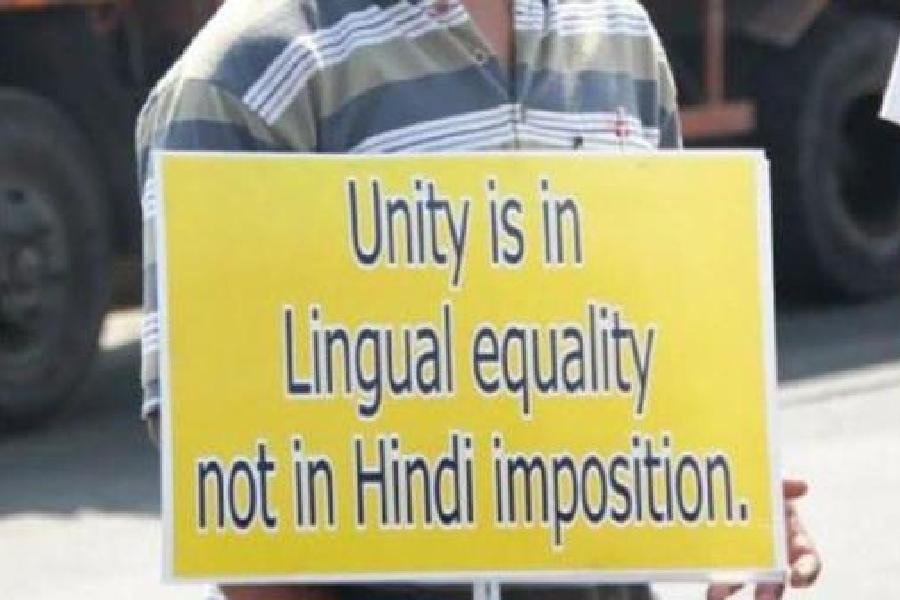
Against this background, it is interesting that English can now be both: a first language or a foreign language; NEP 2020 does not allow you to choose it as both! TLF has been repeated in different avatars since 1966 in every education policy document. What is the driving force of such policies? The feeling that the concept of ‘a territory-a nation-a religion-a language’ must be honoured. In recent formulations, it has approximated to ‘Hindu rashtra-Hindu-Hindi’ to the considerable dismay of South Indians and people in many other parts of the country.
In the world of languages, as Edward Sapir, the noted linguist, said, “... Plato walks with the Macedonian swineherd, Confucius with the head-hunting savage of Assam.” Sanskrit, Bodo, Santhali, Tamil, Manipuri and English are all equal. All linguistic hierarchies are socio-politically motivated — processes of selection, codification, standardisation and dissemination are controlled by the elite. All children, except those with a cognitive deficit, become linguistic adults by the age of four: they master the basic sounds, words, sentences and meaning structure of the languages they get exposed to in childhood. Language faculty is innate. Language names are social and linguistic artefacts of identity. The fundamental nature of language is fluidity. All languages, unless they close their doors to other languages (as modern Hindi often tries to do), are essentially multilingual in nature, freely borrowing words and expressions from other languages. Language contact and fluidity are the norms, not language isolation.
Children, indeed, have the capacity to learn several languages but that capacity gets activated only under certain psychological and sociological conditions. Languages are learnt only when there is a strong motivation to learn them. This motivation could either be integrative — you wish to identify with the speakers of another language; the motivation could be instrumental if you learn a language to get a better job. You could also learn a language to become a spy or a salesperson. New languages are not likely to get learnt if the languages learners bring to school are constantly insulted in the classroom either by teachers or fellow students. The number of students that get pushed out of the school system because their languages find no space in the classroom is very high.
Given these facts and the emphasis of the government on multilingualism and TLF, it appears that most of our students finish 12 years of schooling without having any reasonable proficiency in any of the two or three languages they may be exposed to during their school years.
Rama Kant Agnihotri retired from Delhi University and is now Professor Emeritus, Vidya Bhawan Society, Udaipur