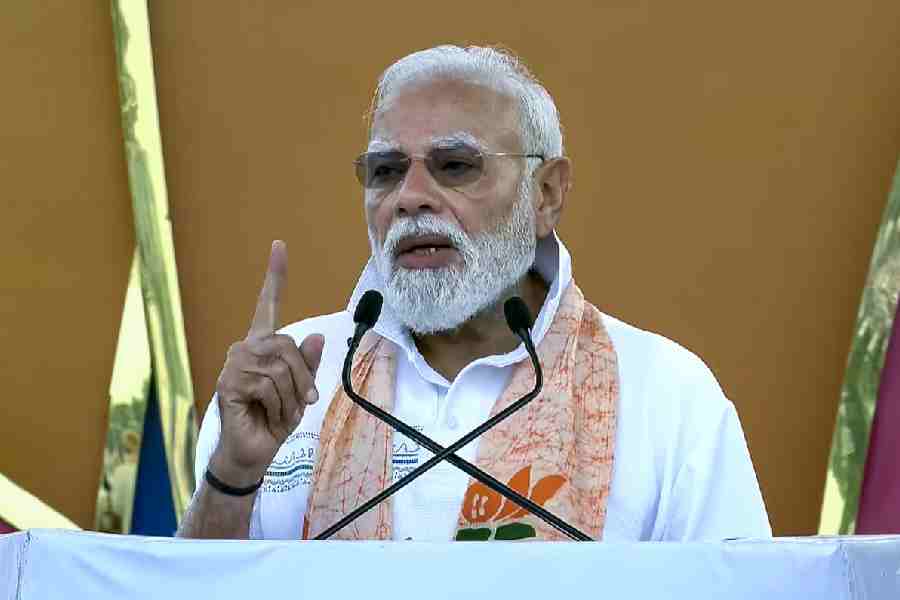
Prime Minister Narendra Modi on Saturday claimed his government would be remembered for its handling of the “biggest energy crisis of the 21st century”, triggered by the West Asia conflict, describing the measures taken under his leadership as “abhutpurv” or unprecedented.
Addressing a rally in Balotra, Rajasthan, after inaugurating a greenfield refinery-cum-petrochemical complex at Pachpadra, Modi said his government’s “visionary policies” had steered India through the crisis.
He accused the Opposition of spreading rumours and creating public anxiety to try and exploit the situation for political gain, but said these efforts had failed.
“The country did not overcome such an unexpected challenge merely by chance. The success of the visionary policies we have pursued over the past decade played a crucial role,” Modi said.
He said India had made the right decisions at every stage by accurately assessing the crisis, formulating an effective strategy, ensuring a balanced use of resources and leveraging diplomacy.
“Only because of these efforts was India able to emerge from the crisis,” he said.
“History will one day record the hard work, the efforts, the patience, and every sensitive step taken at the policy and diplomatic levels while some forces were occupied with spreading rumours and fear,” Modi added, apparently alluding to the Opposition.
Modi said the conflict had thrown the global economy into turmoil, leaving many major economies reeling under an energy crisis, but India had largely escaped its impact and ensured uninterrupted fuel supplies even in remote areas.
He attributed this to the “jalwa” (prowess) of Indian diplomacy, saying India had diversified its energy imports during the conflict.
“Before the crisis, India imported fuel and energy from only 25 or 26 countries. During the conflict, India expanded its sourcing to more than 40 countries,” Modi said.
“India sent out a clear message that national interest and the welfare of its citizens are paramount.”
Modi claimed that market experts had predicted a rise in domestic LPG cylinder prices to ₹2,000 during the crisis, but his government had kept the prices below ₹950 thanks to the policies adopted over the past decade.
He said that amid the crisis, the government had directed producers to prioritise LPG over industrial gas. “And within seven days, there was an increase in LPG production.”
The Prime Minister highlighted the partial reduction in commercial LPG cylinder prices after the recent fall in global crude oil prices, but did not address the demands for cuts in petrol and diesel prices.
He said the government had shielded consumers by absorbing the financial impact of the soaring global fuel prices, with the public-sector oil marketing companies losing more than ₹75,000 crore.
Modi described the Rajasthan refinery as a milestone in India’s push for energy independence and long-term energy security. He said India would continue expanding its refining capacity to secure its fuel supplies at a time when the Western countries were shutting their refineries.
“No new refinery has come up in the US in the last five decades and capacity in Europe has also been constantly declining,” he said.
Modi said India now had the world’s fourth-largest refining capacity and planned to expand it further.
“It is because of such efforts that India has emerged victorious from the biggest energy crisis of the century,” he said.
The Rajasthan Refinery is a joint venture between Hindustan Petroleum Corporation Ltd and the Rajasthan government. The 9-million-metric-tonnes-per-annum complex has been built at a cost of over ₹79,450 crore.
The UPA government had approved the refinery project in 2013, and then Congress president Sonia Gandhi had laid the foundation stone.
In 2017, the Modi government renegotiated the project along what it described as “better and advantageous financial terms and conditions”, while accusing the UPA of rushing its launch without due diligence.
Modi was originally scheduled to inaugurate the project in April, but it was postponed after a fire broke out at the refinery’s crude distillation unit a day before the planned event.
On Saturday, the Prime Minister accused the previous Ashok Gehlot-led Congress government of delaying the project.
“We signed an MoU for (the refinery) in 2017. However, the Congress government ruled Rajasthan from 2018 to 2023. Because of the Congress’s non-cooperation, work here virtually stalled. However, as soon as the double-engine government came into power, work progressed rapidly,” he said.
Although Modi did not name Rahul Gandhi, his remarks came against the backdrop of sustained criticism from the Lok Sabha leader of the Opposition since the outbreak of the West Asia conflict.
Rahul had accused the government of compromising India’s foreign policy and weakening its energy security, warning the conflict would trigger an “economic storm” by sharply raising domestic prices of fuel, LPG andfertilisers.