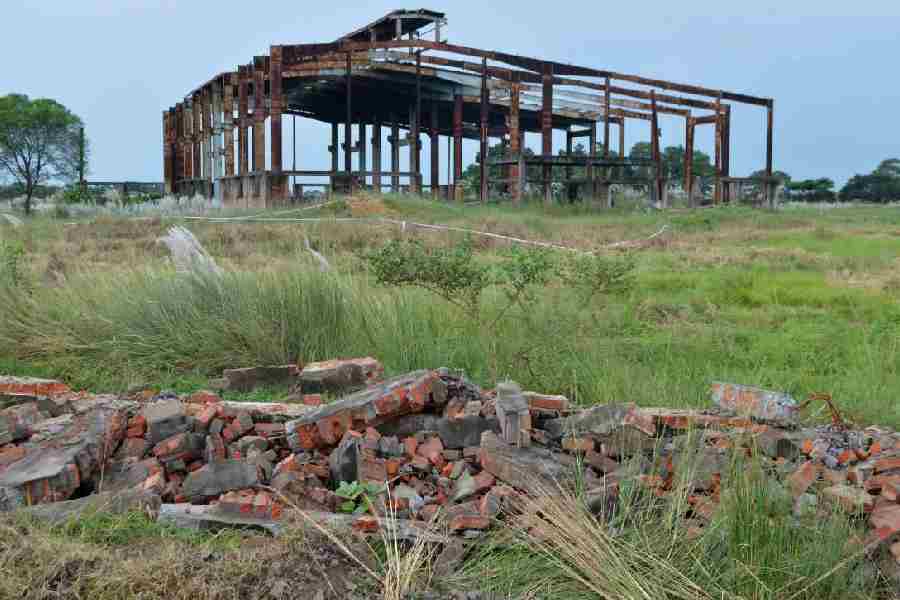
The BJP-led government may find it cannot avoid land acquisition — historically the most sensitive issue in land-scarce Bengal — if it wants to draw big-ticket investment.
Its primary alternative, building a land bank out of unused PSU plots, has failed twice already over the past two decades, and no fresh survey has been done since to say how much idle land actually exists today.
“Both the Left Front government and the Trinamool Congress government tried repeatedly to use idle PSU and government land to draw investment and avoid acquisition. Those efforts ran from 2004 to 2019 and yielded nothing, for multiple reasons,” said a senior state government official, adding that a fresh attempt would likely meet the same fate. The official is not authorised to speak on sensitive policy matters and hence requested anonymity.
The previous Trinamool Congress regime that swept to power after Buddhadeb Bhattacharjee’s government fell in 2011 had been wary of land acquisition, mindful of how strongly sections in Bengal feel about land and of the political price the Left paid after acquiring farmland for industry in Hooghly’s Singur and East Midnapore’s Nandigram. Mamata Banerjee and now chief minister Suvendu Adhikari — then allies, now rivals — built their careers leading the anti-acquisition movement that eventually brought down the Left Front.
The question of reusing idle PSU land resurfaced after finance minister Swapan Dasgupta raised it in his maiden budget speech on June 22, telling the Assembly that the government would “endeavour to develop a comprehensive land bank by identifying and reclaiming industrial land lying unutilised with public sector undertakings and other government entities”.
The Left first tried this in 2004, hiring the agency Webcom to survey unused industrial land. Webcom found 41,078 acres statewide, but the numbers were misleading: 11,552 acres were in Jalpaiguri and 8,082 in Darjeeling, mostly inside tea gardens, and much of the rest had been encroached upon over the years, officials said.
The Trinamool government tried again in 2013, hiring PwC, which identified 20,000 acres of unused land across 337 sick PSUs. But none of the parcels exceeded 500 acres, and most were closer to 100 — too fragmented and too small to attract large investors. “As the plots were not contiguous and there were no large land parcels of around 700-800 acres, it was not possible to draw large investments, as they need larger plots,” a bureaucrat said, again on the condition of anonymity.
That 2013 count is now more than a decade out of date, and officials expect the real number of idle acres to be higher, not lower. More sick units have shut since the PwC survey — Hindustan Cables Ltd, for instance, was formally wound up in 2017 — adding to a pool of unused industrial land that has never been re-surveyed.
With job creation urgent ahead of the 2021 election, the TMC government tried a third route: amending the West Bengal Land Reforms Act, 1955, to let owners of closed factories lease their land to new investors, targeting roughly 11,000 acres, including some 1,000-acre parcels. No owner came forward. The land and land reforms department later found that almost all the closed units were under the Board for Industrial and Financial Reconstruction (BIFR) and barred from leasing, while others had mortgaged their land to banks and were equally stuck.
A separate 2021 attempt to sell 1,000 acres belonging to the sick Durgapur Projects Limited (DPL) also collapsed. The power department could not hand the land over free of encumbrances, as it was tied up in encroachment and legal disputes. The government has not tried again since, officials said, wary of provoking the encroachers a second time.
The new government faces the same arithmetic problem that sank its predecessors. It is currently fielding investment proposals but cannot yet say how much land it will need to meet them. “It is clear that the majority of the proposals would require large land parcels, say 800-900 acres of contiguous land. The previous government had also received similar demands whenever any major investment proposal was received,” an official said — the same scale problem that doomed the PwC survey’s fragmented 100-acre plots.
Senior officials argue the new government has little choice but to invoke the Land Acquisition Act of 2013, already used elsewhere for infrastructure. That is their expectation, not a decision the government has announced — no minister has said publicly that acquisition is the plan.
Before it could happen, the state would first need to frame rules to implement the Act, a step that has not yet begun.
The government has announced it will draft a land policy, but has not said whether that policy will extend to acquiring land for industry.
“The previous government did not adopt the Land Acquisition Act because it had a declared anti-acquisition policy. It asked investors to arrange land on their own, and that didn’t work. The new government carries no such political baggage, which makes acquisition easier for it,” a source said.
Acquisition already happens routinely in the state for national highways and railway projects, under the National Highways Act, 1956, and the Railways Act, 1989.
Officials point to compensation as the reason it draws little resistance: the 2013 Act pays landlosers up to four times the current market value of the land, plus the market value of any structures on it — a sharp contrast with the 1894 Act it replaced, which offered only market price plus a 50 per cent solatium.
“There is hardly any protest, because landlosers get handsome compensation under the new Act. If the state won’t acquire land to drive industrialisation, that’s a double standard,” a source said.