Worthy successor
Sir — A scientist from the University of Oxford has
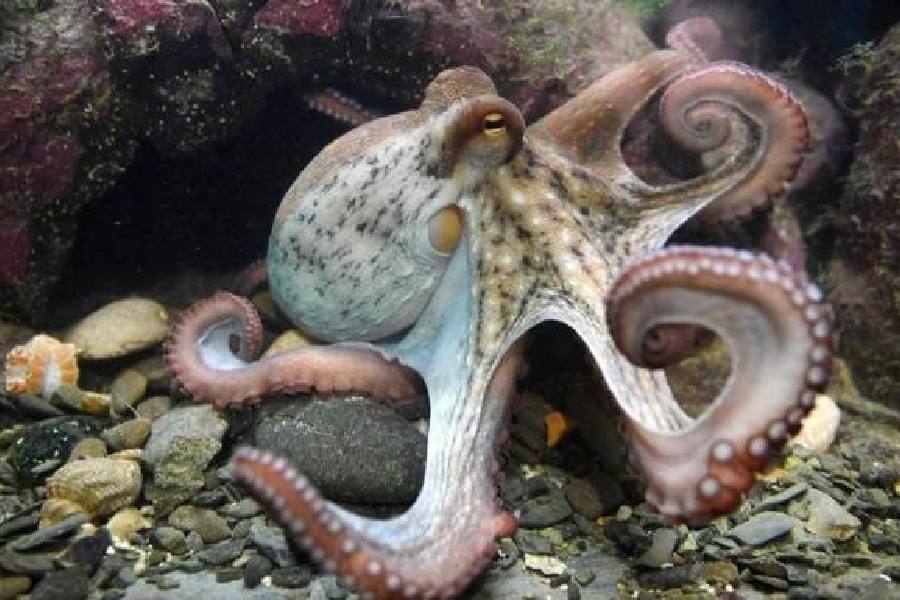
suggested that octopuses — not primates, dolphins, elephants or crows — could one day inherit the Earth from humans. With eight arms, they can certainly multitask better than humans and may end up building an underwater Atlantis. Frankly, the octopus need not wait for our extinction. Given the spectacularly shoddy job humanity has done so far — warming the planet, polluting the oceans, felling forests and arguing endlessly on social media — the octopus may already have a stronger claim to the throne.
Aratrika Saha,
Calcutta
Flawed analysis
Sir — Ramachandra Guha is an intellectual titan and I make it a point to read everything he writes. It is invariably rewarding. His latest article, “Modi’s enablers” (May 30), however, was different. The author describes the Gandhi family as the “enablers” of the Narendra Modi government. I beg to differ. Dynastic succession in politics is anachronistic in a democracy. Yet societies evolve according to their own peculiarities. The reality is that contemporary Indian society seems increasingly star-struck. Our political landscape is largely bereft of ideology or long-term commitment.
One may dismiss this as a flippant observation but the only parties that still openly profess an ideology — the various communist parties — are in terminal decline. Most regional parties are centred around personalities. This is the case even with the Rashtriya Swayamsevak Sangha and the Bharatiya Janata Party. Would it, therefore, be sacrilegious to suggest that the Gandhi family provides the glue that holds the Congress together? Without that unifying force, former and aspiring chief ministers might well have splintered the party long ago.
R. Prakash,
Delhi
Sir — Ramachandra Guha’s article, “Modi’s Enablers”, raises important questions about the role of the Opposition. As the leader of the Opposition in the Lok Sabha, Rahul Gandhi was expected to mount a more effective challenge to the Narendra Modi government. While Rahul Gandhi remains among the most vocal critics of the government, his attacks are often directed at Modi personally rather than focusing consistently on governance failures and policy shortcomings.
Bidyut Kumar Chatterjee,
Faridabad
Sir — Despite being a vocal critic of the Narendra Modi-led dispensation at the Centre, Ramachandra Guha has been found lacking in his criticism of the erstwhile Mamata Banerjee government. Has he sufficiently addressed incidents such as the Kamduni and the R.G. Kar tragedies and the corruption in teacher recruitment? Does he not think that the perceived misgovernance and the corruption of the Trinamool Congress helped create the conditions for the BJP’s growth in Bengal? In that sense, Banerjee may also be counted among Modi’s enablers.
Sukhendu Bhattacharjee,
Hooghly
Sir — Though Ramachandra Guha’s critique of ‘Narendra Modi’s enablers’ was incisive, his comparison of Modi’s India with that of Viktor Orbán’s Hungary was flawed. Guha suggests that the success of Péter Magyar’s Tisza Party in challenging Orbán’s rule could provide a model for defeating the BJP. This comparison oversimplifies structural realities.
Hungary is a small, centralised European nation. India is a vast, diverse subcontinent where elections pivot on complex regional alliances, caste mathematics, and state dynamics. Relying on European political models misreads the intricate nature of Indian democracy.
N. Sadhasiva Reddy,
Bengaluru
Sir — “Modi’s enablers” correctly identifies several shortcomings of the Congress leader, Rahul Gandhi, including his lack of organisational discipline and political focus. Ramachandra Guha’s suggestion that Rahul Gandhi could learn from the example of Péter Magyar, who successfully challenged the Viktor Orbán regime in Hungary, merits consideration.
Jayanta Datta,
Hooghly
Pricier by the day
Sir — While shopping for groceries recently, I was startled to discover that the price of posto has risen to about Rs 1,500 per kilogramme. During the Left Front era in Bengal, posto was available at prices affordable even to the lower middle class. Over the past decade, however, its cost has increased dramatically. Posto is an integral part of Bengali cuisine, featuring in dishes such as aloo posto, jhinge posto, postor bora and knacha posto bata. It would be welcome if the new Bharatiya Janata Party government took steps to bring down its price.
Sourish Misra,
Calcutta
Sir — The frequent increases in petrol and diesel prices have become a heavy burden on ordinary citizens. The relentless rise in fuel costs affects not only transportation but also triggers a cascading increase in the prices of essential commodities and everyday expenses. The frequency of these hikes, often occurring within short intervals, has deepened public anxiety and economic uncertainty.
Bhoomika Shankar,
Tumakuru, Karnataka