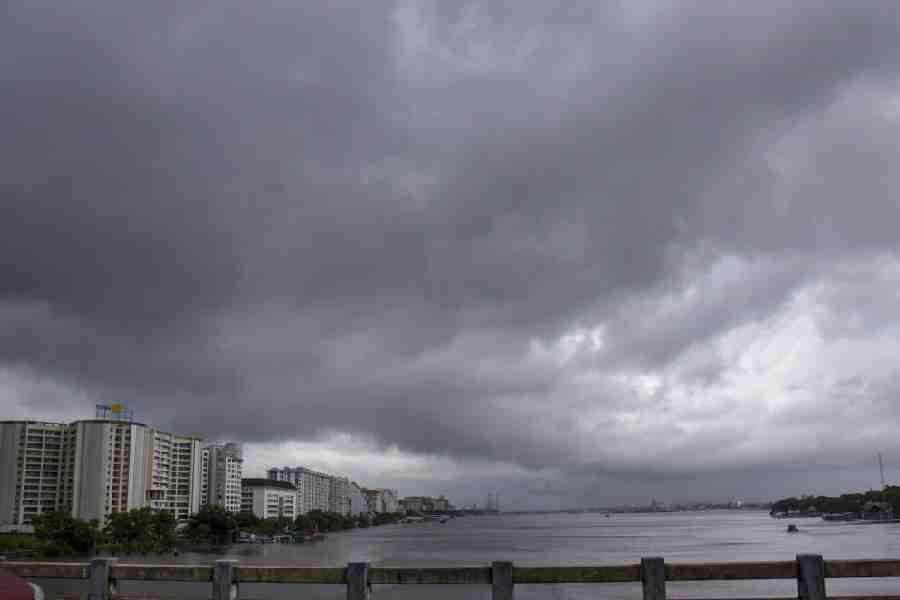
The monsoon has finally swept into Kerala. But even as the rains fall, meteorologists are warning that this year's monsoon could be one of India's weakest in over a decade as a potentially “super” El Nino builds in the Pacific.
The southwest monsoon has already spread across Kerala, Lakshadweep and parts of Karnataka and Tamil Nadu, with forecasters expecting it to continue advancing northwards over the coming days.
The IMD is predicting “heavy to very heavy rainfall” over northeast India for the next five to six days as well as over Kerala and Karnataka and Tamil Nadu. But it’s lowered its forecast again for the monsoon to just 90 per cent of the long-term average.
More worrying still, the IMD says there is a 60 per cent chance the June-September monsoon season could end up “deficient”. If that happens, India could be looking at its driest monsoon in more than a decade.
"While the northeast is likely to witness normal rainfall this monsoon season, the remaining parts of the country may see below-normal rainfall," the IMD said in its latest bulletin.
Last year, it was a completely different story. The 2025 monsoon delivered rainfall equivalent to 108 per cent of the long-term average, boosting crop output and replenishing reservoirs across the country.
Why does the possibility of weak rains matter so much? Because the monsoon supplies around 70 per cent of India's yearly rainfall and nearly half of all cultivated land still depends directly on rainfall rather than irrigation.
A good monsoon means strong harvests, good rural incomes, lower food prices and faster economic growth. A weak monsoon means just the opposite.
The timing could hardly be worse, with the country already grappling with inflationary fallout from soaring oil prices linked to the Iran war. The rupee has cratered, wholesale inflation has climbed to 8.3 per cent and consumer inflation is running at a 13-month high.
Because India imports nearly 90 per cent of the crude it consumes, every jump in energy prices feeds through into transport costs, manufacturing expenses and household spending. A weak monsoon could pile even more inflationary pressure.
What is super El Nino?
The culprit, El Nino, is the climate phenomenon that develops when sea surface temperatures in parts of the equatorial Pacific Ocean become unusually warm. Although it occurs thousands of kilometres from India, El Nino is one of the strongest influences on the monsoon, reducing the amount of moisture reaching the subcontinent and raising the chances of drought.
The IMD says there is a 92 per cent chance El Nino conditions will emerge during this year's monsoon season. And the concern is not simply that El Nino appears likely to develop. It is that this year's event could be exceptionally strong.
Several leading weather agencies are forecasting Pacific Ocean temperatures could rise more than 2.5° Celsius above average, meaning this year’s El Nino could rival the most powerful ever recorded.
Adam Scaife, head of long-range prediction at the UK Met Office, warns that this year's El Nino could become the strongest in decades or "even be of record strength".
Not every El Nino produces drought and not every drought occurs during El Nino. But the odds of a weak monsoon increase significantly when the event is particularly strong.
The last "super" El Nino occurred in 2015. That year, India's monsoon rainfall fell to just 86 per cent of the long-period average, making it one of the weakest in decades. Millions of farmers faced drought-like conditions, crop yields were hit, reservoirs failed to fill and food prices climbed.
When El Nino last emerged in 2023, India also experienced below-normal rainfall nationally, with northeastern states among the worst affected.
Normally, India sometimes gets help from another climate pattern known as the Indian Ocean Dipole, or IOD. When the western Indian Ocean becomes warmer than the eastern side, a “positive” IOD can boost rainfall over India and offset El Nino's effects. Unfortunately, there’s no sign of such help this year with the IMD forecasting a largely “neutral” IOD.
Forecasters are also concerned about another emerging threat: western disturbances. These storm systems traditionally affect northwest India during winter and spring but in recent years have begun behaving in unusual ways. During a typical monsoon season, only a handful affect India but last year there were 17.
When western disturbances coincide with monsoon systems they can trigger extreme weather events like cloudbursts, flash floods and landslides. Already, in the days leading up to the monsoon, two western disturbances were recorded over northwest India.
The good news is that India is entering the monsoon season better prepared than in the past. Reservoir levels are healthy, weather forecasting has improved dramatically and contingency plans have been developed for drought-prone districts. Officials are encouraging drought-resistant crop varieties and water conservation.
But much now depends on events in the Pacific Ocean. "The world must treat it as the urgent climate warning it is," warned UN chief Antonio Guterres this week. "El Nino conditions will pour fuel on the fire of a warming world."