
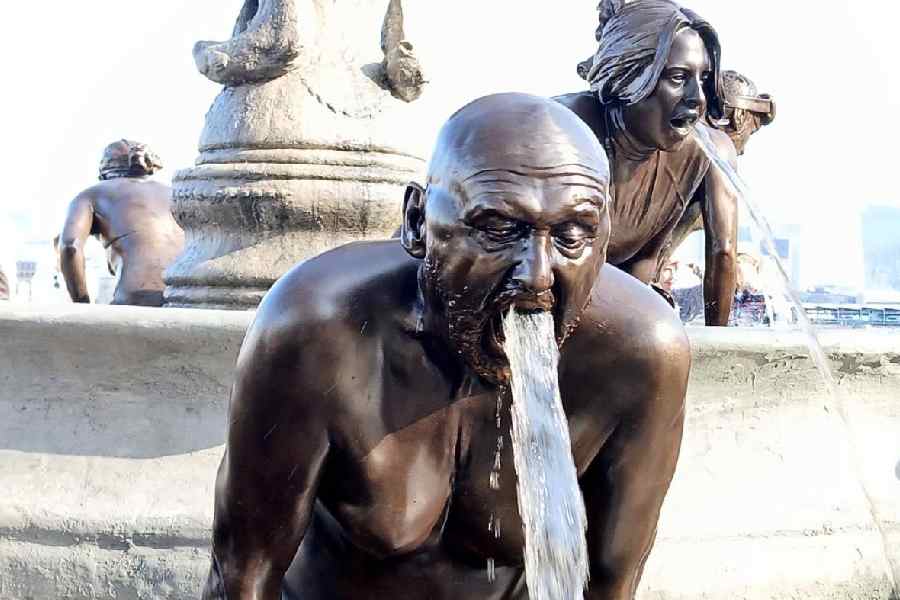
Filthy truths
Sir — “Art should comfort the disturbed and disturb the comfortable,” according to the poet, César A. Cruz. In that spirit, Channel 4 has transformed London’s Observation Point into a site of public provocation. Conceived as the centrepiece of its new documentary, Dirty Business, the broadcaster has put up a striking 10-metre-wide installation titled Fountain of Filth in London’s South Bank. The work comprises statues of men, women and children retching into a basin of murky water as a commentary on Britain’s sewage scandal. The piece is unsettling, making some viewers recoil. Yet, it is difficult to ignore, and that is precisely the point. By inducing discomfort, the installation forces an issue usually hidden underground into plain sight.
Bidisha Seal,
Calcutta
Global crisis
Sir — The killing of Iran’s supreme leader, Ayatollah Ali Khamenei, in a joint strike by the United States of America and Israel has pushed West Asia to the brink of a wider war (“Big blow”, Mar 2). Iran’s retaliatory operations, including missile attacks on multiple US bases, and rising violence from Hezbollah in Lebanon signal a dangerous regional spiral. These developments raise grave questions about the erosion of international restraint.
A forthright assessment is urgently needed. The US is adopting an increasingly aggressive posture that threatens global peace. By sidelining diplomacy and assuming the role of an unaccountable global enforcer, it risks turning war into a demonstration of military power. The international community must show moral courage and collective resolve to end this violence.
Vidyasagar Reddy Kethiri,
Warangal, Telangana
Sir — Ayatollah Ali Khamenei’s assassination has triggered a leadership transition in Iran whose trajectory remains uncertain despite the expectations voiced by Washington (“A nation shaped in his own image”, Mar 2). Iran is not Venezuela; it is not a fragile country. Further, Iran’s strikes on civilian areas and US military installations across West Asia indicate that Tehran will not yield easily. Such attacks will inflame tensions across the region and globally. For countries like India that are heavily dependent on West Asia’s energy supplies, the fallout could be severe. Yet, in the long run, Iran may struggle to withstand the combined military might of Israel and the US.
Abhijit Roy,
Jamshedpur
Sir — A joint military sortie by the Israel Defense Forces and the US army taking out Iran’s supreme leader has drawn mixed reactions worldwide. Conflicting visuals of jubilation and mourning emerging from Iran notwithstanding, the biggest concerns that will plague the nation in the long run are instability, compromised sovereignty and a bleak future for women’s rights. During his three-decade tenure as Iran’s supreme leader, Ayatollah Ali Khamenei projected defiance against global hegemonies and wielded formidable authority. His death silences a dominant voice.
Aayman Anwar Ali,
Calcutta
Sir — Ayatollah Ali Khamenei’s killing marks a seismic moment for the Islamic republic. Under his leadership, Iran exerted wide regional influence. At the same time, it was accused of sponsoring militant networks. After decades of Khamenei’s iron-fisted rule, the nation now faces turbulence and uncertainty. His assassination could ignite a larger war as supporters seek to avenge their supremo.
P. Victor Selvaraj,
Tirunelveli, Tamil Nadu
Sir — The US-Israel joint attack on Iran and the killing of Iran’s supreme leader are gross violations of international laws, Iran’s sovereignty and human rights. The escalation has further destabilised West Asia. The repercussions of Ayatollah Ali Khamenei’s death will extend across the Gulf and beyond. Such destruction may push more nations to pursue an arms race under the guise of safeguarding national interests. World leaders committed to stability must convene, fix accountability and devise mechanisms to prevent further escalation.
Manzar Imam,
Purnea, Bihar
Sir — The elimination of Ayatollah Ali Khamenei by the US and Israel represents a catastrophic breach of international norms. Regardless of one’s geopolitical stance, the extrajudicial assassination of a sovereign head of state is a reckless departure from civilised diplomacy that may lead to global anarchy.
Such a blatant assault on sovereignty sets a dangerous precedent, replacing established legal and diplomatic frameworks with raw military force. This escalation does not pave a path toward peace; it guarantees a cycle of retaliatory violence and massive regional instability. Responsible nations must condemn this violation of international law and demand an immediate cessation of hostilities.
Vijaykumar H.K.,
Raichur, Karnataka
Sir — At a time when the Russia-Ukraine war continues unabated, the launch of a decisive military operation by the US on Iran risks triggering catastrophic consequences for regional and global security. This unprovoked intervention threatens to widen existing fault lines and destabilise an already volatile region. It must
be halted immediately before it plunges West Asia — and potentially the rest of the world — into a deeper conflict.
Achyut Kumar Mukherjee,
Howrah
Sir — Claude is an Artificial Intelligence chatbot developed by the American firm, Anthropic. Reports suggested that Claude was used for intelligence planning and tracking Ayatollah Ali Khamenei mere hours after President Donald Trump ordered federal agencies to stop using AI tools developed by Anthropic. Such AI systems can be misused for spreading misinformation, cybercrime, surveillance or even military targeting.
R.S. Narula,
Patiala, Punjab
Sir — While the killing of Ayatollah Ali Khamenei may appear to be a blow to Iran’s clerical establishment, it should not be mistaken for a setback to the regime. Iran’s political system is deeply entrenched, supported by powerful institutions such as the Islamic Revolutionary Guard Corps. History shows that removing a leader does not automatically reshape a nation’s political trajectory.
M. Jeyaram,
Sholavandan, Tamil Nadu