Spot the irony
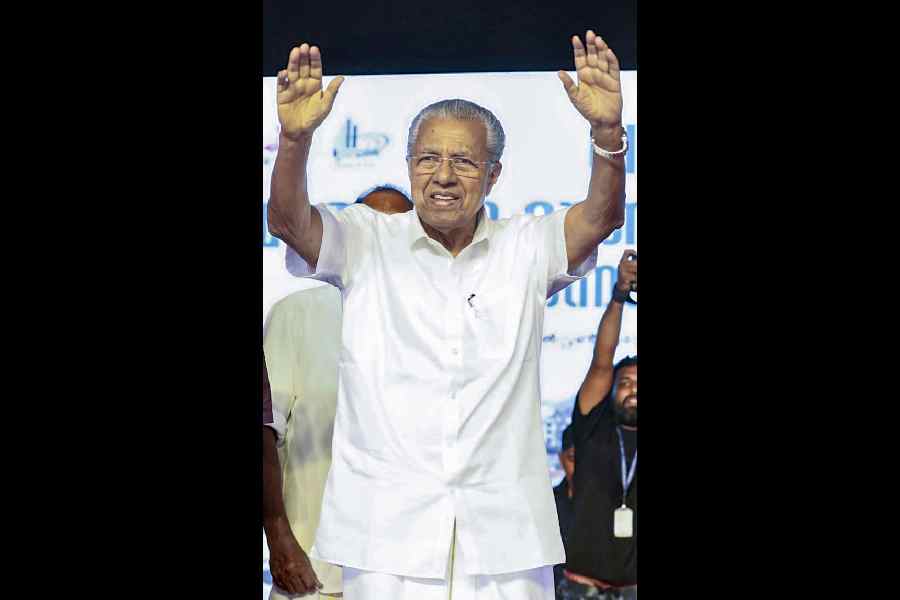
Sir — The Communist Party of India (Marxist) leader and chief minister of Kerala, Pinarayi Vijayan, built his reputation as a stern Marxist who spoke the language of ideology and discipline. That is why his recent reflections in an interview with the actor, Mohanlal, on ghosts and on the Ramayana and his recitation of an Upanishadic sloka raised eyebrows. A leader of the CPI(M) speaking of being detached like a monk and reciting verses on god residing in his heart should invite scrutiny. Marxism rests on materialism, not metaphysics. When a self-declared atheist reaches for spiritual symbolism just before election season, it looks less like introspection and more like a political ploy. There is an irony in this that voters of Kerala will not miss.
Amaya Kurup,
Thiruvananthapuram
Burden of proof
Sir — The recent order by a special court in Delhi discharging the Aam Aadmi Party leader and former chief minister, Arvind Kejriwal, and his deputy, Manish Sisodia, deserves careful consideration (“Discredited: CBI case on Kejriwal”, Feb 28). The judgment underlined that criminal charges require solid evidence; they cannot be filed and examine on mere suspicion. The Central Bureau of Investigation relied heavily on statements of an approver and failed to establish a clear financial trail. Courts exist to weigh evidence presented by investigative agencies against law. When due process is respected by law-keepers, public confidence in institutions grows stronger. That has clearly not been the case here.
Ritodrish Mondal,
Calcutta
Sir — The discharge of all 23 accused in the Delhi excise policy case raises serious questions about the CBI’s investigative standards. Justice Jitendra Singh has pointed out gaps in admissible evidence and criticised region-based labelling such as “South Group” for people from Hyderabad. Criminal trials must focus on irrefutable proof. The CBI must reflect on why seizures, documents and financial links did not meet legal thresholds. Accountability strengthens institutions and prevents future overreach.
C.K. Subramaniam,
Chennai
Sir — A significant message has emerged from the discharge of Arvind Kejriwal and others in the Delhi excise policy case. The ruling makes it clear that policy failure does not automatically amount to criminal conduct. Administrative lapses require proof before they can be treated as offences. By discharging the case against the accused, the court reaffirmed that allegations of conspiracy cannot rest on hearsay, which seems to be all that the CBI functions on these days.
Monidipa Mitra,
Calcutta
Sir — Many Indian citizens, especially in the national capital, watched the Delhi liquor policy case unfold over three years. The arrest of a sitting chief minister, Arvind Kejriwal, shaped public debate and influenced electoral politics. The recent discharge of the case owing to the absence of any evidence shows how essential judicial scrutiny remains in a democracy. Investigative agencies must act independently and present verifiable proof. Public trust suffers when high-profile cases collapse because evidence does not withstand examination. If it had not been for that case, the AAP might have won another term in Delhi.
P.K. Sharma,
Barnala, Punjab
Sir — In a detailed order, a special court in Delhi criticised the investigative approach adopted by the CBI in the excise policy case. The reliance on pardoned witnesses without corroboration from other sources weakened the prosecution’s case. The court also warned that indefinite incarceration based on untested allegations risks turning investigation into punishment. This principle matters for every citizen, regardless of political affiliation. Strong safeguards protect individuals from misuse of State power.
M.N. Gupta,
Hooghly
Defiant script
Sir — Uddalak Mukherjee is right to insist that Victoria Amelina’s Looking at Women Looking at War: A War and Justice Diary belongs to the necessary tradition of women recording war as a lived experience (“The war watchers”, Feb 28). Literature has long shown why women’s war writing matters. Vera Brittain’s Testament of Youth makes grief and nursing labour part of the historical record. Martha Gellhorn’s reporting keeps civilians at the centre of the narrative. Svetlana Alexievich’s The Unwomanly Face of War proves that ‘heroism’ changes shape when it is voiced by those expected to be silent. Susan Sontag, in Regarding the Pain of Others, explains why images can shock yet still leave understanding thin, while narrative forces readers to inhabit consequence.
Yashodhara Sen,
Calcutta
Sir — Placed side by side, Uddalak Mukherjee’s reflections in “The war watchers” and “Omar’s will” (April 30, 2025) trace a clear line across geographies. One centres Ukrainian women who catalogue the Russian invasion while defending archives and memory. The other gathers voices of children from Gaza who write amid siege as streets, schools, and homes vanish. A similar anxiety runs through both pieces: the fear that destruction caused by war extends beyond the physical into the realm of culture and thought. Mukherjee draws attention to form as much as content. Diaries, fragments, letters, unfinished manuscripts, he shows, are immediate, vulnerable records shaped by interruption in everyday life. The act of bearing witness itself becomes defiance. There is also a shared unease about the reader’s position. Safe distance tempts detachment. Both essays resist that comfort. They suggest that to read such work is to encounter an ethical demand, not a literary diversion.
Anupam Neogi,
Calcutta