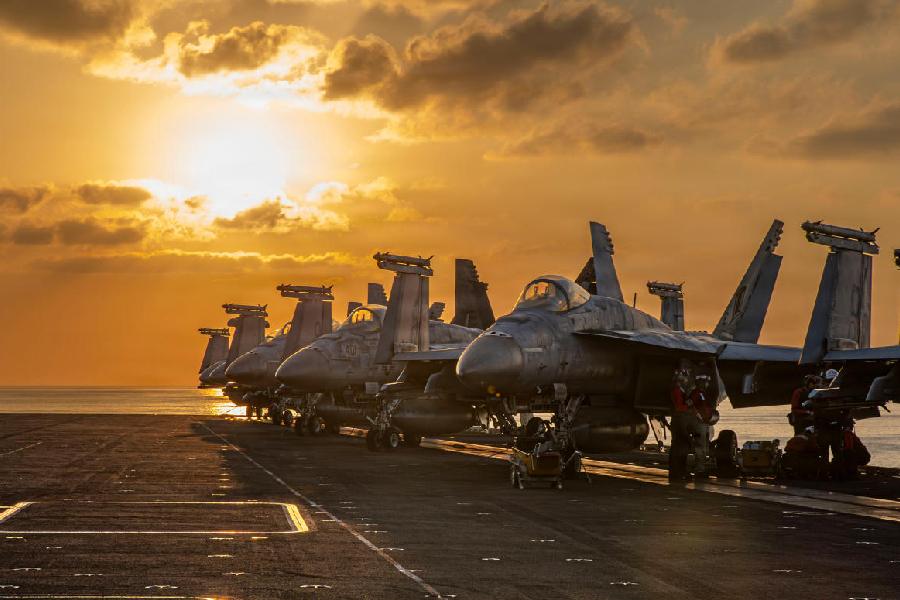
Trump has already spent $779 million in the first 24 hours of striking Iran in Operation Epic Fury and the pre-strike military preparations, including naval and air repositioning, cost an additional $630 million, reported Turkey’s Anadolu news agency and Aljazeera.
With Trump declaring that the war with Iran may last another four to five weeks, this war may prove to be one of the most costly operations the US has undertaken in the Middle East and Central Asia.
This $1.4 billion adds to the $8 trillion already spent since George Bush launched the ‘War on Terror’ in retaliation for 9/11.
The $8 trillion spent post-9/11 only accounts for the attacks undertaken until 2021, according to a Brown University study, titled “Cost of War.”
Another $9 to $12 billion has been spent waging war in Yemen since October 2023, according to Harvard University professor Linda J. Bilmes.
Another estimated $2.2 to $2.5 trillion will have been spent by 2050 on caring for war veterans, most of which has not yet been paid.
When talking about military expenditure, a lot more is taken into account than just weapons. The Brown University study comprises of a comprehensive framework that includes both direct and indirect costs.
The study includes both direct military expenditure spent on personnel, weaponry, fuel, operations and logistics, as well as long term social and humanitarian costs, long term veteran and healthcare costs, interest, infrastructure repairs, environmental, and the cost of migration and displacement.
$21.7 billion have been spent as aid to Israel since conflict with Hamas erupted in 2023.
Bloomberg reported that this year’s campaign on Venezuela cost around $3 billion.
An additional $413 million was allocated under the Trump administration for counter-insurgency operations in Nigeria and West Africa.
For context, the US defence budget for the fiscal year 2026 is heading towards $901 billion. The US has the highest defence budget in the world, exceeding the combined budgets of the next 10 countries.
According to Brown University’s Watson Institute of International and Public Affairs, 940,000 people have died in Afghanistan, Pakistan, Iraq, Syria and Yemen since 2001 as a direct consequence of US attacks. This figure does not include the indirect deaths of disease, migration, healthcare or hunger.
Brown University’s study shows that military spending produced an average of five jobs per $1 million. The same investment in other sectors creates more employment: 13 jobs in education, 9 in healthcare and 7 to 8 in infrastructure.
Trump has projected a $1.5 trillion military budget for 2027.