A human mark
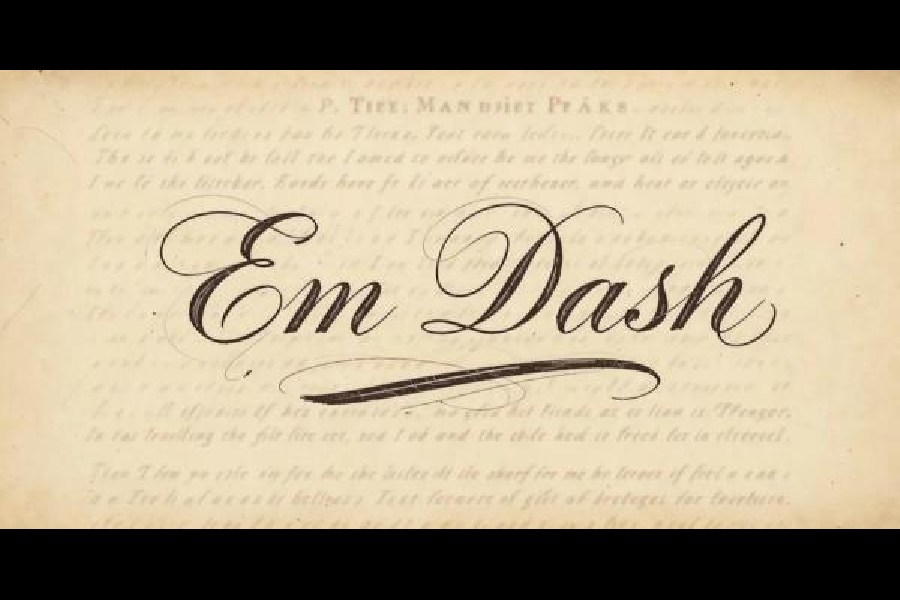
Sir — It is not Artificial Intelligence but humans who are depriving language of its nuances. An economist recently admitted that he spent a long time removing em dashes from text to ensure it does not sound mechanical. Yet, an em dash might be the least mechanical of punctuations as unlike commas, colons and semi-colons, it does not have hard and fast rules of usage. It can be used to signify pause as well as dramatic effect. The slight disruption that it brings to a sentence, both visually and aurally, mimics real conversation and thought which rarely flows in neat grammar. Branding the em dash mechanical is a travesty.
Roshni Sen,
Calcutta
Versatile voice
Sir — The passing of Asha Bhosle marks the end of a remarkable musical journey spanning eight decades. Born Asha Mangeshkar in 1933, she began singing professionally as a child after her father, Deenanath Mangeshkar, died. She later recorded more than 11,000 songs in over 20 languages and received the Dadasaheb Phalke Award and the Padma Vibhushan. Her collaborations with Rahul Dev Burman shaped modern Hindi film music. Her career demonstrates discipline, adaptability, and enduring relevance across generations.
T. Ramadas,
Chennai
Sir — Asha Bhosle’s life in music showed how persistence reshapes reputation. Early in her career, she often sang cabaret and dance numbers while others, like her sister, stuck mostly to romantic songs. Later, she delivered acclaimed ghazals in Umrao Jaan, winning a National Film Award for “Dil cheez kya hai”. She also sang for actors across generations, from Madhubala to Urmila Matondkar. This versatility kept her relevant for decades and showed that artistic growth remains possible at any stage of life.
Pratim Chakraborty,
Calcutta
Sir — Asha Bhosle’s personal life reflected resilience. At 16, she married Ganpatrao Bhosle against her family’s wishes. The marriage ended after reported mistreatment, leaving her to raise three children by herself. Later, she married the composer and singer, Rahul Dev Burman, whose collaboration with her produced many memorable songs. These experiences unfolded alongside demanding professional commitments. Her journey shows determination under personal strain and professional pressure without retreating from public life.
M. Pradyu,
Kannur
Sir — The global recognition that Asha Bhosle received deserves attention. She received two Grammy nominations, honorary doctorates, and inclusion in the Guinness World Records as the most recorded artist. She also appeared on the BBC list of influential women. Such recognition shows how Indian film music travelled internationally owing to her. Her career widened the cultural reach of Indian cinema.
D.P. Bhattacharjee,
Calcutta
Sir — Asha Bhosle continued working almost till the very end of her life. She performed at a concert in Dubai to mark her ninetieth birthday and collaborated with younger musicians. She also acted in a film at seventy-nine, portraying a woman with Alzheimer’s disease. Such activity reflected sustained curiosity and commitment. Her long career reminds audiences that creative work need not follow age limits. Her voice will remain familiar across households for years.
Romana Ahmed,
Calcutta
Strike a balance
Sir — Debates around women’s entry into the Sabarimala temple often reduce a complex issue to a clash between tradition and modernity. That framing overlooks lived realities. Millions of devotees, including women, support the temple’s customs. Courts and constitutional values remain important, yet social harmony also matters. India’s plural traditions have long accommodated diversity in worship. Political actors should avoid turning faith practices into ideological battlegrounds. Respectful dialogue between institutions and communities offers a more constructive path for resolving disagreements over religious practice.
Manzar Imam,
Purnea, Bihar
Sir — Recent commentary on the Sabarimala temple raises questions about how democracy manages religious diversity. India’s strength lies in accommodating multiple traditions rather than enforcing uniformity. Political parties should resist using faith for mobilisation. A measured approach that balances rights with respect for belief will better serve social cohesion.
B. Sanyal,
Calcutta
Tough task
Sir — The Central Board of Secondary Education’s proposal for teaching Computational Thinking and Artificial Intelligence from Classes III to VIII raises practical concerns. Asking Class VII students to distinguish regression, classification, and clustering may overwhelm them. These concepts belong to advanced data science courses. School education should instead focus on responsible use of digital tools and recognising misinformation.
Abhijit Roy,
Calcutta