A Singapore court has sentenced Byju Raveendran to six months in prison, starting off what appeared to be the legal denouement of a business saga that witnessed dizzying heights, cashing in on the startup boom and the pandemic-era edtech breakthrough before crumbling under the weight of runaway expenses and rising debts.
Raveendran, the valuation of whose education technology business spectacularly plummeted from $22 billion in 2022 to zero in 2024, had been sued in Singapore by the Qatar Investment Authority for losses incurred on his venture when it failed two years ago.
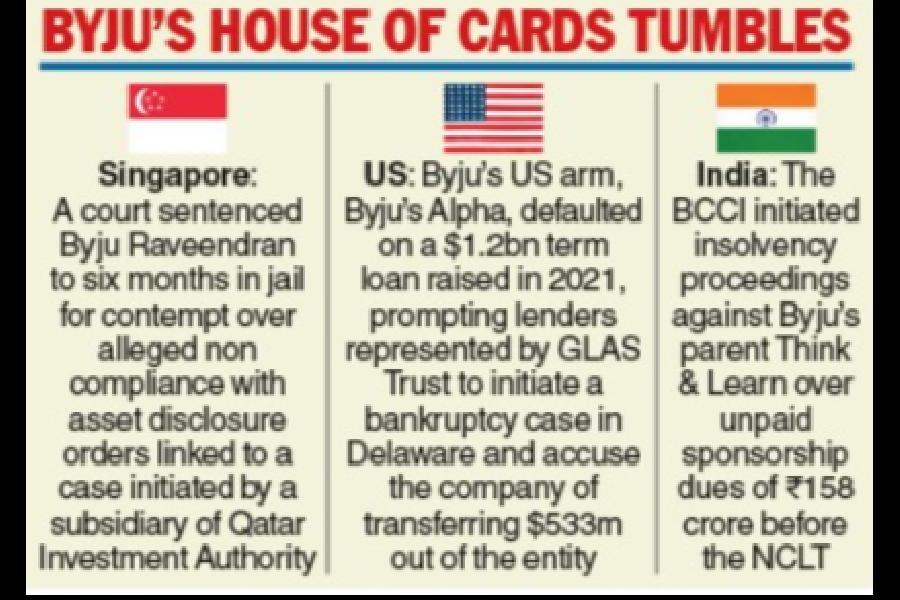
The Singapore judge held Raveendran, who established and ran what was once one of the richest edtech startups in the world but is now mired in litigation across India, Singapore and the US, guilty of contempt as he had repeatedly failed to comply with court directions since April 2024 on disclosure of assets linked to Beeaar Investco Pte, an entity that held shares in affiliated companies of Byju’s.
Raveendran expressed disappointment at the ruling, saying the Singapore court matter “is a procedural contempt of court order, arising only from disputes over document disclosure in ongoing proceedings — not a finding of fraud, dishonesty, or any wrongdoing on the merits”.
Bloomberg, which broke the news late on Tuesday, reported that the Singapore court had directed Raveendran to surrender to the authorities, pay legal costs of S$90,000 (₹67 lakh) and furnish documents proving his ownership of Beeaar Investco.
It was not clear if Raveendran was in Singapore at the time of the ruling earlier this week. His lawyers said they were contemplating an appeal against the decision and applying for a stay on the order. Raveendran said in a post on X that he had been directed to appear on June 15 and that appeal options were available.
The court order marks a fresh setback for the embattled founder of Byju’s, which at its peak splashed its logo across the Indian cricket team’s jersey, roped in superstar Shah Rukh Khan for high-profile campaigns and signed football icon Lionel Messi as brand ambassador ahead of the 2022 FIFA World Cup.
Raveendran said in his X post on Wednesday: “The lenders, including GLAS Trust and QIA, as well as other stakeholders, have been in discussions with the founders and other parties. A settlement has been agreed in principle, with only a few residual minor issues left to be finalised between certain parties. I have no role in those remaining issues.”
He claimed that the ruling had come at a time when all key parties had almost concluded the settlement discussions.
“As part of the settlement discussions, the parties have also acknowledged that there has been no wrongdoing on my part or on the part of the other founders. That is why it is deeply unfortunate that this matter is being used to create a contrary public narrative at this sensitive stage,” Raveendran said.
He went on to state that he had not been actively contesting several court proceedings in recent months precisely because “the parties were working towards a comprehensive settlement”.
Founded in 2011, Byju’s emerged as India’s first edtech unicorn in 2018 with backing from marquee global investors including Sequoia, Tencent and the Chan Zuckerberg Initiative. The pandemic-driven surge in online learning propelled its growth and fuelled an aggressive global acquisition spree financed partly through the $1.2-billion term loan raised from US lenders in 2021.
But as schools reopened and demand for online learning moderated, Byju’s found itself overstretched. Delayed audits, mounting debts, governance concerns, investor backlash, insolvency proceedings and allegations of funds diversion triggered a sharp unravelling in fortunes, eventually wiping out the startup’s valuation.
The Singapore court proceedings were initiated by a subsidiary of Qatar Investment Authority (QIA), which had invested in the company during a period when Byju’s was undertaking large-scale restructuring and job cuts.
The roots of Byju’s financial and legal troubles lie in the US term loan raised through its financing arm, Byju’s Alpha. Following defaults on repayments, lenders represented by the GLAS Trust pushed Byju’s Alpha into bankruptcy proceedings in Delaware and sued Raveendran personally, alleging that $533 million had been transferred out of the entity in 2022 without being returned.
A Delaware bankruptcy court had initially issued a default judgment exceeding $1 billion against Raveendran, citing repeated non-compliance with court directives and evasive responses. The ruling was later reversed after the court clarified that the damages had not been formally assessed.
In India, Byju’s parent Think & Learn also faced insolvency proceedings initiated by the BCCI in 2024 over unpaid cricket sponsorship dues of ₹158 crore. Although the dues were later settled through funds paid personally by Riju Raveendran, Byju’s brother, the matter evolved into a larger legal dispute after the Supreme Court held that withdrawal of insolvency proceedings required approval from 90 per cent of the Committee of Creditors, which included lenders such as GLAS Trust.
The company’s governance crisis deepened further in 2024 when key investors voted to oust Byju Raveendran as chief executive.