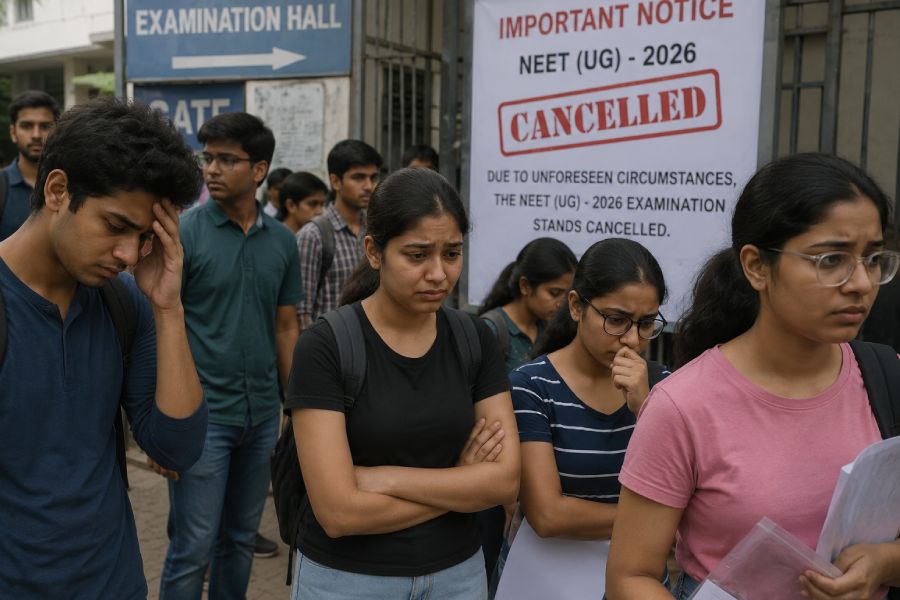
The Supreme Court’s observation that the National Testing Agency has not learnt its lessons even after repeated discrepancies in the conduct of the National Eligibility cum Entrance Test, the Common University Entrance Test and the National Eligibility Test is an indictment of institutional complacency. This criticism is also borne out by the fact that the recommendations of the K. Radhakrishnan Committee after the NEET-UG 2024 controversy were ignored. Further, the NTA is not a statutory body created through parliamentary legislation. It thus remains vulnerable to executive control and policy improvisation without legislative scrutiny. This also reduces the body to a managerial apparatus dependent on private vendors for critical functions, including printing and transportation of exam papers and so on. Such dependence weakens institutional responsibility because accountability is dispersed across contractors.
The NTA’s lethargy, though, is not the only challenge. The Union education minister, Dharmendra Pradhan — under fire from the Opposition after the NEET paper leak this year — announced a series of reforms recently, including Artificial Intelligence-assisted surveillance, biometric authentication, GP tracking of question paper transport for the 2026 retest, appointment of senior officers, and a phased transition towards computer-based testing from next year. But these measures address symptoms without resolving the core weakness of the examination architecture. CBT may reduce the risks associated with the physical transportation of papers but it creates new gaps involving server security, software integrity, cyber-attacks, and technological disparities across regions. India’s uneven digital infrastructure raises serious concerns regarding system failures, connectivity disruptions, and unequal access for candidates from rural and economically weaker backgrounds in this context. Moreover, such a ‘reform’ does not eliminate the threat of collusion within administrative chains or criminal networks operating through coaching centres and local intermediaries. A national testing body responsible for determining access to higher education cannot function as an ad hoc administrative agency dependent on temporary officials and outsourced expertise. The credibility of competitive examinations depends upon institutional integrity, transparent governance, independent oversight, and enforceable accountability. None of these conditions presently exists within the NTA’s framework.