Safe distance
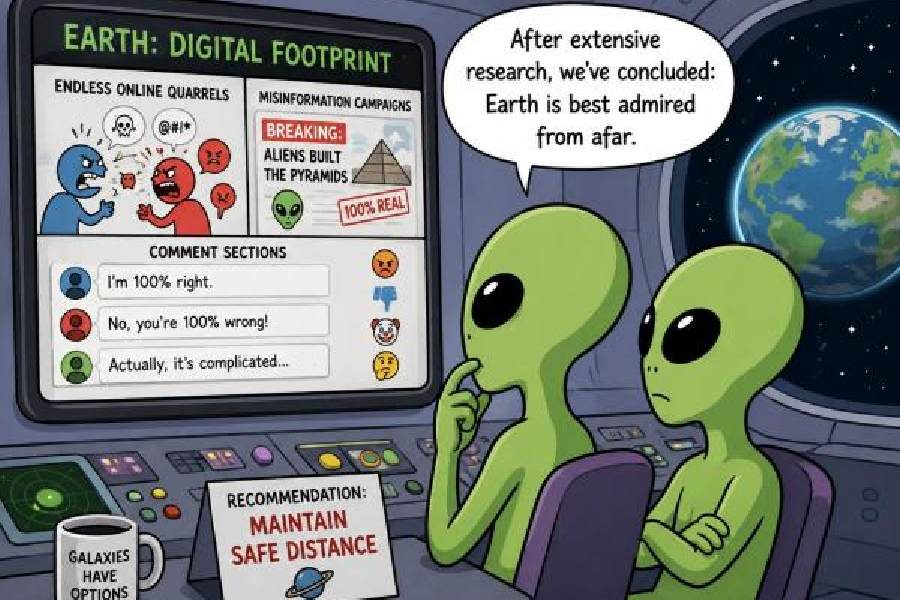
Sir — Could it be that humans are to blame for aliens staying away from Planet Earth? The International Academy of Astronautics has wisely advised scientists to handle any message from aliens with extreme care. But such caution may be too late if aliens have already studied humanity through our digital footprint. After observing endless online quarrels, misinformation campaigns and comment sections where strangers debate with remarkable confidence on subjects they barely understand, extraterrestrials may conclude that Earth is best admired from afar. Humanity often searches the cosmos for intelligent life while giving aliens ample reason to remain distant.
Koyel Halder,
Calcutta
Change the system
Sir — The repeated failures in examinations such as NEET and CUET show that India’s education system has become too centralised and difficult to manage (“Faulty system”, Jun 8). When question papers leak and exams are cancelled, students bear the heaviest burden. Years of hard work disappear overnight. Large-scale tests involving millions of candidates require strong safeguards, yet fairness remains uncertain. Educational institutions should reduce overdependence on single national examinations and explore multiple methods of assessment that better reflect a student’s abilities.
Dimple Wadhawan,
Kanpur
Sir — Recent controversies surrounding the National Testing Agency have shaken public confidence in competitive examinations. Students prepare for years with great effort, while families invest significant resources in coaching and travel. A retest may seem like a solution, but it often increases stress and uncertainty. Examination bodies must ensure transparency, accountability and timely communication. Trust in public institutions is difficult to rebuild once it is lost, especially when the future of lakhs of young people is at stake.
Chaitali Ghosh,
Calcutta
Sir — Teachers spend years observing the strengths and weaknesses of their students, yet they are rarely trusted to assess them fully. Entrance examinations based largely on multiple-choice questions cannot measure creativity, reasoning or communication skills adequately. A balanced system combining school performance with entrance tests may offer a fairer picture of merit. Education should encourage understanding and critical thinking rather than rewarding memorisation and test-taking techniques alone.
G. Dasgupta,
Calcutta
Sir — It is striking that institutions have sought help from the Indian air force and banks to manage educational challenges. Such interventions expose weaknesses in the education system. Schools, universities and examination agencies should possess the capacity to conduct assessments independently and securely. The reliance on outside agencies raises questions about governance, planning and institutional responsibility in education.
Sourish Misra,
Calcutta
Sir — The growing dependence on computer-based examinations deserves careful scrutiny. Technology can improve efficiency but it cannot replace meaningful evaluation. Many entrance tests reward speed and pattern recognition rather than deep understanding. Students from disadvantaged backgrounds may also struggle with unequal access to resources. Educational reforms should use technology to support learning while preserving human judgement and academic diversity in assessment methods.
Vijay Ramasekhar,
Chennai
Too rich
Sir — The prospect of Elon Musk becoming the world’s first trillionaire should prompt serious reflection on the growing concentration of wealth. Technological innovation deserves recognition, but no economic system should allow such vast fortunes to accumulate without public debate on fairness and accountability. When wealth grants extraordinary political influence, democratic institutions risk serving a few rather than many. Governments across the world must strengthen regulations on campaign financing, taxation and competition to ensure that economic power does not undermine democratic values.
Puranjit Sanyal,
Nadia
Sir — Extreme wealth concentration is not merely an economic issue; it is also a democratic concern. Billionaires possess the resources to influence elections, shape public discourse and affect policy outcomes. Such influence may weaken citizens’ faith in representative institutions. Democracies function best when political power is broadly distributed rather than concentrated in a few hands. Greater transparency in political funding and stronger safeguards against undue influence are urgently needed.
Pratima Chakraborty,
Calcutta
Sir — Entrepreneurs such as Elon Musk have advanced technological innovation. But the emergence of unprecedented fortunes raises questions about market structures that reward capital far more than labour.
Altaf Sheikh,
Mumbai