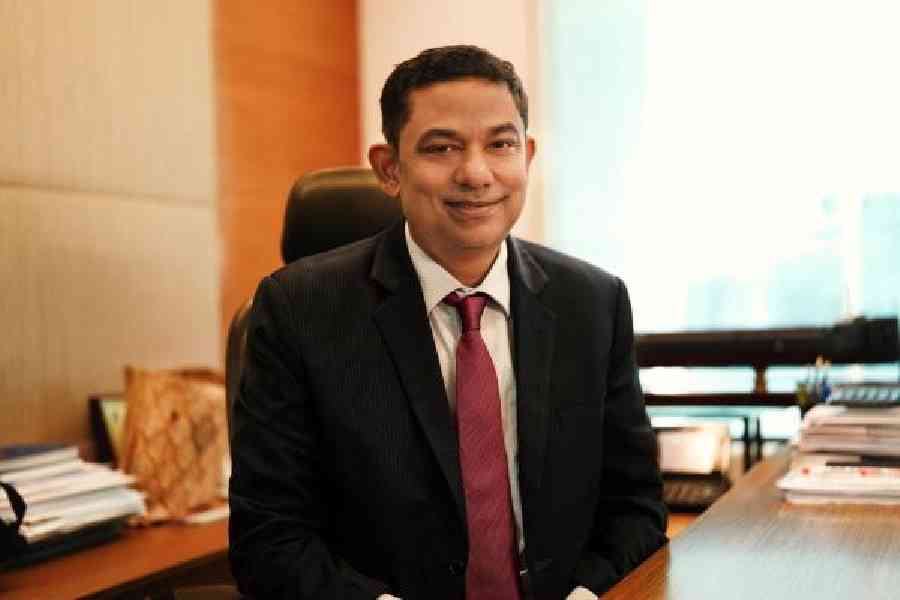
JSW Infrastructure Ltd, part of the $23-billion JSW group, will ‘evaluate’ the new location for a deep-sea port proposed by the newly-elected Suvendu Adhikari government, as the company bets on Bengal’s industrial resurgence under the new political dispensation.
The Sajjan Jindal-led company, India’s second largest private port operator, was one of the two bidders for Tajpur port when the previous government had floated the plan. But it lost out to Adani Ports and Special Economic Zone in the race, even as the tender itself was cancelled later.
“We will definitely be evaluating the new location,” Rinkesh Roy, joint managing director & CEO, JSW Infrastructure told The Telegraph in an interview.
Earlier this month, chief minister Adhikari announced a port is being considered at Dadanpatrabar, instead of Tajpur, because the new location has government land where infrastructure facilities such as warehouse, rail and road connectivity can be developed.
Roy said the navigational channel of the new location would be a key factor. “The most critical element is the area through which the channel pass. We will look into it. It has to be a channel where all permissions of requisite authority are there,” the CEO said.
It is still unclear how the Bengal government will approach the new port development. The announcement of Dadanpatrabar was preceded by two back-to-back meetings with Karan Adani, CEO of APSEZ, and Union shipping minister Sarbananda Sonowal.
A government source had earlier noted that the new location has a better channel – the waterway that connects berthing facility at the dock with the sea.
Calcutta play
JSW Infrastrastructure hopes to make Kolkata Dock System — especially the Netaji Subhas Dock (NSD) — a state-of-the-art facility.
The company, which is aiming to expand capacity to 300 tonnes by 2028 nationally and double earnings before interest, tax, depreciation and amortisation (EBITDA) to ₹5,000 crore, will invest close to ₹1,500 crore to re-develop six berths at NSD and build two new terminals outside the lock-gate for container movement.
Last week it received a letter of award for a PPP project from Syama Prasad Mookerjee Authority, Calcutta for integrated development of the two outer terminal and 5 berths at NSD. Coupled with two more berths it was awarded previously, JSW Infra will be able to handle 1.4 million TEUs a year (16-17 million tonne) cargo.
The plan envisages knocking off two days spent by container ships in voyage from anchorage to port and back to anchorage (the starting point of the riverine channel of KDS at Bay of Bengal) by lowering stay at the berth to 24 hours from 48 hours with mechanisation.
It also plans to enhance the transfer of containers from 800 TEUs per ships per voyage to 1100 TEUs by installing advanced machinery. The outer terminal will further cut down ship’s waiting time to enter lock-gate system.
“Freight rates will start coming down because each ship will be able to generate those extra trips per year. Our train services will bring an integrated logistic solution to customers. It is a very exciting opportunity and in sync with the industrial resurgence we foresee,” Roy, who was a former chairman of Paradip Port, explained. According to him, a lot of efficiency gain are clearly visible with mechanisation, berth creation and integration with logistic service.
Acknowledging the constrains of low draught of a riverine port, Roy argued KDS has the unique advantage of being present where the consumption is actually taking place.
He pointed out that 90 per cent of cargo at NSD are destined to Calcutta and Bengal and the capacity utilisation is also crossing 90 per cent.
“Capacity addition should be planned when utilisation hits 70 per cent. Here it is already 90 per cent and growing by double digits. So, you have full capacity utilisation, growth in traffic and serving an area which will see an industrial resurgence. We considered them when we looked at the project,” Roy said.