In December 1971, the United States of America sent a nuclear-powered aircraft carrier into the Bay of Bengal to intimidate India. It was a moment designed to break the will of a country at war, but Prime Minister Indira Gandhi did not flinch because Delhi understood that sovereignty is not a commodity for sale. When an American nuclear submarine torpedoed an Iranian vessel near Indian shores this month, the Narendra Modi government couldn’t even mention the incident, which extended the war zone to the neighbourhood. His supporters boast that India has arrived as a global power but the reality suggests a submissive trajectory. The Modi government has traded India’s
historical spine for a brand of personalised transactionalism that has rendered 1.4 billion Indians vulnerable.
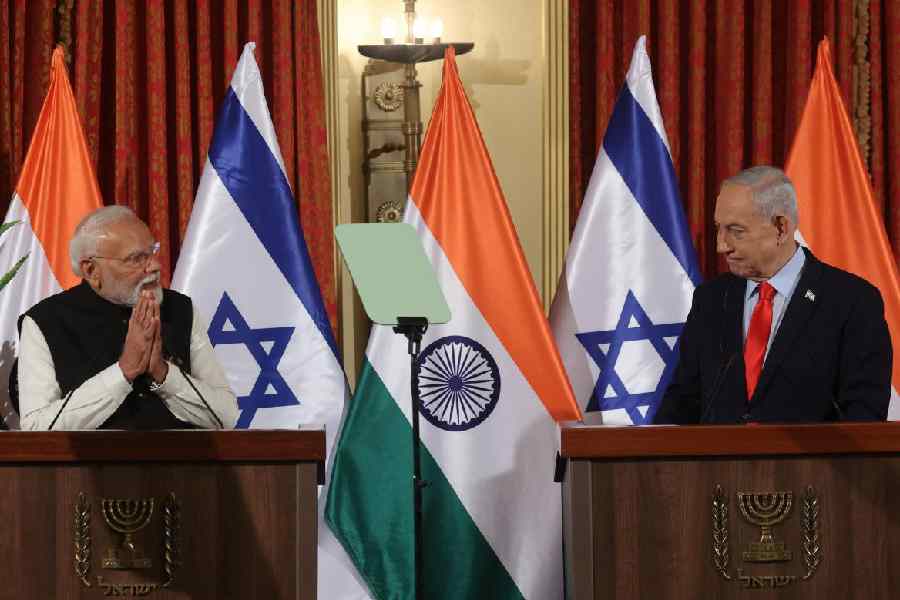
Modi’s recent visit to Israel was perhaps the most striking example of this strategic myopia. Standing in the Knesset and declaring that India stands shoulder to shoulder with Israel was not just a departure from Delhi’s traditional role but a complete abandonment of the balance that once protected its interests. This visit occurred when the region was already on the verge of a military escalation. After the Israeli decapitation strikes, the Indian establishment seemed to believe that the Iranian religious state was finished. The Modi government thought it could simply ignore its old partners in Tehran as a new leadership would emerge. When the regime instead demonstrated its resilience, the Indian government found itself stranded. It had to seek permission from the Iranians to allow some Indian ships to cross the Strait of Hormuz. That fallacy sits at the heart of India’s present vulnerability.
The economic cost of this mismanagement falls directly on the Indian populace. Over 60% of India’s crude oil and about 90% of its LPG are imported via West Asia. Every 10-dollar increase in the price of crude is an additional fiscal burden of thousands of crores of rupees. As the price of oil soars, the Modi government has offered no plan to shield the common man from the resulting inflation. There is also a massive impact on India’s trade routes because the ships are now forced to navigate around Africa to avoid the conflict zones. This increase in transportation costs and insurance premiums is a direct burden on Indian exports. There are over nine million Indians living and working in West Asia. When the crisis engulfed the region, the Modi government had no evacuation plans in place. It is now left pleading with Azerbaijan, a country it censured for its close ties with Pakistan, to seek help in evacuating Indians from Iran.
The humiliation of our current position is most visible in our relationship with the US. India is a strategic partner of Washington but is treated like a subordinate that must beg for 30-day waivers to conduct its own energy trade. The recent comments by the US deputy secretary of state stating that the US will not allow India to rise in the way China did should have been a wake-up call for Delhi. Instead of asserting its independence by rebutting his humiliating assertion, the Modi government continues to seek approval from the same Donald Trump administration. “Narendra Modi has been rather silent about the war in Iran. The explanation is fear of Donald Trump,” this is how The Economist put it.
After Trump reimposed sanctions on Tehran in 2018, Modi did not test room for manoeuvre, seek waivers with serious intent, or insist on its own energy security needs. By mid-2019, India’s imports of Iranian oil had fallen effectively to zero, and overall trade with Iran had collapsed by roughly 87% from 2018 levels. This was not an adjustment at the margins. Iran had been a major supplier of relatively cheaper crude and was central to India’s diversification of sources. Instead of using India’s market size and political weight to carve out space, Modi chose to comply entirely with unilateral US sanctions. The same story was repeated with Russian crude this time around, with Delhi fully succumbing to Trump’s diktats.
India cannot claim to be the voice of the Global South while ignoring the targeted killing of the head of a friendly state, the bombing of schools, and the death of thousands of civilians in a region vital to Indians. Delhi once held a position of moral authority that spoke for the developing world and challenged the hegemony of the West. Today, India is seen as an outlier within groups like BRICS because its positions are so closely aligned with the US and Israel. Delhi’s silence on the civilian casualties in Iran and Lebanon is being interpreted by other developing countries as culpability and has cost India the credibility that Indian leaders before Modi spent decades building.
This loss of strategic autonomy is perhaps the most tragic aspect of the Modi era. Since 1947, Delhi’s idea of autonomy did not mean neutrality or opting out of the world; it was having the freedom to speak for itself and to protect its own interests regardless of the pressures from great powers. That is how India managed to deal with Iraq
and Iran and Israel and Saudi Arabia simultaneously without becoming a party to their conflicts. Delhi stayed out of their internal politics and focused on an enabling environment for India’s own transformation. Under Modi, that institutionalised wisdom has been discarded in favour of a personalised policy that has put everything at risk.
We are currently at a hinge moment in history where the old world order is breaking down, and a new, more disorderly system is emerging. At such a time, a country must be able to stand on its own feet and build coalitions based on its own principles. The Modi government has instead chosen to lock India into a rigid alignment with the US and Israel that narrows our options and increases our vulnerability. We have seen India’s influence in its own neighbourhood shrink as the Hindutva regime fails to engage effectively with South Asian countries.
India is becoming an island of silence and evasion in a world that needs leadership and honesty. If India is to survive and thrive in this new era, it must return to a policy of genuine strategic independence. Sovereignty is not a gift that is granted by others but a power that must be exercised with courage and clarity. The government must stop treating foreign policy as a series of personal triumphs and start treating it as a serious, institutionalised task. A nation of 1.4 billion people with a massive economy and a diverse and talented population does not need the permission of Washington or the approval of Tel Aviv to protect its own people. India’s strength lies in its own diversity and its post-colonial democratic values.
Unless India gets a government that sets its own house in order and reasserts its moral authority, it will find itself increasingly isolated and weak. The 1.4 billion Indians deserve a leader who stands up for them and not just for his own brand or the interests of a select few. India must reclaim its voice and its independence before it is too late. The world will be better for it.
Sushant Singh is a lecturer at Yale University