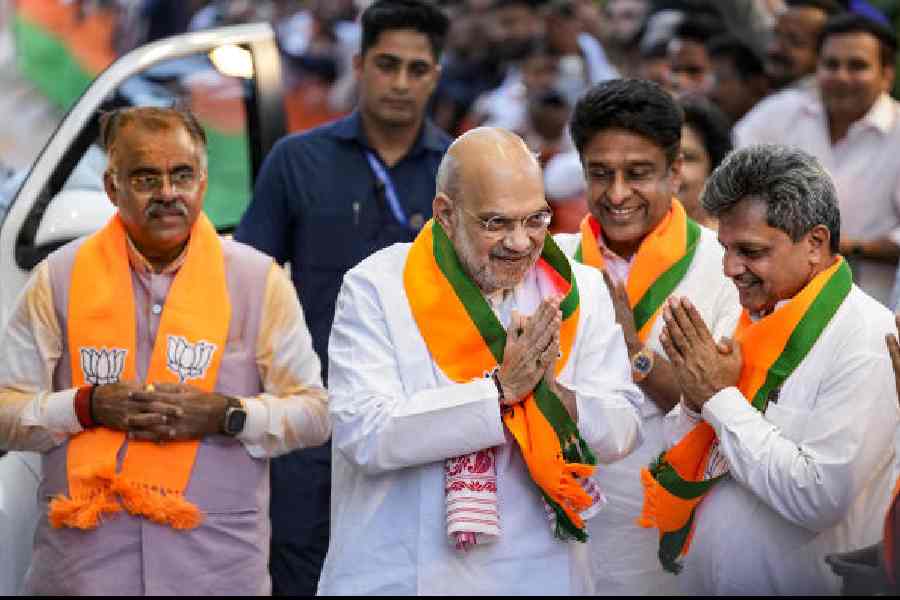
The Modi-Shah combine on Monday captured what they had called the “last frontier”, scripting a sweeping victory in Bengal and reasserting dominance after falling short of a majority in the 2024 Lok Sabha elections.
The scale and symbolism of the win are likely to recalibrate the national political narrative in favour of the ruling party.
The BJP’s push for the southern frontier — critical to its claim of being a truly pan-Indian force — failed to yield desired results in Tamil Nadu and Kerala, but the Bengal stunner overshadowed the setback. The victory comes close on the heels of the BJP installing its first chief minister in Mandal heartland Bihar, strengthening its presence across the eastern belt.
Retaining power in Assam for a third consecutive term and the Bengal result have consolidated the BJP’s hold over a contiguous eastern stretch. Narendra Modi and Amit Shah framed this arc as “Anga, Kalinga, Banga” — a political shorthand for Bihar, Odisha and Bengal — underscoring a strategic consolidation ahead of the 2029 general election.
The ruling alliance also retained Puducherry, reinforcing the perception that this round of Assembly polls has resulted in net territorial gains for the BJP-led bloc.
The Bengal victory carries a strong personal imprint of the Modi-Shah partnership, who led the campaign from the front against incumbent Mamata Banerjee, one of the Opposition’s most resilient figures. The BJP had not projected any chief ministerial face — wary that they had none to match Mamata — and chose to rely on Prime Minister Modi’s popular appeal and home minister Shah’s famed election management skills.
The Bengal victory bolsters Shah’s standing as the BJP’s pre-eminent electoral strategist, buttressing his claim as a potential successor to Modi. Within the party, the result is also being read as a development that could recalibrate internal hierarchies, particularly vis-à-vis Yogi Adityanath, whose growing profile as a Hindutva figure has drawn attention in recent years.
The Modi-Shah leadership has historically favoured a tightly centralised command structure, often leaving limited room for the emergence of strong regional power centres.
These dynamics are likely to be tested in Uttar Pradesh, which heads to Assembly elections early next year. Party insiders expect Shah to take a lead role in crafting the BJP’s poll strategy in the state. Adityanath exercises firm control over the state unit. The evolving balance between central leadership and regional authority will be closely watched as the party prepares for a high-stakes contest.
Murmurs of a strain between Shah and Adityanath have periodically surfaced within party circles. They became particularly visible during the last general election, when the BJP’s tally in Uttar Pradesh dropped to 33 out of 80 seats in the Lok Sabha. Even Modi’s victory margin in Varanasi narrowed significantly. In the aftermath, sections aligned with Shah informally attributed the setback to organisational lapses at the state level while those close to Adityanath pointed to candidate selection decisions driven by the central leadership, underscoring underlying tensions over control and accountability.
“The Lotus blooms in West Bengal! The 2026 West Bengal Assembly Elections will be remembered forever,” Modi posted on X on Monday. “People’s power has prevailed and BJP’s politics of good governance has triumphed. I bow to each and every person of West Bengal,” he added, crediting the victory to the “struggles of countless karyakartas over generations”.
Shah’s post, offering “millions of salutations to the people of Bengal”, sought to associate the victory with the Ganga, subtly underlining his role in scripting the stunning win. “For every BJP worker like me, this is a moment of pride that from the source of Mother Ganga in Gangotri to Gangasagar, today the BJP’s saffron flag is proudly waving everywhere,” he wrote. Gangotri is located in BJP-ruled Uttarakhand and the states Ganga flows through — Uttar Pradesh, Bihar and now Bengal — are now under the BJP.
The result helps repair the dent suffered after the BJP’s underwhelming performance in the last general election, when Modi-Shah’s “400-plus” projection fell well short of the majority mark in the Lok Sabha. The BJP’s tally of 240 had led the Opposition to believe that the downward slide of the Modi-Shah duopoly had set in.
With subsequent wins in the Haryana and Maharashtra polls, the two leaders had managed to reshape the narrative, with insiders terming the 2024 outcome an “aberration”. The Bengal mandate now strengthens that argument, suggesting that the Modi-Shah electoral formula retains its potency even in regions once considered peripheral to the BJP’s traditional base.
A loss in Bengal would likely have elevated Mamata’s stature within the Opposition bloc, potentially positioning her as a principal challenger to Modi. Instead, the defeat of the Trinamool Congress, alongside setbacks for the DMK, has weakened key Opposition voices. This comes weeks after the Opposition had embarrassed the government by defeating amendments to the women’s reservation law in Parliament.
The implications extend to the Rajya Sabha, where the BJP-led alliance is expected to improve its numbers, easing the passage of contentious legislation. The party has already bolstered its strength in the Upper House with recent additions from the Aam Aadmi Party.
For the BJP and its ideological affiliates, the Bengal win is being framed as more than an electoral milestone. Party leaders termed it the culmination of an ideological project—on a par with the abrogation of Article 370 in Jammu and Kashmir and the construction of the Ram Temple Ayodhya. The symbolic resonance was heightened by the party’s success in the home state of Syama Prasad Mookerjee —Hindutva ideologue and the founder of its predecessor Jana Sangh — long seen as a difficult terrain.