A tectonic shift has reshaped Bengal’s political landscape. On Monday, a blinding saffron storm swept away the green gulal that had coloured the state since 2011, clearing the path for Bengal’s first BJP chief minister.
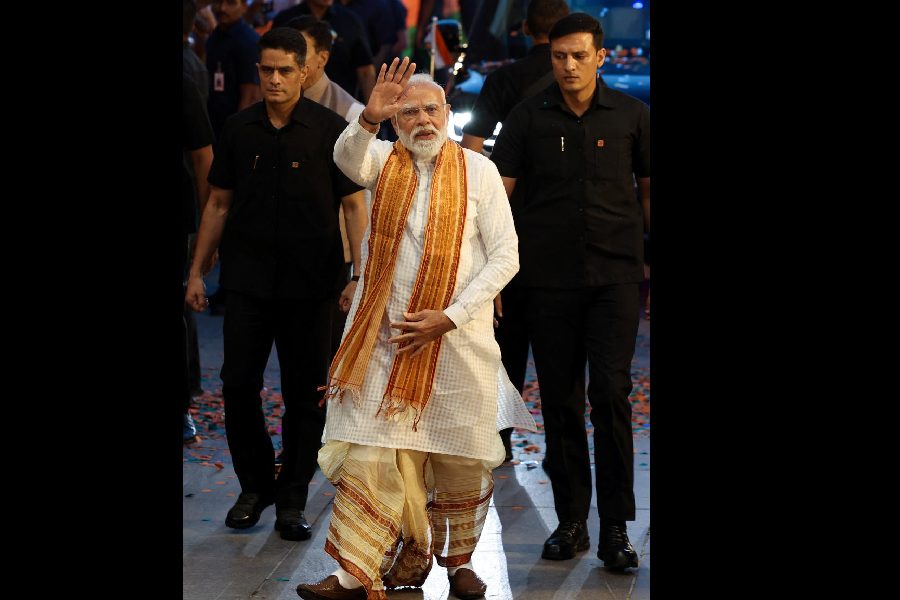
Prime Minister Narendra Modi’s sartorial choice, clad in the traditional Bengali dress of dhuti-panjabi, during his celebratory speech in New Delhi marked the epoch-making significance of the BJP’s triumph in the state.
The change marks the end of a political era — 15 years after Mamata Banerjee breached the Left’s apparently impregnable 34-year fortress and turned Bengal from red to Trinamool’s celebratory green, the wheel has turned again. Mamata herself lost her Bhabanipur fief, beaten again by her protege-turned-bete noire Suvendu Adhikari.
Three consecutive terms in power proved to be the TMC’s undoing. The accumulated weight of non-governance, rampant corruption, a jobs crisis, and deteriorating law and order — compounded by the ruling party’s visible arrogance — left Mamata too weakened to weather the storm. The BJP comfortably
crossed the magic figure of 147 seats for a majority and romped to 206, while Trinamool struggled at around 80: ironically, not much ahead of the BJP’s own tally of 77 in 2021.
The BJP’s rise has been nothing short of spectacular. In 2011, the party — fighting alone, save for minor partners like the Gorkha Janmukti Morcha — had scraped together 19.34 lakh votes and a 4.06 per cent vote share. To travel from near-insignificance to leads in 206 seats with a vote share of 45.85 per cent, within the span of a single generation of politics, is a transformation without precedent in
modern Bengal.
Winning Bengal has effectively completed the BJP’s saffron map east of Uttar Pradesh. The BJP’s win is all the more historic as the party still does not control any municipality or municipal corporation in the state — a telling commentary on the limits of its organisational reach in Bengal.
The scale of the verdict was so sweeping that even the controversy over the special intensive revision of electoral rolls — which saw the deletion of around 90 lakh voters — was dwarfed by the wave of polarisation the BJP succeeded in engineering.
Prime Minister Modi’s prophecy proved grimly accurate: at least eight districts have not returned a single Trinamool MLA.
The BJP’s victory was built on two pillars — its own relentless campaign and the TMC’s self-inflicted wounds.
An aggressive offensive helmed by Modi and home minister Amit Shah, backed by foot soldiers imported from BJP-ruled states who camped in Bengal for months, capitalised on the anti-incumbency that 15 years of TMC rule had generated. Hindu voter consolidation and a fractured Muslim vote in minority-dominated districts did the rest. Even the rural Hindu women voters, who have been steadfast in their support of Mamata, have deserted her.
The TMC, meanwhile, contributed to its own downfall with remarkable consistency. The government’s failure to generate jobs or attract investment, the rape and murder of a junior doctor at RG Kar Medical College and Hospital in August 2024 — and the administration’s fumbling response to it — and the teacher recruitment scam that gutted the credibility of a leader once admired as a street fighter: each delivered a blow from which the party could not recover. The more the government reacted with arrogance and contempt to public anger, the deeper it sank into the same quicksand that had swallowed the Left Front before it.
Bengal’s political history now carries three distinct chapters. In 1977, CPM patriarch Jyoti Basu took over from the last Congress chief minister, Siddhartha Shankar Ray, and ushered in 34 years of Left rule — a tenure shaped by land reforms, the empowerment of the rural poor, and the restoration of panchayati democracy, even as it earned criticism for militant trade unionism and industrial stagnation.
When Basu’s successor Buddhadeb Bhattacharjee finally brought a major industry to Bengal, the resulting land acquisition controversy lit the fuse that ended the Left’s reign. Mamata rode that parivartan wave in 2011, won the people’s trust for two terms, survived a formidable BJP challenge in 2021, and then — in her third term — squandered it all.
The people gave the Left 34 years. They gave Mamata 15. The message is clear, and the BJP would do well to read it carefully.
For the party, winning Bengal is both a historic triumph and an immediate burden. The state that is home to BJP ideologue Syama Prasad Mookerjee has finally turned saffron — but the incoming chief minister inherits a Bengal starved of investment, employment and institutional credibility. The polarising rhetoric of the campaign trail must give way to governance. The people have taken note of every promise made, and they have already demonstrated, twice in living memory, that they will not wait indefinitely for results.
Bengal’s verdict is not just a political realignment. It is a mandate that must be respected — and a warning that must be heeded.