This column might attract even fewer readers than usual, for it appears on the day of election results. Before the ensuing excitement eclipses all other issues, let us remind ourselves of the new and potentially lasting malaise that underlay the elections this time. It afflicted the state of West Bengal to a unique degree, but it can descend anywhere at any time.
In Bengal, it affected 27.16 lakh people who were prevented from voting. Whatever the strident unbacked claims of a certain party, the initial figures emerging from tribunal hearings confirm what sober thought might suggest: the vast majority of those excluded are bona fide citizens. They were born in this country, have lived here all their lives, and have documents to prove it. They voted in previous elections, many in the magic year 2002. Yet the Election Commission of India suspended their voting rights, alleging ‘logical discrepancies’ in their records.
Among these ‘discrepancies’ are more than six persons claiming the same parent, or age differences between parent and child that, however common in Indian society, the EC deems inadmissible. Another common ‘discrepancy’ is a minor mismatch in the spelling of a name — perhaps in a document prepared by an unmindful clerk decades ago, or the familiar variations in rendering Indian names in ‘English’ or Roman script. For the privileged, such objections are merely exasperating. For the poorly educated and disadvantaged, they are incomprehensible. If they cannot meet such vague and shifting clerical objections, it is not owing to their ‘failure’ to negotiate an uncaring officialdom. It is owing to the authorities’ resounding failure to devise and conduct an effective procedure with the ground realities in mind.
Why should such trifling anomalies attract suspicion at all? If a father’s name is spelt ‘Mukherjee’ or ‘Husain’ and the son’s ‘Mukherji’ or ‘Hussein’, the mind boggles to weave a tale of fraud or imposture around the difference. Seasoned novelists might feel challenged to construct such a fiction. Those who thought up this ‘discrepancy’ had applied not their minds but their Pavlovian bureaucratic reflexes.
Some 27.16 lakh people have been disenfranchised on such trivial grounds. They may get back their voting rights one day, but meanwhile one or more elections will have come and gone. It is not only those individuals’ rights that are impaired. 27.16 lakh is not a small number. It is enough to upturn the election results and install a different party in power, affecting the interests of every citizen of the state and (if only we realized it) the nation.
Even if that does not happen (we shall know this very day), it is alarming that our electoral system should have this huge hole in the middle of it. The current impasse is not due to sabotage by miscreants. It is the outcome of a course of action charted by the EC, ratified and in part expressly directed by the Supreme Court. We have conducted an election while officially suspending the voting rights of over two and a half million citizens, even though we admit their likely entitlement. Henceforth, such electoral democracies as remain in the world might hesitate to count us among their number.
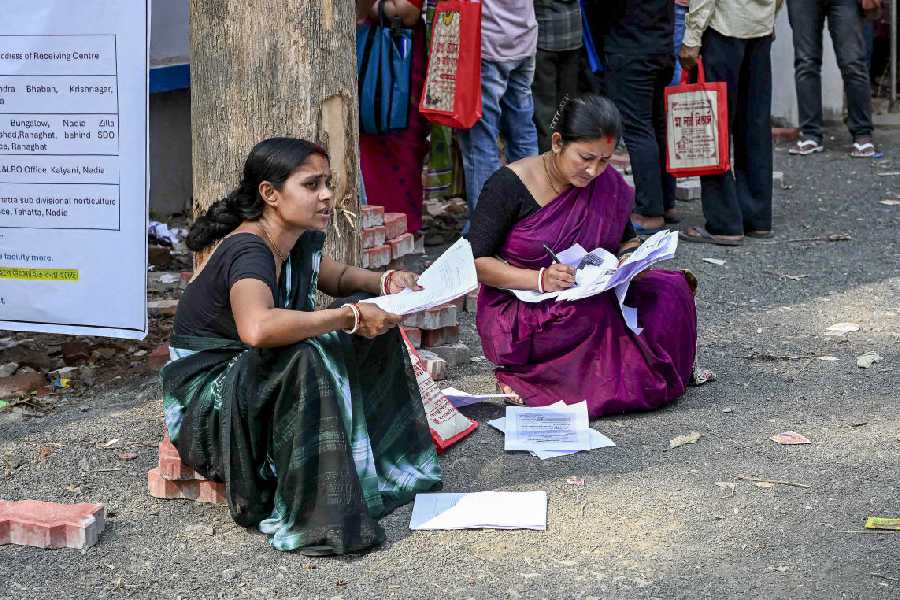
More importantly, all Indian citizens should take warning that they are subject to the same system and can be similarly deprived if it suits the powers that be. In their own interest, let them not dismiss the current impasse as a local commotion stoked by those troublesome Bengalis. Our luckless race has paid a disproportionate share of many debts that India owed history, the freedom struggle and the pain of Partition among them. In fact, it is the Partition that underlies the current Goebbelsian uproar about ghuspaithiyas. Hence the singular havoc wrought in Bengal by the Special Intensive Revision of electoral rolls. The fear of losing one’s citizenship is compelling the common Bengali to comply with the SIR’s punishing demands, sometimes (especially among migrant workers) at a huge cost of time, money, energy and morale.
Such humble citizens make up the largest part of the 27.16 lakh whose fate now rests with the tribunals. This prompts a serious caveat. There is a view that those who do not approach the tribunals have no case to defend: they are infiltrators — Bangladeshis, or those unseen, near-mythical Rohingyas. They can thus be expunged from the electoral rolls, and in due course from the citizens’ register when it materializes.
This is fallacious if not malicious logic. The tribunal benches all function from Calcutta. Appellants from across the state, even Alipurduar or Purulia, must travel there at their own time and expense. After several futile petitions already, they may simply lack the money, energy or family support for this further punishment. Suicidally, they may feel they have done all they can, and must now resign themselves to whatever happens — a not uncommon reaction among people with little to lose and little to hope for. Hence justice demands that each of the 27.16 lakh cases be reviewed, whether or not there is a formal application.
This is especially imperative from the experience so far. Till April 27, the tribunals had examined 1,621 cases and restored all but fourteen to the rolls. In other words, over 99% of these hapless people have suffered untold harassment, tension and expense, besides being deprived of their franchise, owing to a flawed adjudication process. If anything like this ratio holds, the entire list of ‘logical discrepancies’ might as well be scrapped and all its constituents get back their voting rights.
If that seems too much like capitulation, could we think of some face-saving formulae? What about restoring all names where the discrepancy consists solely in the spelling? And with families of ten or twelve members, letting them all through if even one is already on the rolls?
The alternative is to continue with individual hearings for the rest of the 27.16 lakh appellants. The tribunals took 8-10 days to dispose of 1,621 cases. At that rate, the entire exercise will take only forty years or so.
Sukanta Chaudhuri is Professor Emeritus, Jadavpur University