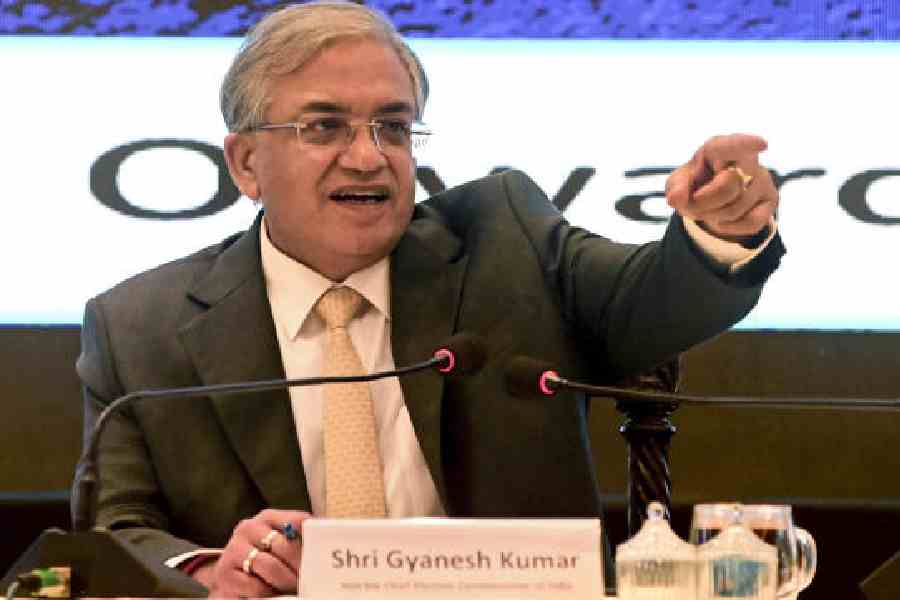
The poll panel under chief election commissioner Gyanesh Kumar has left an indelible mark on the 2026 Bengal polls, in a way it has impacted few elections before.
The Election Commission introduced key changes to the second round of the special intensive revision (SIR), which covered 12 states and Union Territories including Bengal.
One, the booth-level officers (BLOs) were not authorised to collect copies of the specified documents from voters whose names could not be "mapped" to the previous SIR, held over two decades ago.
Two, the "logical discrepancies" filter — a term undefined in law — was expanded and voters who fell in this category were summoned to prove their eligibility even if they had been "mapped".
In Bihar, which underwent the first round of the SIR, this filter applied to actual fallacies, such as the age or name on the voter list not matching those in the identity documents. This, too, was dealt with mostly without issuing summons.
In the Round 2 states, the "logical discrepancies" category also included those who had more than five siblings or those whose age differences with their parents and grandparents were above or below a stipulated range.
In most of the states except Bengal, though, the BLOs had the discretion to "map" voters despite spelling errors, and many electoral registration officers (EROs) cleared names on the basis of documentary evidence without physically summoning all such voters.
In Bengal, the commission brought in thousands of central government employees as "micro observers". The Trinamool government underlined that these officials had no legal sanction to register voters. The poll panel countered that the state government had not provided enough officials of the requisite rank to serve as EROs.
The matter went to the Supreme Court, which allowed the commission to publish a "final SIR list" and then add supplementary lists — for which judicial officers from Bengal and neighbouring states took on the role of the EROs.
Multiple analyses have shown that the "logical discrepancies" axe disproportionately affected Muslims, married women, and the Matua Dalit community, who the Trinamool claimed tended to vote for the party. Among those deleted were the former Jaynagar MP, Tarun Mandal.
More than 27 lakh appeals against the "logical discrepancies" deletions remain pending before the 19 tribunals in the state, alongside 7 lakh appeals against inclusions.
In February, chief minister Mamata Banerjee walked out in the middle of a meeting with CEC Kumar and his fellow election commissioners at Nirvachan Sadan, saying she had been "humiliated".
Last month, a similar confrontation took place between a Trinamool delegation and Kumar at the commission headquarters. In both instances, Trinamool members claimed that only the CEC spoke, and the other election commissioners remained silent.
The poll panel then took the unprecedented step of naming the ruling party in an X post that highlighted the "ECI's Straight-talk to Trinamool Congress".
"This time, the Elections in West Bengal would surely be: Fear-free, Violence-free, Intimidation-free, Inducement-free and without any Chappa, Booth Jamming and Source Jamming," it said.
Soon afterwards, district election officers and district police heads in Bengal were asked to do news conferences repeating the latter part of the tweet. Schoolchildren were marshalled in the name of voter awareness to carry placards inscribed with the same message at rallies.
By the end of the elections, there were an estimated 3 lakh central force personnel in Bengal. This was more than triple the number of troops deployed for the 2021 polls. Some 700 companies have been retained to provide post-poll security until a government is in place.
Before the polling, flag marches were carried out using armoured personnel carriers.
The central forces have been running their own control room from a CRPF compound in Calcutta, communicating directly with units in the field without having to rely on the district administration.
Although Bengal witnessed heavy force deployment also during past elections, notably in 2006 and 1972, this unprecedented security blanket appears inspired by the one put in place by then chief election commissioner T.N. Seshan during the 1995 Bihar polls.
Seshan is seen as a messianic CEC who lifted the stature of the poll panel as a fair arbiter and strict enforcer. His act of sending 650 companies of central forces to Bihar, after the poll panel lost faith in the state police’s ability to prevent rigging, was widely seen as a virtual declaration of war on then chief minister Lalu Prasad.
Seshan also replaced senior Bihar officials. The polls, notified on December 8, 1994, were postponed four times and staggered over four phases, ending on March 28, 1995. At the end of it all, Lalu Prasad's Janata Dal won.
As it turned out, the security blanket deterred criminals from all sides and enabled the lower castes to come out and vote in a state where they had been historically oppressed and often prevented from voting.
In Bengal this time, Calcutta High Court had to stay the execution of an order to the police to crack down on 800-odd "troublemakers" notified by the poll panel. These included several elected Trinamool representatives.
Even without a "troublemakers" list, returning officers and district election officers do have the powers to detain anyone they suspect of trying to disrupt the polls.
Trinamool complained that the security forces were selectively targeting its members, and shared videos of BJP supporters assaulting their Trinamool opponents in the presence of the central forces.
A fresh election has been ordered in Falta — a first since the re-election in Bihar's Chhapra parliamentary constituency in 2004.
Police observer Ajay Pal Sharma — an IPS officer from Uttar Pradesh — was seen publicly warning Trinamool candidate Jahangir Khan against any mischief during the polling. Observers are expected to report what they see rather than take action.
Both in Bengal and Tamil Nadu, the commission transferred the chief secretary, home secretary and DGP, among other officials. In Bengal, it went further and transferred hundreds of police inspectors and block development officers, prompting a court case against the "paralysis of the bureaucracy". Mamata accused the poll panel of imposing "President's rule".
Election authorities imposed blanket bans on two-wheelers during the silence period, later modifying the order following court intervention. A prolonged ban on alcohol, too, had to be modified.
In the past, the commission has banned bike rallies and even roadside carrom clubs in Bengal during polling but never attempted a blanket ban on the most popular mode of private transport.
At one stage of the campaign, Bengal had recorded more seizures of cash, gifts, liquor and so on than the usual chart topper, Tamil Nadu.
The southern state did eventually emerge with higher seizures of almost ₹600 crore, but Bengal was not far behind at more than ₹510 crore.
To the credit of Kumar — who virtually turned himself into the face of the poll panel's drive — the elections were conducted without a single death, a rare feat for Bengal.