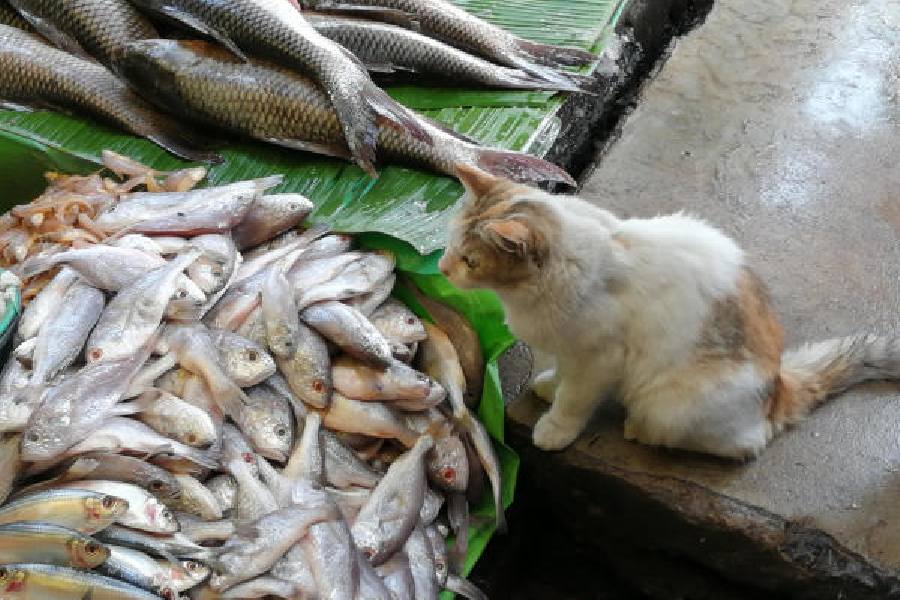
George Orwell once wrote about places where necessity overrides sentiment. A fish market is one of those places. Life is loud here, death is loud too, and nobody pretends otherwise. There’s no real way to aestheticise a fish market. A lot of fish are still alive, while most of them are long dead: the flies, the cats, the crows and the dogs wait patiently nearby. This is where nature, labour, and consumption collapse into the same square metre. There’s no clean separation, or distance, or any illusion that’s quite possible. There are hands that earn, hands that choose, hands that clean, and hands that cook. It is essentially capitalism without the abstraction. And unlike the supermarkets, where death is hidden behind plastic and lighting, here, it’s regulated by visibility. You don’t get to forget mortality here.
The maacher matha — the fish head, the part most people discard but Bengalis fight over — is where Barthes lives. Not the semiotician in his Paris study, but the argument itself: that bourgeois culture takes what is ideological and dresses it as inevitable. My grandmother never read Mythologies. She did, however, make muro diye moong dal every Thursday, cracking the hilsa head open against the rim of a boti with the confidence of someone who knew that the best thinking happens close to the bone. She would have found Barthes perfectly agreeable and his prose unnecessarily long.
The supermarket tried to solve the matha problem with refrigeration, plastic, and the particular quality of white light that makes packaged things seem to have arrived from nowhere in particular. The fish cooperated up to a point — allowing itself to be portioned, drained of colour, sealed. But it could not be made to arrive without a past. The past kept leaking through: a faint iron smell under the plastic, the slight give of flesh cold too long. And, always, always, the eye — which the packaging could not reach — looking back at you with the specific attention of something recently alive. The maacher matha cannot be made abstract. It is mortality that the supply chain forgot to launder.
The woman who has stood behind this slab for 40 years is the maacher peti of this essay — the belly, the fatty, unglamorous middle where all the real flavour lives. Her knowledge is what Bourdieu called habitus: 40 years of reading gills the way a scholar reads manuscripts, attention so trained it has ceased to feel like attention and become, instead, pure perception. She can tell a river fish from a tank fish without touching it. She can read the particular slump of a rohu and tell you whether it has been honest about its origins. No algorithm has replicated this. No university has certified it. When the last fish is wrapped in yesterday’s newspaper, the city’s unreality descends — its insistence, in malls and planning documents and aspirational hoardings, that she is not quite there. That the knowledge in her hands is not quite knowledge.
The mall is Adorno’s nightmare rendered in marble and air conditioning. You cannot tell, from inside one, which city you are in — Mumbai, Manchester, it makes no difference, which is precisely the point. The same escalators, the same semiotic grammar of shop frontages designed to make aspiration feel like oxygen. Pseudo-individualisation, Adorno called it: the Zara where yesterday was an H&M. The maacher peti has no place in this grammar. It is inefficient. It cannot be standardised. It requires someone who knows what to do with it, which is the kind of knowledge that cannot be acquired between a food court and a multiplex.
The maacher lyaja — the tail, least flesh, most flavour — is where Lefebvre and Iris Marion Young meet over the drain. Lefebvre argued that space is produced by social relations and, in turn, reproduces them. The mall produces the sovereign individual-consumer: alone, sovereign, and comprehensively deprived of anyone to argue with about fish heads. The fish market produces the neighbour — the person with a name, a history, a running argument about price that is also a conversation, that is also community maintaining itself in real time. Young called the rest cultural imperialism: the rendering of these ways of life as primitive, deviant, candidate for relocation to the periphery. The wet market smells. These smells are read as backwardness by a modernity that has decided, foundationally, that the smell of actual life is a problem to be managed.
The flies are telling the truth. The cat is telling the truth. The woman at the slab since before the city woke is telling the truth — about mortality, labour, and the fact that eating requires killing and commerce requires hands and community requires time to linger, to argue, to stay after the transaction is complete because the transaction was never only a transaction. It was also mutual recognition. An acknowledgment that the person across the slab is a person.
The voice from the whirlwind of the demolished market says: I am the matha you tried to discard, the peti you could not standardise, the lyaja you were always too impatient for. I am the non-identical that your systems cannot capture and therefore cannot replace. I am everything your malls are designed to make you forget — and I am, inconveniently, still here.
The fish market does not need your sympathy. It needs you to understand what you are endorsing when you sign the redevelopment proposal — not a hygiene assessment but a confession: that the city finds visibility inconvenient, labour acceptable only when invisible, and the smell of actual life a planning problem rather than a civilisation to be reckoned with. This is not progress. This is Barthes’ mythologisation with better lighting and a loyalty card.
The maacher matha is where Barthes and Marx converge at the slab — the myth of the commodity-from-nowhere refused daily by a fish that will not stop having had a face. The maacher peti is Bourdieu and Lefebvre: forty years of embodied, unreplicable intelligence producing human relations that Zomato’s rating system has not once approximated. The maacher lyaja is Young and Adorno’s last word — the non-identical, the remainder, the flavour that concentrates precisely because everything extractable has already been taken.
Urbanisation’s central aesthetic racket is not about sanitation. It is about whose knowledge counts, whose labour deserves an address, and whose community occupies space since identified as developable. What is being called modernisation is, in fact, an eviction.
Sometimes it is good to start from the end. For example, from the end
of fish. The lyaja is still in the mustard oil.
Sohagni Roy is a student at the Centre for Comparative Literature, University of Hyderabad