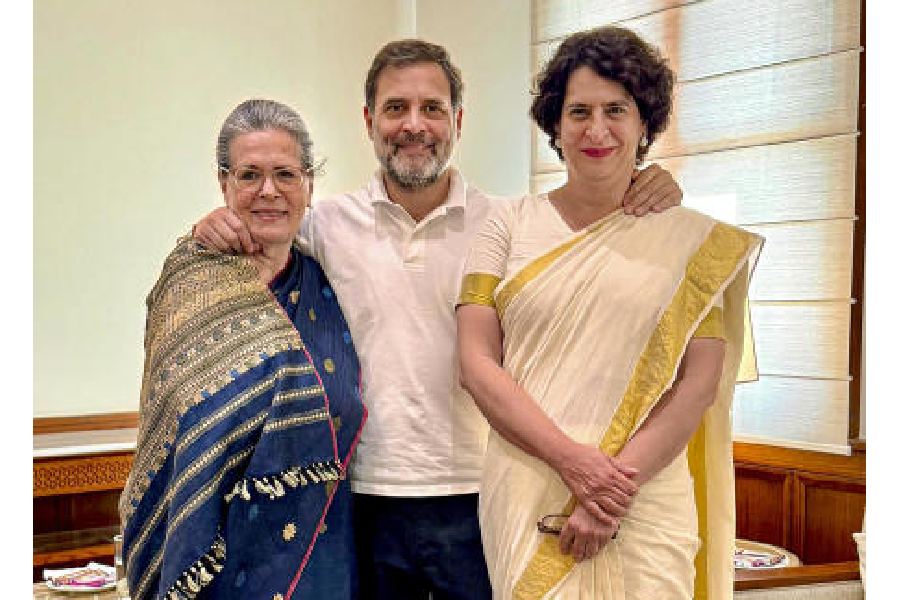
Soon after the general elections of 2024, I met a young Congress legislator. He asked me for five pieces of advice for his leader, Rahul Gandhi. I said I had only one; that Priyanka Gandhi should not run for the Lok Sabha from Wayanad. I added that I was certain the advice would be disregarded.
There is little doubt that Rahul Gandhi’s Bharat Jodo Yatra helped in enhancing his credibility, in portraying him as being a man of the people. Yet the Yatra’s gains were frittered away by the reassertion, after the elections, of the Congress as a family firm. Priyanka Gandhi won the Wayanad seat (as safe for her as Gandhinagar is for Amit Shah), and spoke grandiosely about how she and her brother were uniting the country, her representing the South and he the North. Then, for a parliamentary debate on the Constitution’s 75th anniversary, the Congress chose Priyanka as the lead speaker, even though it was her own grandmother who sabotaged the Constitution by imposing the Emergency.
Meanwhile, the Congress winning 99 seats in the general elections encouraged the coterie of sycophants around Rahul Gandhi to proclaim that he was now a prime minister-in-waiting. These claims were amplified by intellectuals and journalists in Delhi, whose sterling anti-Hindutva credentials were clouded by their lack of judgment, and perhaps by the seductions of being rajgurus.
Two years later, we can see that this sense of elation was premature. The odd state unit of the Congress (such as Kerala) remains well-organised, and capable of winning the odd assembly election. In most other parts of India, the party has steadily lost ground. The Bharatiya Janata Party is now the natural party of governance in Gujarat, Madhya Pradesh, Haryana, and several other states where the Congress was once dominant. Rahul Gandhi has been incapable of arresting this slide. According to a recent report in The Print, since Rahul assumed a formal leadership role in the Congress around 2008, the number of Congress MLAs nationwide has dropped by almost half, from 1,204 to 676.
I have met and corresponded with Rahul Gandhi, and know him to be a decent human being. Even without this slight acquaintance, I would have much sympathy for him because of the personal tragedies he has suffered, and because at the age of fifty-five he remains an instrument of his mother’s will. One can have little doubt that he entered politics at Sonia Gandhi’s command, and that he leads the Congress at her behest too. However, when the future of the Republic is at stake, one is forced to state one’s case directly and even brutally. Rahul Gandhi may be a good fellow; nonetheless, those who wish for a successful pushback against the hate-filled regime of the BJP should perhaps stop looking to him as their principal source of hope.
As a prospective prime ministerial challenger to Narendra Modi, Rahul Gandhi lacks discipline, gravitas, and a curriculum vitae. Even when he takes up an important issue, such as the partisan conduct of the Election Commission of India, he rarely does so in a sustained manner. We see him giving the odd press conference on ‘vote chori’, followed by a trip to Europe or Latin America. Indeed, in his twenty-two years in politics, it was only during the few months of the Bharat Jodo Yatra that Rahul Gandhi showed himself capable of the focused hard work that the leaders of the BJP put in all the time. Nowadays, his political interventions are mostly on X, attracting an array of immediate likes, yet destined to be forgotten within twenty-four hours.
Rahul’s lack of gravitas is also manifest in his gestural gimmickry, his naïve belief that jumping into a pond with fisherfolk or entering a kitchen with a chef will win his party votes. And his lack of a curriculum vitae is manifest in his never having held a real job. No one really knows what employment Rahul Gandhi had before he became an MP in 2004. In the ten years that the UPA was in power, he refused to take a ministerial position. Why then should Indian voters trust him to be an effective prime minister of this large and diverse country, and in an ever more threatening geopolitical environment?
Finally, Rahul Gandhi has a marked inability to learn from past mistakes. The ‘chowkidar chor hai’ campaign spectacularly backfired in 2019, yet he continues to personally attack the prime minister (calling him cowardly, compromised and so on), instead of focusing on governance failures or indeed on renewing his own party at the grassroots.
Many in the Congress acknowledge these criticisms, but, out of a lifetime of devotion to the Gandhis, think that his sister should be presented as the prime minister-in-waiting instead. Having belatedly realised that Rahul is not the new Nehru, they now hope that Priyanka will be the new Indira. Admittedly, Priyanka is a far better orator than her brother in Hindi, a language understood by a plurality of Indians. However, she too carries the burden of being an entitled dynast. And she may be even less successful in getting voters out. On the one occasion Priyanka led an election campaign, for the 2022 assembly polls in Uttar Pradesh, the Congress’s vote share was 2.27%.
Incidentally, one (apparently unnoticed) lesson from the recent assembly elections is that all represented a negative comment on dynastic entitlement. The BJP was helped in Assam by Tarun Gogoi’s son leading the Congress campaign, and in West Bengal by Mamata Banerjee’s promotion of her nephew, Abhishek. In Tamil Nadu, Vijay was aided by Stalin’s elevation of his son, Udhayanidhi, in Kerala the Congress by Vijayan’s promotion of his son-in-law. Of course, there were many other factors at work, but this was certainly one of them.
These criticisms of the Congress’s First Family are far from being an endorsement of the current regime. In numerous articles written since the Modi government came to power in 2014, I have documented how it has eviscerated public institutions, cowed the press and the judiciary, undermined democratic processes, brutalised religious minorities, pursued an error-strewn foreign policy, damaged Indian science, promoted crony capitalism, and ravaged our forests, soils, water, and air.
There is no question that the principal architects of this undoing of the Republic since May 2014 are Narendra Modi, Amit Shah and their party, the BJP. Yet it is also now starkly evident that in their pursuit and consolidation of power, Modi and Shah have had, as their (witting or unwitting) accomplices, Sonia Gandhi, Rahul Gandhi, and the sycophants who surround them.
I must not end on a despairing note. At the moment, the BJP under Modi looks impregnable. But so did Viktor Orbán and Fidesz in Hungary, and yet they were spectacularly unseated by the hitherto unknown Péter Magyar and his new Tisza Party. For two years prior to the election, Magyar travelled the country tirelessly, going to small towns and even villages to make his case against the authoritarian who had run and ruined Hungary. Magyar worked assiduously to build an Opposition alliance of all parties, Left, liberal, and Centre-Right. That he was a fresh face, untainted by corruption or dynastic privilege, and worked so hard were all inestimable assets. As a Hungarian editor quoted in the Financial Times said about Magyar: “He is incredibly driven. Others have the tools, but he went in and did all the legwork.” This, alas, is not what anyone can say about Rahul or Priyanka Gandhi.
It is quite possible that the air of indestructibility that currently envelops Modi’s BJP will unravel in the years ahead. The public educational sector is in a mess; the NEET scandal is symptomatic here. The costs of the Union government’s economic mismanagement are now starkly apparent, manifest in the precipitous fall of the rupee, the flight of capital, and the failure to generate jobs. In the run-up to the 2029 general election, more Hindus may come to recognise that hatred of Muslims cannot really compensate for a higher cost of living, the lack of dignified employment, or the prospect of an uncertain future for their children.
Indeed, the growing popularity of political satire, as in the success of the memes of the Cockroach Janta Party, suggests that many young Indians have begun to see through the lies and propaganda of the ruling party. (The BJP knows this, hence the desperate attempt to shut down the CJP’s avenues for expression.) As and when this disenchantment deepens, who will shape it into an effective political challenge? Which leader, or leaders, can inspire voters nationwide by taking apart the failures of the current government and presenting a constructive programme for economic and social renewal? Based on their past record it seems altogether unlikely that this can be either or both of the Gandhi siblings.
ramachandraguha@yahoo.in