|
|
| Pure magic |

India and Germany have much in common. They are united not only in appreciation for each other?s culture, but also in the pain inflicted by their tragic histories. The Partition and the Holocaust are now being researched as parallel histories. Indians and Germans continue to suffer from a trauma which results in feelings of inadequacy. Germany has been able to overcome much of it by its economic success and the peace it has been able to cement with its former enemies ? the United States of America, France, England and even Russia. But when Germany organized the Olympics 1972, the dark shadows of the past came revisiting: a number of Israeli sportsmen were assassinated by terrorists. The fear that history would repeat itself was palpable throughout the preparatory stage of the football championship. It is one of the achievements of this global event that politics was unable to mar it.
But there was more to it. To the surprise of many Germans themselves, the championship evolved into a one-month festival. It came to be called ?The Party?. Germans revealed their sunny side which we normally associate with people from the Mediterranean. The weather-gods favoured the game. From the first to the last day, the sun was out and pleasantly warm, sometimes even a bit too hot for central Europeans. Germans wait for days like these when they are able to go outdoors and sit in their gardens or at tables in the street in front of restaurants and caf?s. Also, earlier, the fussg?ngerzone did not exist. This is an area in the centre of each town, big or small, which is reserved for pedestrians. No cars and cycles are allowed. These streets have metamorphosed into shopping malls, and a ?street culture? has developed with street performers, small-time vendors and the open air pubs. People stop and talk to each other, children play, and old people sit and muse,.
During the championship, entire cities turned into pedestrian malls. We witnessed a veritable carnival with people wearing fancy dresses and hats and frolicking on the streets. The warm weather encouraged light clothes baring a lot of skin, which many younger people painted over. The national colours predominated, be they the black-red-gold of Germany or the colours of visitors from participating countries. This orgy of colours predominated in the so-called fanmiles, areas in each city which were cordoned-off. Giant screens were erected and thousands of people gathered to witness each game. This, too, is a new phenomenon in Germany and is called ?public viewing?. Rather than watching the game in their homes, the followers of football preferred to have the experience in a large group. Once I entered a public viewing space in Koblenz. We were first screened by the security personnel. These public viewings were considered as the next best thing to actually being with the crowd in the stadium. There were drums and applause, demonstrations of anger and pep-songs spiced with precious advise. The fanmile in Berlin collected almost a million people during the games featuring Germany.
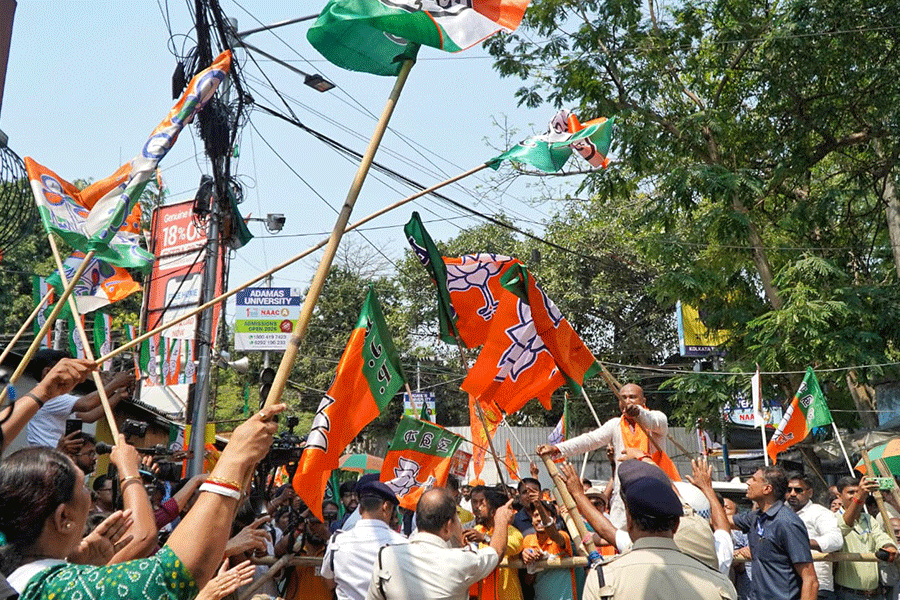
Many enthusiasts took the national flag to the stadia or the fanmiles to wave it frantically. Formerly, the German flag could be seen only on national holidays fluttering from government buildings. Still traumatized by the abuse of national symbols perpetrated by the Nazi rulers, West Germany was wary of exulting in symbols of power and of the state. No flags in classrooms as in the US, no flags in government buildings except on holidays. After the reunification, the show of patriotism increased slightly. People were actually willing to sing the national anthem before international games. But, this year, German flags were simply everywhere. Shops sold them freely. You saw them in restaurants, hung from windows, stuck on cars, and in the hands of millions. I was in Bonn before an important game. Around the main station, people wore conal sorcerer?s hats in the national colours, looking a bit like German Harry Potters. Boys and girls had coloured their hair in black, red and gold. They carried shopping bags with the national colours stitched on them.
Almost every item of daily use had these colours pasted on them in different ways. The more bizarre beatnik types draped their bodies in large flags. Some commentators even saw the shadows of Nazi Germany looming in the background. Then the flag had had the status of a sacred symbol. But this time, the German flag was handled with nonchalance. It was more colour than symbol.
The championship had many heroes. For me, the person I looked up to was J?rgen Klinsmann, the trainer of the German team. Formerly, he himself was the captain of the German football team and won a world championship title for Germany. He later married an American and emigrated to California. When the German team was in the doldrums two years ago, Klinsmann was called and he accepted the challenge. Within two years, he not only moulded a world class team, he also revolutionized German football. His no-nonsense attitude earned him more enemies than friends. During the championship, he evolved into a passionate young man who managed to unite his players. Everybody calls him great now. But only a few months ago, he was harshly criticized for not attending an important meeting. Even the mighty Franz Beckenbauer did not spare him. Klinsmann then revealed that he had returned to California to be with his mother for his father?s first death anniversary. Everybody felt ashamed. This man has got his priorities right and may serve as an example to German youth.
I was in Koblenz sitting in an Italian restaurant when Italy beat Ukraine. Within minutes, the Italians started a car procession, jubilating wildly and letting Italian flags flutter from their racing cars. Our waiter raised his fist and shouted forza Italia. Then it became clear to me that the population in Germany were not only supporters of the German team. During the economic boom in the Sixties and Seventies, the Italians were among the first foreigners to arrive in Germany to make the ?economic miracle? happen. They opened ice-cream parlours, pizza pubs and snazzy Italian restaurants. They worked in factories and succeeded in integrating themselves with Germans. The second and third generation Italians speak impeccable German and yet keep close links with their motherland. We have immeasurably profited from Italian culture. Not only from culinary culture, but also from their music, wine, and the Italian art of living. Italy has, since the time of Goethe, been a sehnsuchtsland for Germans. Italians? wonderful lightness of being and their Mediterranean emotionality have always been admired by Germans who tend to be too serious and introvert. Well, until this championship, which has witnessed an ?Italianization of Germans?.
With all the ?lan and energy displayed by the German team, and the joyous support of the masses, it would have been too much of a fairy-tale finish if the Germans had actually won. To me it was precious to realize that even in defeat, the spectators spontaneously feted their team, and that there was no hunt for scapegoats. Klinsmann went down nobly, and praised his team for their performance. A radio commentator had said that the reunification was a great surprise, nobody expected this. This football championship is another surprise. Nobody expected it to happen the way it did.