The tussle between a constitutional order focused on a strong Centre and a more federal arrangement has been a feature of the Indian political discourse since the 1930s. Some historians argue that it was the adherence of the Congress, particularly of Jawaharlal Nehru, to a quasi-unitary State crafted on centralized planning that facilitated the partition of India in 1947. Mohammad Ali Jinnah, it is said, would have been more kindly disposed towards a genuinely federal order. Likewise, there is a perception that Indira Gandhi’s overemphasis on centralism not only distorted politics but also contributed immeasurably to the indifferent performance of the Indian economy in the 1970s and 1980s.
Since the opening-up of the economy and the progressive dismantling of the licence-permit-quota regime, the debate on Centre-state relations has waned. Even the Left Front in West Bengal has stopped going on incessantly about the Centre’s discriminatory attitude. The high growth rates since the late 1990s have meant that both the Centre and the states have more resources in their treasuries to fund development and welfare schemes than at any time before. In a deregulated environment, states are in fact competing among themselves to attract private sector investment. The Centre’s subjective preferences are limited to a public sector that no longer occupies the “commanding heights” of the economy.
It is interesting that the shift in the balance of power from the Centre to the states has not been fully reflected in the political debate. This is partly due to the relief in the Establishment that the end of one-party dominance after 1989 has not led to total fragmentation. Since 1998, India has moved in the direction of coalitional bipolarity — with two national coalitions being held together by two national parties. Both Atal Bihari Vajpayee and Manmohan Singh lasted their full terms, despite leading seemingly incoherent coalitions.
The arrangement, unfortunately, is not proving to be too resilient. In 2004, the Congress and the Bharatiya Janata Party between them secured a little over half the seats in the Lok Sabha. In view of the Congress’s inability to enter into meaningful alliances in Uttar Pradesh and Bihar — it is being endorsed by its partners in only nine of the 120 seats — and the the BJP’s complete wipe-out from Kerala, Tamil Nadu, Andhra Pradesh and West Bengal, there is a growing feeling that the two national parties will account for less than 272 seats in the 15th Lok Sabha. In short, there is trepidation among those who have a stake in India that the coming years could witness endemic instability, political fragmentation and the formation of short-lived, rapacious governments at the Centre. The third front may yet be a mirage but its mere mention as a contender for power is calculated to strike terror in the hearts of the decision-making classes. Political instability, it is feared, could mean the end of Incredible India.
The steady truncation of the Congress and the inability of the BJP to reach all parts of India is a subject worth considering. Why have the national parties failed to accommodate regional impulses? Have their failings created openings for regional parties? The disproportionate power vested in the so-called High Command of the parties and the corresponding absence of any democracy in the selection of party nominees for elected posts are two factors responsible for national parties ceding ground to regional outfits. It is not that the regional parties are more democratic; they just happen to be more accessible and more responsive to a variety of local ambitions.
There is a long history of important state satraps seceding from the parent body. What Charan Singh and Biju Patnaik had to do in the 1960s was followed by Sharad Pawar, Mamata Banerjee, S. Bangarappa and Bhajan Lal subsequently. The cumulative outcome was the erosion of the Congress’s national credentials. In an earlier era, a loose combine of strong regional leaders — later vilified as the Syndicate —kept Nehru’s imperiousness in check. This came to an end with Indira Gandhi.
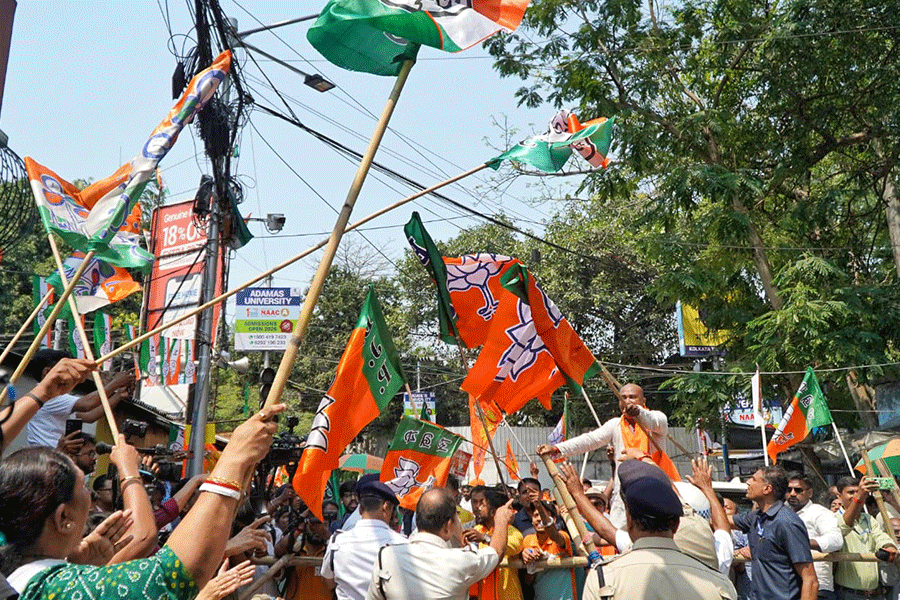
Likewise in the BJP, it was a clash with the central leadership over local issues that led to Kalyan Singh, Uma Bharti and Babulal Marandi going their own separate ways. Uma could not make a dent in the BJP’s support base in Madhya Pradesh but the departure of Kalyan and Marandi has devastated the party in UP and Jharkhand. A potentially damaging conflict involving Narendra Modi and a section of the Rashtriya Swayamsevak Sangh was narrowly averted after the Gujarat chief minister demonstrated his electoral clout in 2007.
The over-centralized structures of the national parties are based on a dubious intellectual premise. Since both the Congress and the BJP see themselves as ideological groupings rather than coalitions of diverse interest groups, it is assumed that all its adherents must necessarily share a uniform perception of what constitutes the shared national interest. This is precisely the same understanding on which the centralized Nehruvian State was constructed — with consequences that were often unhappy.
The early Marxist belief that politics is a straightforward expression of economics has been jettisoned in favour of the more nuanced formulation that politics enjoys a certain autonomy. Yet, there appears to be more than a casual link between the growing deregulation of the economy and the growth of regional impulses. The Communist Party of India (Marxist) in West Bengal, for example, has had to take innovative steps to confront the reality of economic decline. Many of the steps have been in direct conflict with what the CPI(M) as a national body professes. Similarly, Modi’s aggressive economic modernization of Gujarat has pitted him against a section of his ideological family that continues to cling to more austere visions of growth. Modi’s decision to put special emphasis on the English language, for example, is sharply at odds with the aggressive proponents of Indian languages in the BJP. Modi has been able to manage the contradictions because of the strong backing from L.K. Advani and other “modernizers” in the BJP. A less nimble regional leader may have been forced to consider other drastic options.
The lessons of decline and stagnation are staring the national parties in the face: the prescriptive politics of the High Command has to yield way to greater accommodation of diversity.
Indian political parties have based themselves loosely on either their British counterparts or, in the case of the communists, pursued an organizational model that was forced upon the Bolsheviks by Tsarist repression. The British party system, however, has endured because both Labour and Conservative parties have become more democratic and diverse. The strategic weight of the trade unions has been lessened in the Labour Party and the dominance of the “men in grey suits”, who decided the Tory future in the Carlton Club, is a thing of the past. The selection of candidates in both parties, for example, now follows a structured, democratic route.
Indian parties have been slow to adapt to contemporary realities. They have not taken into account either the added depth of democracy in the past four decades or the other shifts in the polity. Most important, they have assumed that politics follows a national trajectory.
The Centre is important, but there seems an unwillingness to recognize that power no longer flows downwards from New Delhi. The energies of post-socialist India lie in the localities. The architecture of politics must begin to reflect this shift. To remain relevant, national parties have to reinvent themselves as a sort of broad church that incorporates different, but not necessarily contradictory, impulses.