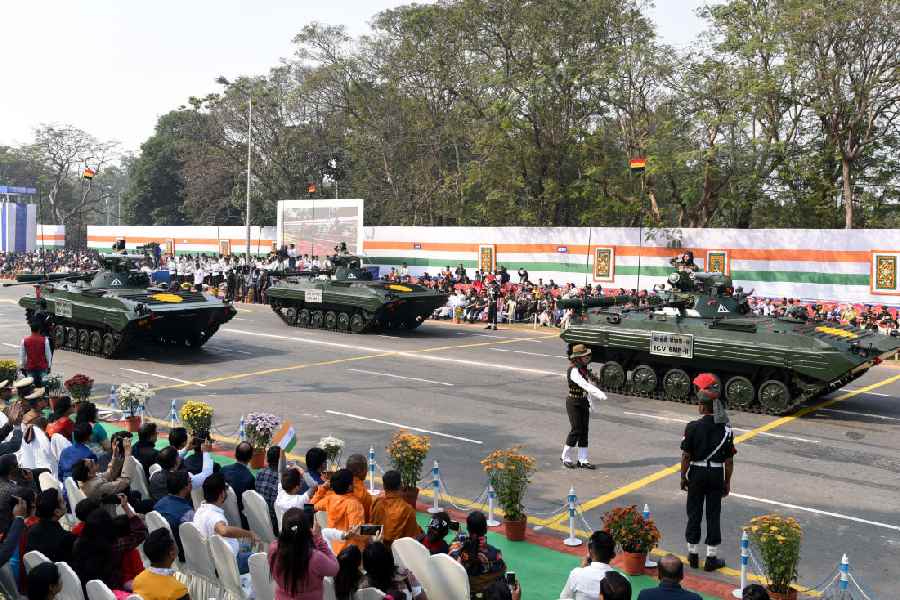
In less than a fortnight, India will celebrate its seventy-seventh Republic Day. The thick pall of official ceremony that hangs over the occasion, with its highly ornate displays of State power, can often blind us to the historical and the political substance of the
celebration. At its root, it is a commemoration of the foundational moment of our popular sovereignty when ‘We, the people’ gave to ourselves the Constitution that governs our polity. It was the constituent power of a unified people that created the State and all its institutions, not the other way round.
In Constitutional Theory (1928), the legal theorist, Carl Schmitt, analogised the creative power of the people to bring forth a political order through an act of collective will with the generative power of god to bring forth the natural order through an act of divine will. And, unlike god, the people are not supposed to disappear after the originary act but remain ‘above’ and ‘alongside’ the constituted order as a politically active force. Thus, Republic Day is meant to be the occasion when we gather together as a public to oversee the grandeur of our creation as well as to renew our collective resolve to sustain and defend it.
Yet, the mode of participation of the citizenry in Republic Day events today resembles less that of the masters of the Republic than that of its dependents. The descent of the public — from a demi-god creator to a collection of distracted children — is visible in the three roles expected of it. First, as spectators, watching the rituals of military parades and cultural tableaux on our personal devices. Second, as contestants, participating in government-mandated exercises: the task this year entails singing “Vande Mataram” and painting on the official theme of ‘Atmanirbhar Bharat’. And, finally, as consumers, scrolling relentlessly through digital platforms to snatch discounted mobiles or televisions in the week-long ‘Republic Day Sale’.
One might note that in the performance of all these roles, we act not as an organised public but as an atomised multitude. Alongside, we can gauge here the complete dominance of the constituted governing power (State institutions) over the constituent sovereign power of the people. Consider the manner in which the State uses the justification of security around Republic Day celebrations to subject ordinary people to intrusive forms of policing, often in contravention of constitutionally-guaranteed civil liberties. In Jammu and Kashmir, for example, security forces have launched “massive search and combing operations”, according to media reports, alongside an arbitrary ban on virtual private networks on mobile devices.
What explains the erosion of the public as a domain for the expression of popular sovereignty? This is the question we shall address in this essay.
As the question suggests, the public can be understood both as a political actor — a body of citizens exercising collective action in pursuit of a common good — as well as a space in which collective action is enacted. In other words, the former is the agent for the expression of popular sovereignty whereas the latter is the medium.
Our argument is that the constituent force of the public has become hollowed out in our republic owing to the de-politicisation of the public sphere and the ideological neutralisation of political parties. Both of these trends, to varying degrees, have been intensified by the neoliberal turn.
First, let us come to our public institutions: schools, hospitals, sanitation and transportation, among others. It would be fair to say that barring states like Kerala and Tamil Nadu, Indian public institutions would rank among the worst in the world. The culprit is a technocratic rationality, which has thoroughly depoliticised these spheres, a pattern which harks back to the Nehruvian era, making these sectors immune to the pressures of political contestation. The subsequent neoliberal turn has further eroded State capacity from these arenas of public management, carving them out to either the private sector or networks of NGOs. As the public sector is increasingly judged through the metrics of efficiency, governance has been detached from the democratic logic of the public good.
The liberal public sphere of the news media remains in hock to the interests of the State-corporate nexus. It has an unenviable record of decrying every progressive change in Indian politics: socialist parties in the 1960s and the 1970s, Mandal politics in the 1980s, and welfare politics post-1990s. The ‘anti-populism’ stance of the media has too often been a thin cover for an ‘anti-political’ stance, privileging private interests over public good.
Secondly, by the early 2000s, the ideological content of most political parties had become neutralised owing to the enormous opportunities for rent-seeking made possible by pro-market reforms and de-centralisation of administrative power. This influx of big-money coursing through the body politic changed the ‘rules of the game’ which structured political competition. Political parties across the board abandoned their previous function of making broad constituencies through popular mobilisations against existing institutional arrangements. Thus, politics turned into an enterprise of constructing a political majority by aggregating fractions of voters based on the basis of their caste, linguistic or religious identity. The electorate was viewed not as a collective to be mobilised with a shared vision of politics but as disparate fragments to be wooed separately on the basis of patronage or symbolic overtures. The logic of coalition politics — where governments at the Centre were made through political brokering and backroom dealing — further severed from political competition the notion of a coherent popular will.
It was on such a parched republican terrain that Hindu nationalism found fertile ground for its project of recasting India as a Hindu republic. The ruling Bharatiya Janata Party has made little attempt to provide a more substantial meaning to the public through popular mobilisation in pursuit of collective goods. The BJP and the Congress share the same penchant for the technocratic depoliticisation of public institutions. The BJP has simply excluded certain categories of public enemies (religious minorities, chiefly Muslims) from the political community. This concrete grounding of the public in the intensely political and homogenising container of Hindu identity has, indeed, lent some meaning and enchantment to politics, particularly for sections of the upper middle class. Yet the result is not the overcoming of the anomic consumerist society of the Congress era but its reconfiguration: that is to say an anomic consumer society now overseen by the BJP but with the mobilising and re-enchanting flavour of majoritarian violence.
‘We, the people’, in the meantime, are no closer to fulfilling the solemn resolves we had made in the Preamble:
Justice, social, economic and political;
Liberty of thought, expression, belief, faith and worship;
Equality of status and of opportunity.
Asim Ali is a political researcher and columnist