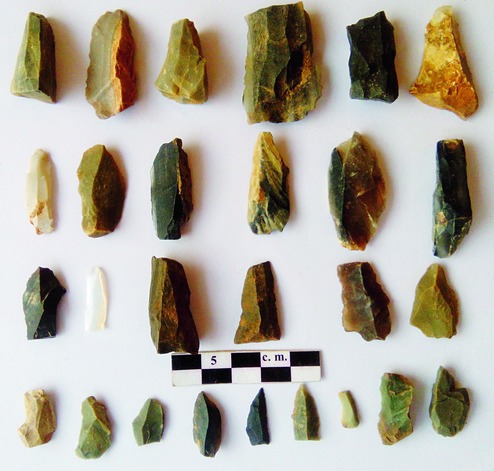


Balasore: Several old tools, sculptures and building remains found in the foothills of Devangiri hills in the district suggests human civilisation existed in the region 8,000 years ago.
Archaeologist and historian Atul Pradhan, who had earlier worked as an assistant director with the Archaeological Survey of India (ASI), came across these artefacts last week.
He had earlier found a sculpture of the Varahi, the feminine of Bhairav.
Pradhan, who is carrying out a survey and exploration in the Kuldhia area, said the tools and remains found in the patches suggest that human civilization existed there 8,000 years ago.
"Till now the tools and sculptures found during exploration suggest that the civilization in Balasore belong to the pre-historic era. Hundreds of such remains are found in the foothills of the Devangiri hill between Kuldhia and Kamarapala. During the survey, an eroded statute was found. It probably belongs to the 13th or 14th century, the period of Banga dynasty," said Pradhan.
Pradhan is an assistant professor and heads the department of history at Oupada College in Balasore.
"The scientific exploration also revealed large number of sculptures, fort and temple remains. The sculptures of Varahi, Mahisamardini and Shivling are scattered near Kuldhia sancutary. This patches require more research," said Pradhan .
District collector Ramesh Rout said: "The antiques found in the area would be picked up and stored at the museum in Ayodhya, Nilgiri. The ASI is being apprised about the items that have been found in the area."