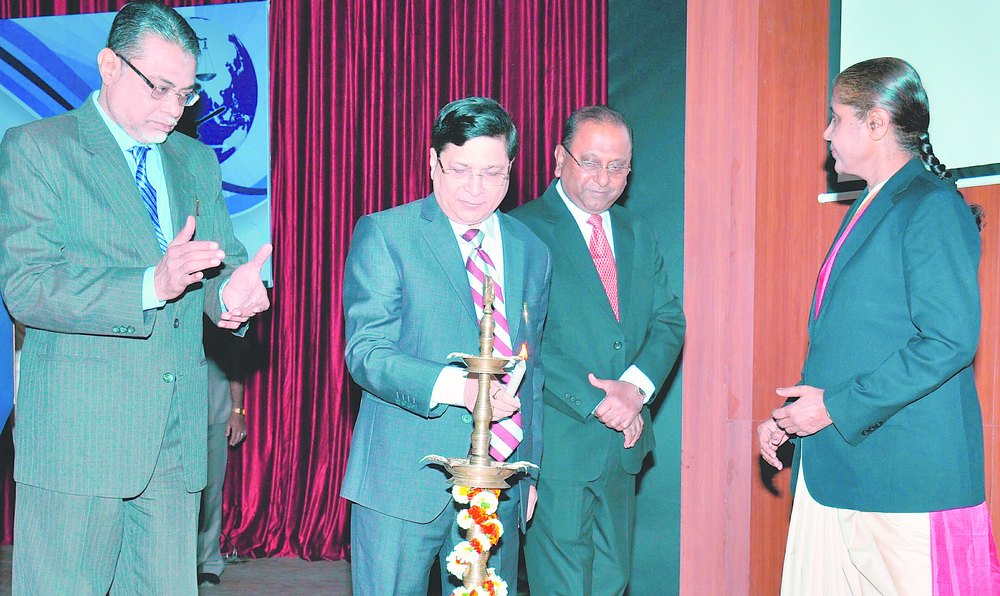

Cuttack, Feb. 7: Jurists today underscored the need for invocation of updated rules, practices and advanced technology, imbued with institutional commitment to take justice to the doorsteps.
Speaking at the inaugural session of a national seminar here, they said rules ensured orderliness in approach, practices certainty and technological applications held promises of functional betterment. The two-day seminar on "Enhancement of Judicial Capability" is being organised by the Odisha Judicial Academy.
Supreme Court judge Dipak Mishra said there was an urgent need for reducing the pendency in courts, but not at the cost of eliminating quality. "Poor people should be helped. But, judges need to be passionless, emotionless and sentimentless, tempered with mercy depending on facts of the case," Justice Mishra said.
Chief Justice of Orissa High Court Amitava Roy said a foray of technological advancements in institutional functioning was necessitated in view of the rising expectations of the society the judiciary was increasingly encountering.
Supreme Court judgeR. Banumathisaid: "An action plan is essential to enhance the judicial capability of the subordinate courts," Justice Bhanumathi said.
Supreme Court judge Justice Fakkir Mohammed Ibrahim Kalifulla said: "We are in a service-oriented institution (judiciary). Hence, by simply discharging duty you will not be able to deliver the goods as per satisfaction of the society," Justice Kalifulla said.
Management talk
The demand of labour and protecting their rights in various sectors, including agriculture, industries and the social service sectors, will pose a challenge for various companies. Several such issues were discussed at the inaugural session of the Management Development Programme on Contract Labour: Reality and Challenges, organised by the National Law University, Odisha here today.
Speaking on the inaugural session, retired IAS officer Ashok Mohapatra said contract labour had been a focus area neither for the state or the central government. Stagnation of industrialisation process in the past three years is to be blamed for rapid labour migration from the state. "The state function so far has been limited to registration and licensing while there has been no supervision by the state machinery and district labour officials in the country," he said.