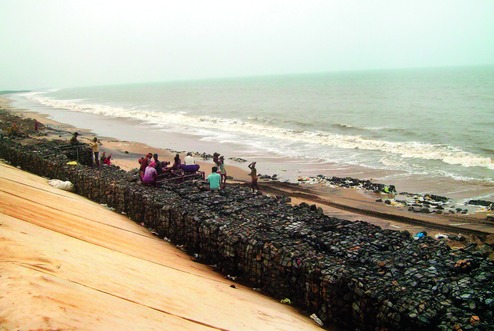

File picture of a sea wall being built at Pentha in 2014
Bhubaneswar, Sept. 17: The marauding sea continues to pose a threat to people in several areas of the state though officials claim that the geo-tube wall experiment to check coastal erosion has been a success at Kendrapara's Pentha village, which is the worst-hit area.
A 505-metre geo-tube structure had been installed at Pentha village in July last year much to the relief of local residents who had been living under the constant fear of being swept away by the ever-advancing sea.
'Now, the villagers feel confident enough to build brick houses,' said an official associated with the project, the first of its kind in the state.
However, experts such as former environment director Bhagirathi Behera not only cast doubts on the claims about the success of the project, they are not even convinced that the experiment could be replicated in other areas where the sea has been eating into the land.
'I don't think the project at Pentha went the way we wanted it to. I am not sure if it can be replicated elsewhere,' he said, while admitting that erosion caused by the high intensity sea waves was a problem that needed to be tackled on a war footing.
A government official associated with the Rs 32.95 crore Pentha project agreed that the geo-tubes were expensive and it might be difficult to erect similar protective walls along the sea at other erosion-hit sites.
'It is not cost-effective which could be a major consideration while executing similar projects elsewhere,' said the official who did not want to be named.
Erosion is rampant on the state's 480-km coastline with Ganjam, Puri and Balasore districts considered the most vulnerable after Kendrapara.
K. Alaya, a fisherman from Ganjam's Sanaarjapalli village, said if the sea continued to make further inroads into the land where he lived, people would be forced to move away.
The threat from the sea was perhaps the worst in 2007 when cases of erosion were reported from coastal stretches in Puri, Gopalpur and Pentha.
Increasing roughness of the sea was attributed to a number of factors including enhanced wave energy caused by tectonic movements.
'The underlying factors remain more or less the same today but we need better engineering and technology to arrest the damage,' said Behera.