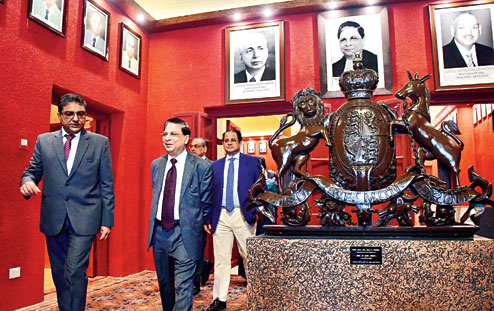

Cuttack: Chief Justice of India (CJI) Dipak Misra inaugurated a judicial museum of Orissa High Court here to showcase the rich judicial history of the city spanning more than a century.
The Circuit Court of Patna High Court, which had its first sitting in Cuttack on May 18, 1916, was the precursor of Orissa High Court.
On April 30, 1948 the Government of India had declared a Court of the Province for Orissa to be functional from July 5, 1948. But subsequently, the date was changed by an Orissa High Court (Amendment) Order and H.J. Karania, the then Chief Justice of the Federal Court of India inaugurated Orissa High Court on July 26, 1948.
Inaugurating the museum, the CJI said: "There is excellent space and building to enrich the museum."
The museum has come up at the building on the Barabati Fort premises which was the residence of the chief justice of Orissa High Court from 1948 to August 2012.
The museum exhibits include a high-back ornate wooden chair and a revolving wooden bookshelf used in Cuttack judgeship in the pre-Independence era, calculators, locks and table lamps made in London and antique wall clocks used by the court about seven decades ago. It also showcases a British-era manual typewriter, wooden chest, wooden seals, brass badges, brass weighing grams, court seals, silver badges and table calling bells used by various judgeships in Ganjam, Bhadrak, Balangir, Dhen-kanal, Rayagada and Aska.
Brainchild of Chief Justice of India Dipak Mishra, who suggested it more than a year ago, the museum took shape under chief justice of Orissa High Court Vineet Saran after months of concerted effort.
The highlights include law books and journals used by legendary lawyer Madhusudan Das, popularly called Madhu babu, whose birth anniversary is observed as lawyers' day in the state. The exhibits also include rare original copies of important pre-Independence era judgments including the capital punishment awarded to freedom fighter Laxman Nayak by Additional Sessions Judge, Koraput, on November 13, 1942 and the confirmation given to it by High Court of Judicature, Patna, on January 13, 1943.
Chief Justice Vineet Saran said: "The museum preserves the history of Orissa High Court and the history of judiciary in the state."
Chairman of Orissa High Court Museum Committee Justice Biswajit Mohanty said: "The museum is in a formative stage and process of collection of rare exhibits is on. The latest find has been the "will" of Madhusudan Das. It will soon be exhibited in the museum."
The British had constructed the building after taking over the Barabati Fort by defeating the Marathas and made it the residence of the commissioner of Odisha division of Bengal presidency.