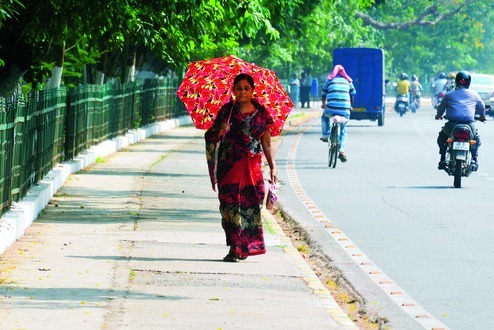

A woman uses an umbrella to escape the scorching heat in Bhubaneswar. Picture by Ashwinee Pati
Bhubaneswar, Sept. 16: The Indian Institute of Technology (IIT), Bhubaneswar, has come up with a proposal to assess change in the climate pattern of the city and suggest remedies for it.
The IIT-Bhubaneswar has forwarded a proposal to the state government requesting the authorities to allow the institute to adopt Bhubaneswar as an experimental pilot city under National Network Projects on Climate Change, an initiative of the Centre's department of science and technology.
The proposal states that the scientific outcome under this project would help in making Bhubaneswar a climate-resilient city and simultaneously the model could be replicated in other cities of the country. The institute will also organise a two-day national workshop on the subject in the city on September 21 and 22.
'Increase in temperature will lead to heat waves, thunderstorms and heavy rainfall,' said director of IIT-Bhubaneswar R.V. Raja Kumar.
Kumar said understanding the science behind the urban climate and adopting strategies for developing a climate-resilient city was the need of the hour. 'Bhubaneswar is not exempted from the climate change phenomena. The study will help the city as well as the country,' Kumar said.
According to the proposal, an expert team will be formed and stationed on the IIT campus. The team will examine the state of science of urban climate, related impact and come up with mitigation strategies. They will provide an end-to-end solution to the policy makers for its adaptation in the city.
Bhubaneswar is witnessing climate changes in form of increase in the maximum temperature during summer. The weather department had noted that the average temperature in Bhubaneswar last summer was 3°C higher than average since 1960.
'Rapid urbanisation and rampant cutting of trees are the major reasons behind the change in climate in the city. Over the past few years, the city has lost its green cover in the name of urbanisation. The authorities are cutting the trees but not planting more. The problem of global warming is on the doorstep and we should do our bit to prevent the phenomena,' said environmentalist Sailabala Padhi.
An official of the housing and urban development department said they had received the proposal of the institute and would allow them to carry out the study. 'We have taken up a few commercial buildings for its implementation. We will be happy if the institute helps us in our initiatives to control the phenomena of climate change,' the official said.