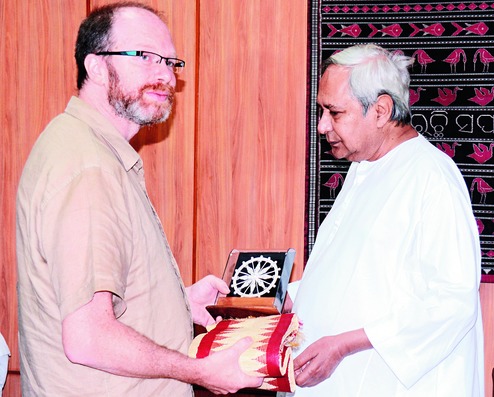

Bhubaneswar, April 22: The Kalinga Foundation Trust (KFT) today felicitated Argentine scientist Diego Andrés Golombek for winning the Unesco-Kalinga Prize - 2015 for his contributions to popularise science.
The Argentine, a professor at the University of Quilmes in Buenos Aires, received the award and the prize money from Unesco director-general Irina Bokova in a ceremony at the World Science Forum in Budapest, Hungary, on November 4.
Chief minister Naveen Patnaik had felicitated Diego Andres Golombek at the secretariat yesterday for his win. Naveen was scheduled to felicitate Golombek at the Institute of Physics today, but he had to leave for Delhi to attend a meeting of the Niti Aayog.
In his absence, science and technology minister Pradeep Panigrahi felicitated the noted scientist.
Golombek said: "I am honoured to be here in Odisha. The Unesco-Kalinga Prize has placed Odisha on the global science map. I have a great interest in the culture of Odisha as well as India."
Speaking on the sidelines of the event, Panigrahi said: "We are honoured to felicitate a scientist of the calibre of Golombek."
He also recalled how Biju Patnaik had wanted to popularise science in the state and said "the Odisha government is moving in that direction".
Golombek was instrumental in the development of the first science cultural centre in Argentina at the Ricardo Roja Centre in Buenos Aires, that country's capital.
Golombek is a teacher, researcher and an author who holds a PhD in biology and also a degree in music.
He is an expert in neurochemistry of circadian rhythms in mammals, specifically the time-dependent effects of the pineal hormone melatonin on different behaviours, and heads the chronobiology laboratory at the University of Quilmes. He has published over 120 international peer-reviewed scientific journals, as well as many chapters in books, and has also been invited professor in several universities throughout the world.
An independent jury had selected Golombek for the prize in recognition of his tireless contributions to science communications and education in diverse and entertaining formats, notably for his role in the development of Argentina's first science cultural centre, where the sciences meet the arts.
Former chief minister Biju Patnaik instituted the Unesco-Kalinga Prize for popularisation of science among the people in 1951.
The prize money given with the award initially was US $20,000, but has been increased to US $40,000 from this year.
The central and state governments and the Kalinga Foundation Trust jointly contribute to the prize money in a 6:4:4 ratio. The state government has contributed Rs 86 lakh towards the award as a one-time grant.