|
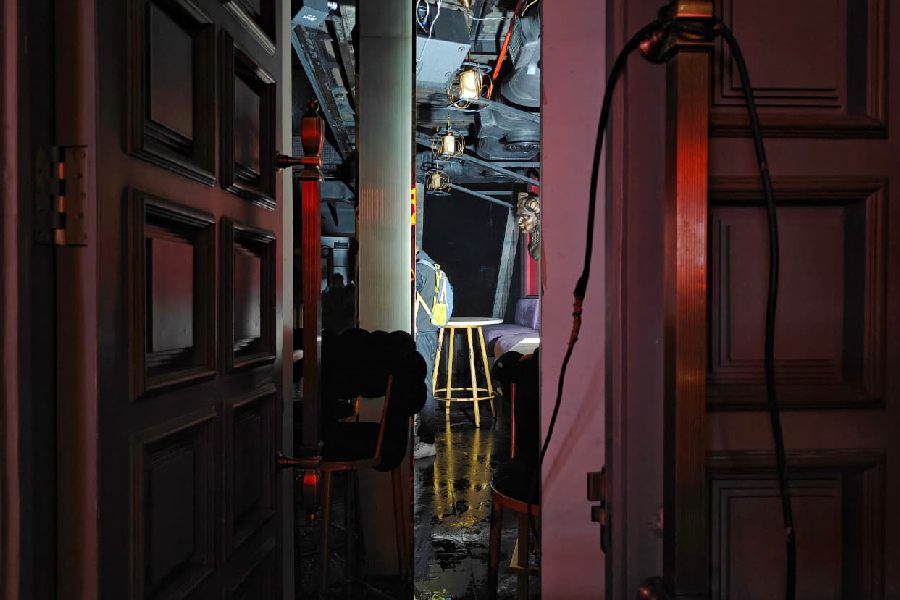
| Renovation in progress at the 300-year-old Baldevjew temple in Kendrapara. Telegraph pictures |
Kendrapara, Sept. 17: Too few funds and too much to restore. That’s the fate of the 300-year-old Baldevjew temple here.
Though conservation of the temple is under way, the Rs 30-lakh grant, released for the purpose, has proved inadequate.
“The project to restore the endangered portions of the temple is on in full swing. However, the grants may not be enough for full-fledged restoration. More funds are required to give the temple a thorough facelift,” said Chitta Ranjan Rath, a senior consultant with the State Archaeology, which took up repairs of the temple earlier this year.
The temple dates back to the reign of the Marathas. Stone blocks from parts of the temple have fallen off on a couple of occasions, raising safety concerns.
“The project to refurbish the temple with help of the central grants for ancient heritage conservation has begun. The State Archaeology is the project co-ordinator. We are emphasising on conserving the temple in such a way that its original character remains intact,” said curator of the State Archaeology Ashwini Kumar Satpathy.
The dadhi nauti (summit structure) has been rebuilt. Vital structures such as Jagamohan, natya mandap and bata deula are being given a facelift. The exterior walls of the temple have been de-plastered. Later, they will be chemically treated.
During de-plastering, it was found that some of the stones had been corroded. These were replaced with new ones. The original stones used to build the temple building were kandolite, laterite and bricks, said Rath.
The de-plastering of the garva griha or sanctum sanctorum was successfully carried out during rath yatra, when the trio of deities were at Mausi Maa temple. Some structures, such as the jhulan mandap, are still in a bad shape.
The load-bearing capacity of the stone structure has decreased. Besides, the dilapidated boundary wall of the Mausi Maa temple needs to be rebuilt.
Conservation of the heritage temple is being taken up in accordance with recommendations and suggestions of the committee consisting of archaeological experts.
The temple was built in 1707 during the Maratha subedar rule in these parts. The Maratha style of temple building was simple, without intricate stone carvings.
“The State Archaeology is carrying out conservation of the temple and we are hopeful that the shrine will regain its former glory,” said Kendrapara collector Niranjan Nayak.