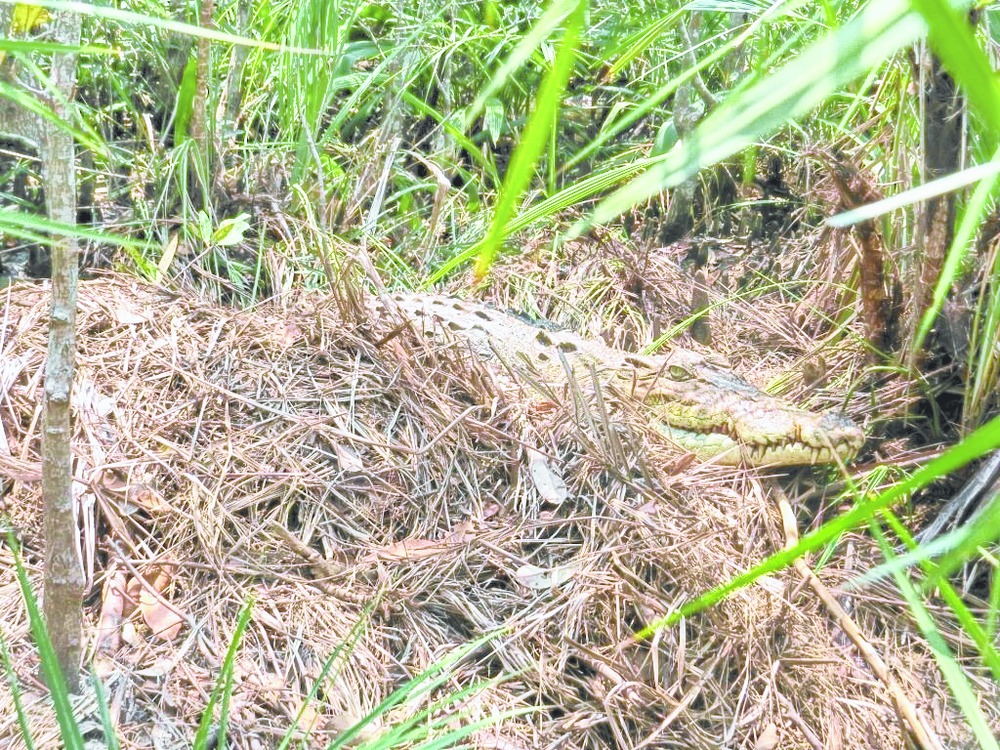

Paradip, June 10: Wildlife personnel in Bhitarkanika National Park have spotted 68 nesting sites of estuarine crocodiles even as the annual breeding ritual of these reptiles has reached its peak stage.
While 66 nesting sites were spotted within the core area of the Bhitarkanika national park, two sites were found along the Mahanadi deltaic region under Mahakalpada forest range outside the park territory. Last year, 66 nesting sites of estuarine crocodiles were spotted.
More nesting sights could be spotted in coming days, said a forest official. Wildlife enumerators of the forest department had spotted the nest.
Female crocodiles lay 50 to 60 eggs and the hatchlings usually emerge from the nests after 70 to 80 days of incubation period.
Forest department officials said that the wildlife staff members were taking care so that snakes, jackals and dogs did not devour the eggs.
Adequate measures have led to a systematic rise in the number of these reptiles over the years, said another official.
The number of saltwater crocodiles, which are not found in any other river system in Odisha, in Bhitarkanika wildlife sanctuary stood at 1,644.
The wildlife sanctuary has remained out of bounds for tourists and visitors to ensure peaceful nesting to crocodiles. Besides, the animals turn violent due to human interference in their habitats. The enforced restriction on entry to sanctuary was clamped on May 31 and it would be lifted on July 31, said an official.
"The increase in population of these species is happening at a snail's pace. Its growth is getting stabilised and is also getting stagnated," said divisional forest officer, Rajnagar mangrove (wildlife) forest division, Bimal Prasanna Acharya. Nowhere in the country these species are spotted in such abundance, he claimed.
Wildlife researchers studying on saltwater crocodiles are of the view that habitat of these species is getting squeezed in about 26sqkm of water bodies within the national park.
These reptiles prefer the ideal water bodies because of its salinity content.
The salinity level in some of the water bodies might be dropping proving to be less ideal for the reptiles. It should be intensely studied to ascertain whether desalinised water has anything to do with re-productivity of these sensitive species, according to wildlife researchers.