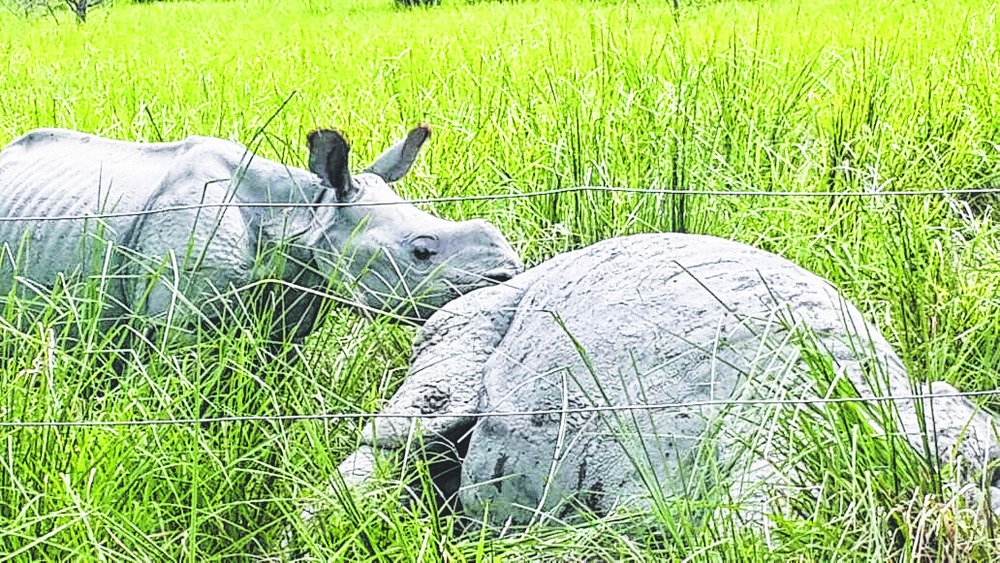

Guwahati, May 23: The first rhino translocation to Burachapori wildlife sanctuary in Sonitpur district of Assam received a big blow with the death of a 35-year-old rhino last night.
Two female rhinos, a mother and its calf, were translocated from Kaziranga National Park on March 29. The mother passed away last night and sources said its horn was intact. While the cause of the death is yet to be ascertained, those associated with wildlife conservation said the new BJP-led government should look into all such deaths, whether natural or unnatural, and take appropriate steps to preserve wildlife, especially rhinos.
"The development brings to the fore wildlife conservation challenges before the government as the BJP and the AGP had made rhino protection an election plank in both the 2014 Lok Sabha and 2016 Assembly elections. The onus is now on the government to protect wildlife in the state," a wildlife conservationist said.
K.K. Sharma of the College of Veterinary Sciences, Khanapara, who conducted the post-mortem, said, "It is difficult to tell now what could be the reasons for the rhino's death."
He said samples were being tested at the College of Veterinary Sciences to find out the actual cause. "A number of rhinos have been translocated but we have not faced a problem like this one," he said.
For Sharma, the death of the rhino has been tragic as he had captured the rhinos during translocation. The two rhinos were captured from the Bagori range of Kaziranga National Park.
The life span of a one-horned rhino is between 40 and 50 years.
A senior WWF official said it would work with the Assam forest department to find out the actual reason of death. "This will help us take necessary precautions for all rhinos," he said.
Tezpur sadar circle officer Tahidur Rahman (magistrate) visited the spot this morning.
Ten rhinos - eight in Kaziranga, one in Manas and one in Burachapori (yesterday) - have already died in Assam this year.
There are nearly 2,500 rhinos in the state.
Forest officer Narayan Mahanta told The Telegraph that conservation initiatives could be successful if there was a concerted effort from all quarters to join hands.
The translocation programme is being done under the aegis of the Indian Rhino Vision, 2020, which is a joint programme of the state forest department, WWF and the International Rhino Foundation.
The programme aims to attain a population of 3,000 wild rhinos in Assam, spread over seven of its protected areas by 2020. Laokhowa wildlife sanctuary is spread over 70.01 square km in Nagaon district and Burachapori wildlife sanctuary over 44.06 square km in Sonitpur district.
The Laokhowa-Burachapori area plays a critical role as a corridor for rhinos between Kaziranga and Rajiv Gandhi Orang national parks.
The conservation breeding specialist group of the International Union for Conservation of Nature, in its population viability analysis report, stated that there should not be any problem in translocating 10 rhinos from Kaziranga as it will maintain a positive population growth rate as long as no more than 30 to 40 animals are removed each year.
ADDITIONAL REPORTING BY PRANAB KUMAR DAS