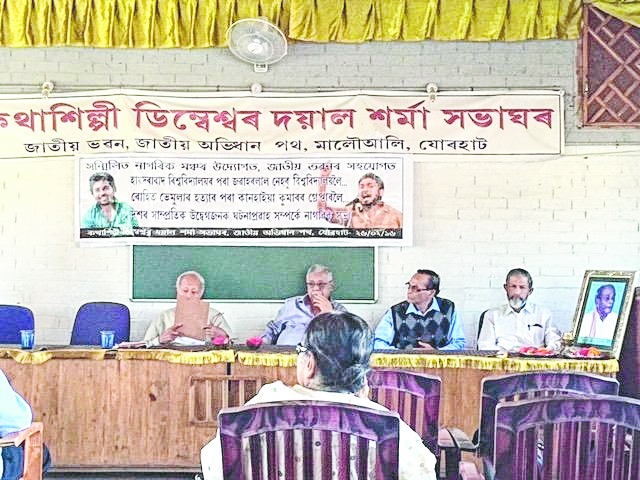

Jorhat, Feb. 26: From an impartial analysis of the environment prevailing in Jawaharlal Nehru University (JNU), New Delhi, to comparing Kanhaiya with Krishna - born in jail but grew up to destroy the likes of Kansa - the citizens' meet held at the Jatiya Abhidan Bhawan here today unanimously condemned the violation of fundamental and human rights.
The meet, called by the Sanmilita Nagarik Mancha, demanded the release of Jawaharlal Nehru Students' Union president Kanhaiya Kumar, an inquiry into the death of Rohith Vemula of Hyderabad University and the suppression by the ruling power of dissent, protest, free thinking and freedom of speech - a fundamental right enshrined in the Constitution.
Former alumnus of JNU and former professor of the political science department, Dibrugarh University, Adil ul Yasin, said in the early seventies, the atmosphere that prevailed was one of free thinking and discussion.
"There were two students' unions, the SFI and Freethinkers. Both Prakash Karat and Sitaram Yechury were present. No one tried to suppress the other's opinions. When vice-chancellor G. Parthasarathi was gheraoed and the home ministry had asked whether police was required, he had denied permission for police to enter the university campus," he said.
Yasin said prior to the 12th century, in the Muslim world, there was a word istihaad, which meant independent thinking. "But this was suppressed by the mullahs and maulvis after the 12th century. It is now seen that places like Pakistan, Afghanistan and others are backward and have been destroyed and they are backward because of this. Where there is no istihaad there can be no development. God forbid that India becomes a place like this," he said.
Devabrata Sharma compared Kanhaiya to the divine Kanhaiya and said the walls of the jail could not hold Kanhaiya and he would come out and destroy his detractors.
Sharma said the atmosphere which prevails in India is akin to the atmosphere that prevailed during the time of Hitler.
Jatyanta Madhav Dutta, a teacher, quoted from a few reports which had been published in The Telegraph and after introducing the topic questioned what kind of democratic values still existed in our country.
Madhurjya Handique, a scholar who would soon enrol in JNU, appealed to the RSS to read other philosophies and make the Hindutva they subscribe# more acceptable to the people of the country.
Jiten Tanti, a student of JB College, said in Dibrugarh University and JB College, the authorities had denied permission to students to hold protests, debates and discussions on the topic of Kanhaiya and Rohith apprehending that they might go out of hand. "This is another form of suppression," he said.
Swantana Sharma, headmistress of Garmur Jatiya Vidyalaya, said she was brought up in a Brahmin family, married into one, both of which subscribed to free mixing and thinking and not to traditional belief that Brahmins were one cut above the others.
"In Jorhat, the Brahmins who had set up Sanskrit tols were broadminded and no one held narrow casteist beliefs. It is from Jorhat that other districts should learn what free and fair environment means," she said.
Earlier, people observed the 5th death anniversary of Kathashilpi Dimbeswar Dayal Sharma and 10 people pledged to donate their bodies to Jorhat Medical College and Hospital to aid cadaver study and research.