 |
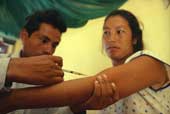
| A drug-user helping another addict |
Drug abuse in Nagaland first began with opium and marijuana, which was followed by heroin and brown sugar. Thereafter, there was a kind of lull and drug abusers, mostly youths, turned to over-the-counter (OTC) drugs like Phensedyl and Spasmoproxyvon. But now, turning full circle, hard drugs are making a comeback in Nagaland — much to the chagrin of both the citizens and government agencies.
What is more disturbing is that despite concerted efforts to curb the menace, drug abuse is increasing with new users joining the bandwagon and old ones returning to brown sugar and heroin.
The so-called “menace” is actually a “grave danger”. It is believed that with the return of the “bad sugar”, there has also been an increase in the number of abusers.
Says P. Ngullie, “The use of hard drugs like heroin had come down but many are going back to it and that is cause for great concern.”
Even the police admit that there has been a shift back to brown sugar and heroin.
“There is a lot of truth in it. We have thus increased our strength in the narcotics wing and also the number of checkposts where there is chance of smuggling,” says state director-general of police Hesso Mao. He added that during routine checking, thousands of tablets like Relepen and Spasmoproxyvon were also being seized “with regularity” and many persons were also being arrested.
Drugs and HIV
According to official estimates, there are at present more than 50,000 drug abusers in the state, including 34,000 injectors.
In the past 15 years, the drug haul in the state includes seven tonnes of heroin, 2.6 tonnes of opium and about 15 tonnes of ganja apart from regular seizures of banned OTC drugs.
Ruing the new trend, Kumuni, project director of the Nagaland AIDS Control Society (NACS), says, “Yes, hard drugs are back with a vengeance. Moreover, what is more worrying is that drug abuse and spread of HIV is intertwined. AIDS cases are increasing in the region, with Manipur taking the top slot in AIDS spread.” More than 45 per cent of drug users in Manipur are believed to be infected with AIDS.
The scene is no doubt better in Nagaland with the figure dropping from 39 per cent in 1994 to just about 6.9 per cent today. But no hasty conclusions can be reached as regards “decrease in drug abuse” in Nagaland since the other side of the coin is that HIV occurrence has increased from 1.5 per cent in 1994 to over seven per cent today.
Drug-users — mostly between 12 and 20 years of age — also happen to be the most sexually active age group. Since the use of drugs and spread of AIDS are inextricably linked, the risk doubles.
The blame for the rise in drug-use and the return to hard drugs has been put on both decrease in prices of drugs and on the law-enforcing agencies.
Says an NGO worker, “The price of heroin in the new millennium has come down to Rs 900 per gram while brown sugar prices are hovering around Rs 300 per gram. This drop in prices is largely responsible for the return of many to IV and “chasing”.
The state’s drug addicts had started off with both brown and white sugar in the Eighties which continued into the Nineties. In the Nineties, there was a crackdown on drug smugglers and peddlers. As a result, prices shot up and users switched to OTCs like Relepen and Spasmoproxyvon.
Uncontrolled routes
Sources also allege that the drug-smuggling routes — from Khamti in Myanmar to Noklak and Mokokchung in Nagaland, from Mandalay via Tamu to Moreh in Manipur and into the mainland and from Homalin in Myanmar to the Nagaland capital of Kohima — are not being adequately controlled by paramilitary forces along the Indo-Myanmar border.
The state governments are also not doing enough, allege NGO workers. For instance, Lahorijan on the Assam-Nagaland border is a free-for-all for any drug abuser as even little children and women sell the “stuff”, say sources. The Assam government has been turning a blind eye to the problem “for obvious reasons”, said an NGO worker, requesting anonymity.
Moreover, as Atou Mere, project coordinator of Kripa Foundation, an NGO working in the sphere of drug abuse, opines, “A transition in Naga lifestyle — from the kitchen to the common room — has been causing lots of family problems which in turn is also making many youths take to drugs”. Mere, a former drug addict, is trying to reform 15 persons, but expresses concern over the number of new users. “Treatment can be more effective if we can stop drug peddling,” he adds.
An offshoot of drug abuse in the state is the problem of extortion. Present drug addicts as well as those reformed of the habit admit that most of them resort to extortion to satisfy their daily needs of the drug. In fact, sources claim, more than half of those who collect money in the name of “taxation” by hitherto underground outfits, are drug addicts.
The underground outfits, however, say that they are dead against drugs and have “from time to time even punished peddlers and users”.
“We also got some of the addicts to our camps but it is risky without doctors,” says a senior functionary of the NSCN-IM, adding that since the organisation was short of funds no concerted programmes could be taken up for awareness drives against drugs.
Awareness programmes
According to state health minister Thenucho, there are several programmes — most of them on awareness against the menace of drugs — in the offing.
There are several non-government organisations carrying out activities for drug de-addiction, awareness against drugs as well as controlling drug peddling at the village level. Whereas many are sincere, there are others working only to get grants from the several donors in Western countries who are concentrating on the Northeast.
As regards the AIDS programme in the state, there have been complementary efforts. The Nagaland AIDS Control Society (NACS) is the nodal organisation with more and more NGOs like Kripa Foundation and Bethesda Youth Centre working towards the same goal. On April 3, the Naga People’s Movement for Human Rights (NPMHR) organised a meeting of the different NGOs of the state in Kohima. “When we were told by the UNAID to carry out a programme here, we thought it would be a good thing to have more people participating to fight AIDS,” says Neingulo Krome of the NPMHR.
Though substantial data has been collected on the twin issues of drug abuse and AIDS, a scientific study by any organisation is yet to be conducted.A base-line study remains to be done despite a direct link with the Central AIDS control programme.