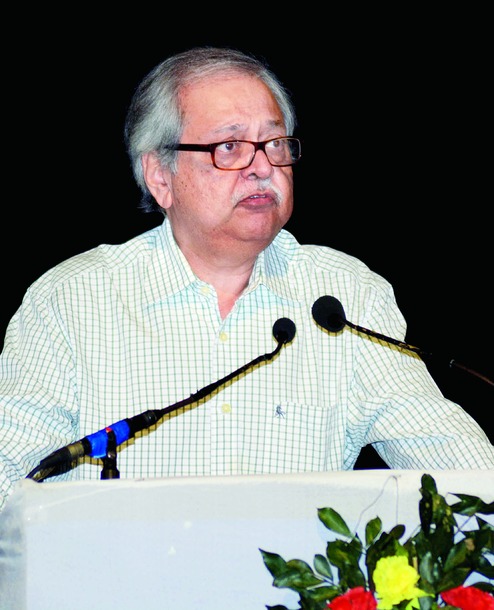

Guwahati: Chancellor of Ashoka University and eminent historian Rudrangshu Mukherjee feels India is facing a situation where some of the fundamental features of democracy are under serious threat.
Delivering a talk on Challenges To Rule of Law and Constitutional Democracy in India, organised by the Asom Nagarik Samaj, here on Sunday, he said the threat emanates from the ideological orientation of the Prime Minister Narendra Modi and the ruling party.
"There are two aspects of this ideology. One is the assertion that India is a country of the Hindus and the future of India lies in making her a Hindu nation where religious groups will have to live on terms determined and dictated by the Hindus," he said.
"The second aspect follows from the first, Indian civilization equals Hindu civilization and that is the true colour of India's ideology. From this follows a particular reading of India's past and this allows for no difference or dissent," Mukherjee added.
The historian was of the view that the assertion of Hindutva has come to acquire a hyper nationalist dimension and the BJP and the RSS decide on what is anti-national.
"Thus any criticism of the present government and its actions are labelled as being anti-national. The Prime Minister and his government are held up as the only people who can project what is truly Indian," he said.
On increased lynching incidents, Mukherjee said perceived threats to the Hindu India are made targets of violence and the targets are always ordinary Muslims.
"And because perpetrators of this kind of violence are always supporters of the ruling political dispensation, police become bystanders and no action is taken against the inciters and the executors of violence," he said.
"A political party, and its various wings that enjoy a popular mandate are assuming that they have the right to impose their views on people who disagree with them. The violent suppression of dissent and the imposition of the Hindutva ideology are essential part of his (the Prime Minister's) core ideology," he added.
Mukherjee pointed that even under the previous government that professed to be tolerant and secular, writer Arundhati Roy and political activist Vinayak Sen were charged with sedition.
"In Bengal, the chief minister, who sees herself as a strong and loud opponent of Modi and his policies, got an academician arrested for circulating a cartoon that lampooned her," he said.
Another speaker, Nilayananda Dutta, a senior advocate, was of the view that selective outrage (over incidents of violence) can't establish the rule of law.
"Killing of RSS workers in Kerala should also be condemned like lynching of any person for eating beef," Dutta said.