India’s pledge to import $500 billion worth of US goods in five years would be difficult to execute and could strain the country’s current account deficit, putting renewed pressure on the rupee, trade economists said.
India’s annual imports from the US hover around $40-45 billion a year in contrast to exports of $85 billion, handing it a rare trade surplus which allows the emerging South Asian economy to soften the deficit it runs up with other major trading partners, notably China.
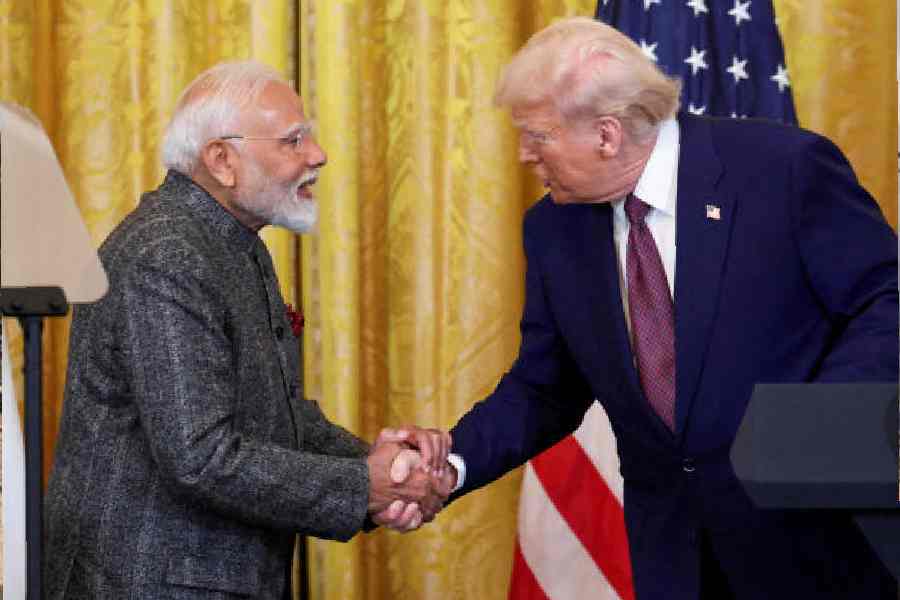
The joint statement issued by both countries on February 6 specified the five-year timeframe for the import commitment, translating to $100 billion worth of import on an average, doubling from the prevalent rate, even as the factsheet posted by the White House on Monday omitted the timeline.
“This (import pledge) is surely going to impact India’s trade balance and hence, overall balance of payments,” Biswajit Dhar, trade economist and a former professor in Jawaharlal Nehru University, said.
For April-November 2025, the merchandise trade deficit reached $248.32 billion, higher than $223.96 billion in the same period of FY25.
Difficult target
According to Ajay Srivastava, founder of think tank Global Trade Research Institute (GTRI), a commitment of $100 billion a year is “more aspirational than operational”.
The fundamental constraint to meet the target is structural, he said, pointing out that most of such imports that found mention in the joint statement and factsheet such as aircraft, energy, data-centre equipment and industrial machinery are made by private firms, not the government.
“These firms cannot be compelled to source from a particular country if the US products are more expensive, commercially unviable or technically unsuitable,” Srivastava observed.
Dhar concurred. “Putting all your eggs into Boeing’s basket will be risky,” he said. IndiGo, India’s dominant airline by miles, predominantly operates an Airbus fleet and aircraft procurement is usually driven by delivery schedules, fleet compatibility and financing terms.
Trade experts, on condition of anonymity, said that the US is well aware that it is not competitive and it tried to force a commitment on India, which surprisingly also accepted it.
Sluggish exports
Dhar argued that India’s exports have been sluggish, save for mobile phone production, which has given a fillip to the overall numbers.
“There are a whole lot of reasons — from competitiveness to non-tariff measures in other countries,” he argued, adding that the possibility of India growing its exports to bridge the gap would be difficult.
Srivastava agreed, pointing out that tariff to the US for Indian merchandise goods is eventually going up from 3 per cent (most favoured nation tariffs) to 18 per cent after the trade deal.
Following the imposition of Trump-era tariffs, exports fell by roughly 21 per cent between May and December 2025, reflecting the sharp loss of price competitiveness.
Under the new arrangement, Indian exports will still face tariffs of about 21 per cent — comprising 18 per cent reciprocal tariffs plus around 3 per cent MFN duties.
“At these levels, a strong export surge is unlikely. At best, if implementation is smooth and market conditions are supportive, India may be able to recover and sustain last year’s export level of around $85 billion over the next 12 months after the agreement takes effect,” Srivastava said.
Moreover, preferential tariff treatment granted to competitors such as Bangladesh, particularly in garments, may erode India’s competitiveness in labour-intensive sectors.
Oil not well
Dumping Russia in favour of the US will cost India, warned experts, given that cheaper oil had helped soften inflation.
“Procurement from the western hemisphere will be fraught with risk and higher logistic costs,” Dhar said.
According to Srivastava, the US does not have enough surplus petroleum products.
“The US continues to import substantial volumes of oil even as it exports refined products, reflecting a mismatch between the light shale oil it produces and the heavier grades required by many refineries worldwide,” he observed.
Meaningfully calibrating imports in favour of the US is constrained both by market realities and supply limits.
Impact on the rupee
Experts caution that the rebound of the rupee from ₹92 on the back of the US trade deal could be temporary.
“This $100 billion will directly put pressure on the rupee. If the trade deficit goes up, it puts pressure on the current account deficit, which in turn leads to currency depreciation, making imports costlier. It’s a vicious cycle,” Dhar said.