 |
Travel was the leitmotif of my last write-up. This one, too, follows the same trail. The seven days I spent in Bangalore in April 2005, were hardly nostalgic. I didn’t quite miss the place where I had once spent six months at a stretch, followed by occasional visits during subsequent years. Long ago, the streets had a different look. The flowers were much more romantic, the people hardly, if ever, hurrying around and the parks were the next best thing you had to the home you had made for yourself on Assaye Road.
Fragmentary memories: of daylong walks through the city, experiencing forbidden hemp in concealed cigarettes on Commercial Street, entering clean halls on MG Road for the latest Al Pacino film, coping with a broken heart set adrift in a senseless world of seeming convention and conformity. Last, but not the least, of wondering just how you could manage the month with Rs 250.
However, this time we had sufficient cash at hand to hire a Maruti against a substantial discount offered by a rental agency whose proprietor I had known from years ago. The five of us — my wife, son, niece and I with Nagaraj behind the wheel — left for Goa as soon as the sun was up. Nagaraj was coal black in colour. That was the first thing I remember about him: his pigmentation. And then the wide blazing pupils together with the scraggly brownish mop of hair. The bottom end of his shirt hung loosely over his belt and he never seemed to be still for more than a couple of seconds. The chappals were frayed but not dirty. He was thin but not sickly and he kept on addressing me with that suffix-epithet “Sir” that always manages to distance people in a feudalistic sort of way.
When he first came in to the guesthouse, I didn’t take to him. I was even suspicious. Was he reliable? Was he part of a gang of operators who waylaid helpless passengers in some remote part of the highway? He had almost all the ingredients that you attach to a villain in a B-grade Hindi movie. He was quick, alert, his shiny coal-black complexion a possible sign of a darker heart.
I was tired in body as well as in mind. And as we set off along the highway, I would doze off now and again. The landscape was smooth, often undulating but without any sharpness etched out against the skyline. I remember gawking at the windmills atop the small hills, giant arms lazily spinning against an invisible wind. And in the seat behind, my niece and my son chatted on every conceivable subject under the sun. It was not very hot inside the car but it was not cool either. My legs felt cramped with the seat not allowing me space to recline. I was awash with emotions from my workplace in Guwahati, emotions that I could have done without and I kept thinking how good it would be to stay back in some remote corner of Goa with the sea in front and the dark, blue hills of Kanwar behind.
By 10am the hunger pangs had begun gnawing. “You wait another 15 minutes, Sir,” Nagaraj said in Hindi. “I will take you to a fine place.” He swerved to the right off the highway and entered a rut road — dusty and stony. I woke up from my semi-stupor, my mind suddenly alert as I looked at him from the corner of my eye. His eyes, wide and white, stared maniacally against the windscreen, his knuckles standing out in lumps of tension as he steered the wheel over the stones and pebbles. “Oh, heck!” I thought, “we shouldn’t have come with him.” I leaned forward and opened the glove compartment and felt for the iron wrench inside the canvas toolbag.
In the seat behind, the chatting had stopped and I could sense the uneasiness in the trio. “Stop,” I said, “let’s eat somewhere on the highway.” But he looked at me quietly, then away to the windscreen, the red shirt that he wore now bursting into a kind of perspiration that bordered on tension and God-knows-what. I felt that gentle warmth of the steel in my palms and took a deep breath. Slowly, very carefully I slid the wrench out and using my left thigh as a shield placed it under my seat.
Once, long ago, I had entered a wildcat fight in Guwahati (about which I will write later) where five persons had confronted me, one with a knife and another with a wooden club, but I had got the better of them. I had been given stray lessons by a great streetfighter while still in college but that was when you were quicker, healthier, stronger and without the immediate thought of protecting your family. Here, in the middle of Karnataka, with my family and with a man who refused to listen to me, I was not very sure. I turned around and said in Assamese to my son: “If he tries anything, use the mobile and dial Max.”
Max was the caretaker of the Sports Authority of India Complex in Bangalore and he knew just about everyone in the state. Some people have it in them and Max was one. I thought: “You think too much about fighting. You are no fighter. You are just a hyena caught in your own web of imaginative defence.”
Hardly had the words left my mouth when Nagaraj drove into a compound and then stopped by a restaurant on a hilly rise.
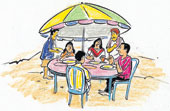
There were chairs and tables scattered around, and men, women and children sat relaxed in long armchairs with rainbow coloured umbrellas protecting them from the April sun. The building looked clean and as Nagaraj stepped out, two boys ran up to him.
He swung one of them high in the air and turning to my wife said: “Come, madam, bahut aacha jagah hai!” He cuffied the other boy playfully and shouted: “Aacha table lagao. Jaldi.” I placed the wre-nch back to where it belonged and as I got out and shuffled off to the toilets, I caught my wife’s eyes. “It’s those detective books you always keep reading. You find everyone suspicious,” she said.
“How could you distrust someone recommended by a good friend?” I slunk away, tail tucked between my cowardly legs and when I came back from the washroom, fresh both in mind and body, I remember thinking: “It’s not just the detective books, not just Ed McBain and P.D. James. It’s also because of a mind conditioned by stories from yore where fair or white meant good and black or dark meant bad.” I could think of only two exceptions that mollified the traditional stand vis-à-vis legends and myths and religion: Lord Ram and Lord Krishna who still maintain a complexion beautifully darker than the rest in the many-splendoured gods in our Hindu pantheon.
I watched Nagaraj washing the car with a hosepipe, his trousers rolled up to his knees, the boys who were not attending to the customers helping him with the extra rags he had handed out.
After finishing his work, he fished out a towel and a bag from the boot of the car and went into the bathroom. A young man in white pants and shirt came up to me with a bottle of beer. My son and my niece had come up and once more I caught that deadpan look on my wife’s face, a look that was equivalent to the strongest of disapprovals. I sat up quietly in my chair. “But I didn’t order any beer,” I told the waiter. “Thank you, but no beer so early in the morning.” The deadpan had given way to a softening of the corners of the mouth.
“Nagaraj said you will like chilled beer,” the waiter said. “No, please. Not now,” I said gently. When they finally brought the food it was a combination of rice, dal, uttapam, sambarvada and red-hot chilli pickles that made me wish I had kept the chilled beer with me. Moments later, Nagaraj was at my side in a fresh white shirt. The towel and the washed undergarments lay splayed out on a large rock by the side of the well near the washroom.
“Are you comfortable, Sir? This chair is all right for you? Please take rice and dal. It is fresh. I checked in the kitchen. Madam, you also take rice and dal. Uttapam and sambarvada very good also.”
He spoke in Hindi, taking recourse to English once in a while. I kept looking at his intense black complexion, made blacker now by the white of the shirt and the large white eyes and the blazing pupils and thought: “In my distrust of you I was the snake. In your trust in yourself you are the King of Snakes. Nagaraj, you are the noun. I am but a poor adjective for all that I purport to be.”