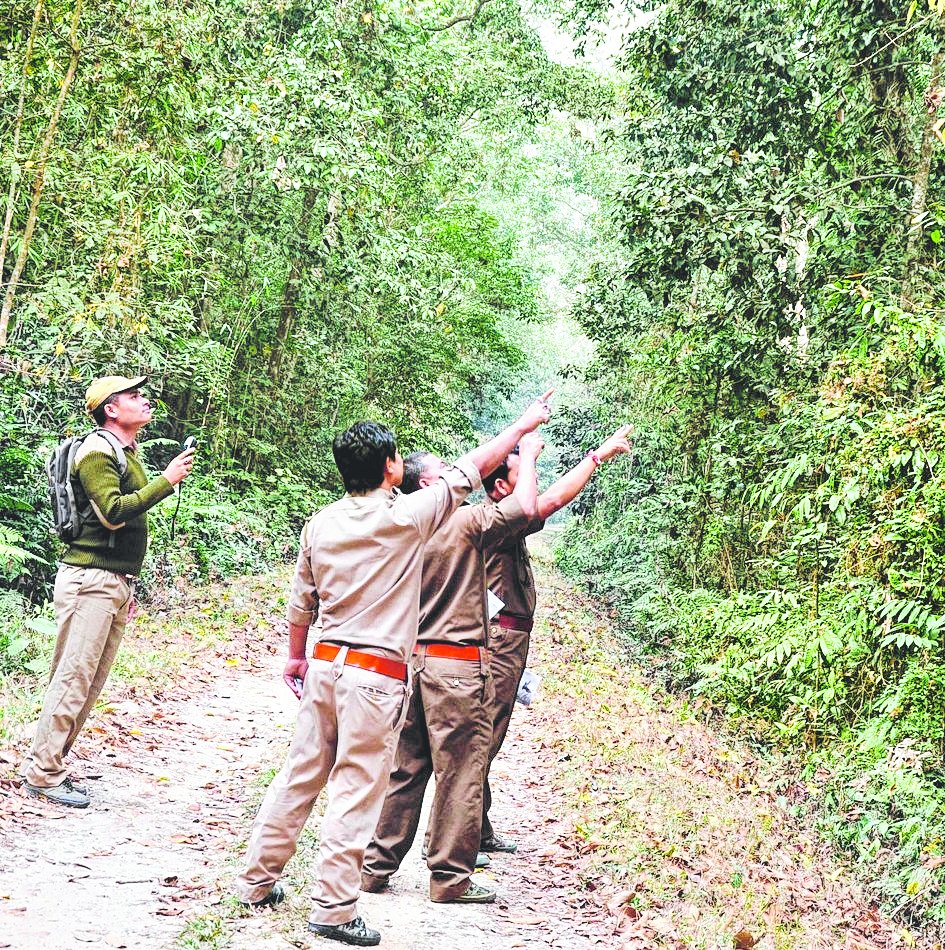

Guwahati, March 8: Forest guards in Assam are being trained for the first time on conservation of hoolock gibbon.
"This is the first time such an initiative is being taken and the response of the forest guards has been very good," Dilip Chetry, honorary wildlife warden, Assam and head, primate research and conservation initiative of Aaranyak told The Telegraph .
The training is being imparted by the Aaranyak and Gibbon conservation centre in collaboration with Assam forest department with financial support from the US Fish and Wildlife Service.
He said habitat fragmentation and hunting are the major threats to gibbons in the country and added to this situation is the lack of basic information and poor conservation awareness about the species among people, including the frontline staff of the forest department, which is yet another major hindrance in the conservation of the species.
"The forest guards who actually work in the field are unaware about the various facets of hoolock gibbon conservation strategy and this is why the training programme was conceptualised," Chetry said.
Around 27 forest guards from 15 forest divisions of the state attended the programme at Hollongapar Gibbon Wildlife Sanctuary (commonly known as Gibbon wildlife sanctuary) in Jorhat from February 21- 27 and the next training will be from March 21-27. It is the only protected area in the country to be named after a primate species. The sanctuary with seven species of primates, including western hoolock gibbon is one of the highest primates diverse areas in the country.
Two species of hoolock gibbons, the western hoolock gibbon ( Hoolock hoolock) and the eastern hoolock gibbon (Hoolock leuconedyes) are distributed in the Northeast.
He said training is being given on gibbon census or population estimation, gibbon data collection, maintaining and reporting, gibbon habitat characteristic and restoration, gibbon rescue and rehabilitation, global positioning system and use in field and legal orientation (wildlife laws and its application).
"The course has provided participants with an initial understanding of the basic principles of primatology, experience with the methods and techniques used in field research," he said.
Training is being imparted to each batch consisting of 20 participants for a week.
Western hoolock gibbon is one of the two apes found in Assam which is distributed only on the southern bank of Brahamaputra.
The population of western hoolock gibbon in Assam is 5,000 whereas that of eastern hoolock gibbon is less than 500 and found in the reserve forest of Sadiya subdivision only.
"The course has provided participants with an initial understanding of the basic principles of primatology, experience with the methods and techniques used in field research," he said.