The rooftop of What’s Up! Cafe was humming with the familiar choreography of a city evening. Plates travelled from kitchen to table as Calcutta settled into another bustling night. Bathed in warm amber light, the familiar rooftop seemed destined for yet another evening of food, drinks and easy conversation. Then interdiscliplinary artiste Sujoy Prasad Chatterjee walked to the microphone, and almost imperceptibly, the room changed pace. The chatter softened. Faces turned. What had moments earlier felt like an ordinary evening at a resto-pub was suddenly transformed into something far richer — an invitation to listen. Not merely to Rabindranath Tagore’s songs, but to the journeys they have taken across generations, cultures and soundscapes.
The evening belonged to Tagore on the Highway — an audacious yet deeply respectful musical project conceived by singer Neepabithi Ghosh, nurtured by Sujoy Prasad Chatterjee and presented by What’s Up! Cafe recently as part of @Sujoy, an ongoing series of carefully curated musical evenings. The premise was simple: reimagine Rabindra Sangeet through contemporary Western musical arrangements without altering either the poetry or the melodic soul of the compositions.

Anamika Sengupta and Anirban Sengupta, co-owners, What’s Up! Cafe
It is a delicate balance. One that has, over decades, inspired admiration as much as anxiety. Chatterjee acknowledged that tension almost immediately. “I wanted to have events every month with my signature,” he smiled, reflecting on the journey of @Sujoy, which began on International Women’s Day and has steadily evolved into a platform for unusual artistic conversations.
For Chatterjee, Tagore’s music has always been inseparable from the extraordinary mind that created it. Before introducing the first song, he traced a sweeping intellectual landscape that moved from Tagore’s political essays to his conversations with Albert Einstein, from debates on nationalism to reflections on Western classical traditions and Indian folk idioms.
What many listeners often overlook, Chatterjee observed, is that the musical architecture surrounding Rabindra Sangeet has never been entirely static. Reinvention, he suggested, has always existed within the history of Rabindra Sangeet itself.
That historical perspective forms the very foundation of Tagore on the Highway. “We’re trying a different soundscape,” he explained, “but this was fundamentally Neepabithi’s idea.” The ambition has always been to ask a deceptively difficult question: how does Rabindra Sangeet continue speaking to younger listeners whose musical vocabulary has been shaped by so many genres of music, including modern popular music?
“How do we make Tagore youth-centric without compromising Tagore?” Chatterjee asked. He stressed how fresh sonic language could coexist with fidelity to the original compositions.
For Chatterjee, Neepabithi Ghosh belongs naturally within that lineage. Long before audiences recognised her as one of Calcutta’s finest pianists and concert performers, she had already begun imagining Tagore’s music differently. “She tried to see Rabindranath in another light,” he said. “That wasn’t easy in those days.”
It has always been about discovering new musical homes for timeless songs. To understand why such experimentation matters, Chatterjee took the audience on an engrossing historical detour. A Western notation of a Rabindra Sangeet composition, he reminded listeners, was prepared by Sarala Devi Chaudhurani, niece of Rabindranath Tagore as a birthday gift for the poet. The song, Sokatore oi kandiche sokole, was carefully transcribed in Western notation, opening an entirely new way of reading Tagore’s music.
Instead of changing the compositions, Tagore on the Highway surrounds them with the textures of Western popular music, allowing it to converse with melodies that remain unmistakably Rabindranath’s.
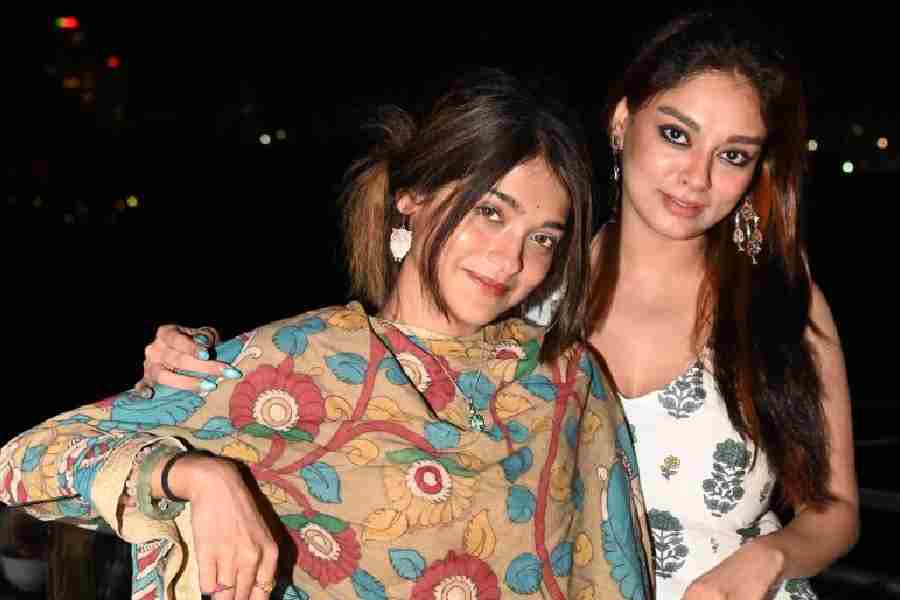
Anusha Viswanathan and Bibriti Chatterjee were in the audience
That innate rhythmic intelligence becomes the bridge between Eastern and Western musical worlds. Explaining the vision behind @Sujoy, Anirban Sengupta, co-owner of What’s Up! Cafe, said: “For years we’ve hosted live performances, but we wanted to explore territories that commercial venues rarely touch,” he said. “We began with Divas Unlimited on Women’s Day, followed by a tribute to R.D. Burman, and now Tagore on the Highway. There are many more such evenings planned. Rabindranath, Bob Dylan, R.D. Burman — they all deserve a place. That’s what we’re trying to create.”