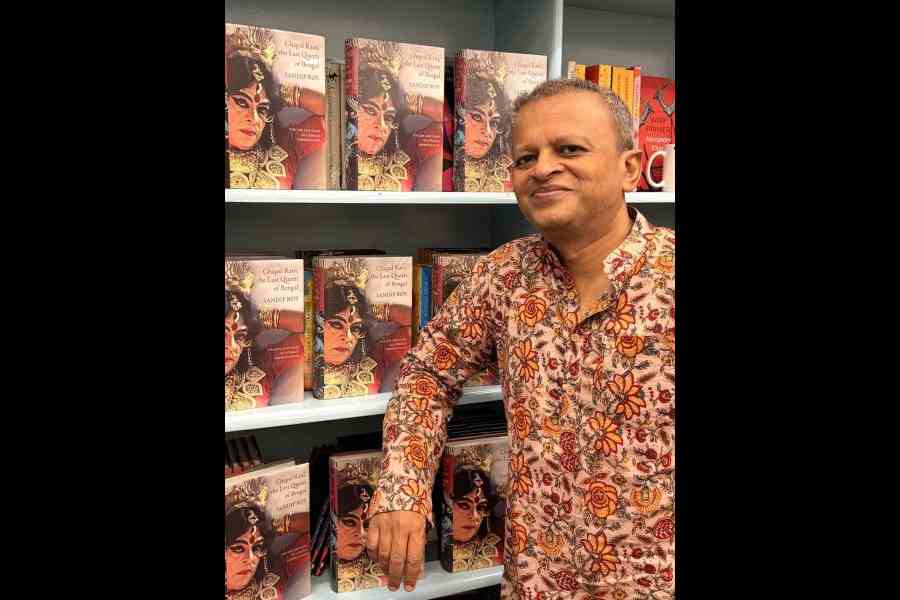
With Chapal Rani, the Last Queen of Bengal, Sandip Roy not only resurrects the enigma that is Chapal Bhaduri, who reigned as an iconic female impersonator in jatra as well as Bengali theatre in the 1960s, but also tells the story of an individual whose extraordinary journey has left an indelible mark on Bengal’s cultural landscape. The rich history of both jatra and Bengali theatre is incomplete without Chapal, whose story deserves to be told and whose life deserves to be celebrated, as a star who continues to guide many and as a rainbow that remains a silver lining in the queer movement.
Though the book was launched earlier this year, International Pride Month seemed the right time to flip through the pages of Bhaduri’s life and remember him as an icon who was unapologetically himself and unbothered by binaries. And though the month-long celebration of queer identity, inclusivity and belonging ends on the calendar today, we sincerely hope Chapal’s smile, his expressive eyes, his commanding stage presence, his humble demeanour, and his unputdownable spirit and legacy do not remain limited to any month or geographical boundary.
A t2 chat with Roy, a conscience keeper within Calcutta’s LGBTQ+ community, whose podcast and literary works have travelled far beyond India.
Roads that led to Chapal Rani
Chapal Rani, the Last Queen of Bengal is the first biography Roy, whose debut book is Don’t Let Him Know, has attempted. We had to ask him whether it was Chapal’s eventful life, his importance to jatra and Bengali theatre, or the LGBTQ+ angle that prompted him to embark on the book. His answer was simple: all of it, and more.
“After my first novel, I was looking for something new to write, and that’s when Naveen Kishore, publisher of Seagull, who had made a documentary on Chapal Bhaduri, suggested that I consider writing the biography. Honestly, at first the project seemed simple. I assumed he would tell his story and I would record, translate, transcribe and write it. However, the more I got into it, the more layers emerged,” shared Roy as we sat at the Seagull Bookstore in Bhowanipore, the same venue where Roy had spent many sessions with Chapal, listening to him with renewed interest.
It is hard not to be fascinated by Chapal and the trajectory of his life, and that is exactly what happened to Roy. “It fascinated me that there was this man who existed before all of the Pride Month movement and all that. He not only played women’s roles all his life on stage, but unlike many of the other jatra queens, he also chose not to get married. In fact, at one point, he was quite open about the fact that he had a long-term relationship with a man. So, I thought, we talk about our LGBTQ+ movement and everything, but he might well have been our first openly gay actor from the mainstream,” Roy told us, recalling a conversation with filmmaker Kaushik Ganguly, who had pointed out that while Rituparno Ghosh was a pioneer, without Chapal Bhaduri there might have been no Rituparno Ghosh.
“He (Kaushik Ganguly) says that it is after Rituparno acts with Chapalda in Arekti Premer Golpo that he starts making films that deal with sexuality in a more overt way. And I thought this was a rare opportunity. Such a person was still around, willing to talk and share his story, and it would have been silly not to take that chance and write about someone from our own backyard.”
Taking Chapal beyond Bengal
Chapal was not well versed in English. In fact, in the book he talks about how poor he was at the subject. That made us ask why the biography was not first written in Bengali.
Roy explained that Chapal had already written a slim Bengali memoir chronicling his early years, but it could not reach a large audience. He also pointed out that writing in English would widen the book’s readership and take Chapal’s story beyond India.
Recalling the moment he handed Chapal the finished book, Roy shared: “When the book came out, I went to his old-age home to give him a copy. The very first thing he said was that it was unimaginable to have a 500-page book written about him. In fact, when we sat in this very room, surrounded by so many books, he had said: ‘Baba, bhabhte parchhi na je, aama ke niye erokam English te ekta boi lekha hobe.’ (I can’t believe an English book like these is being written about me.)”
Roy then added something that lent even greater weight to his decision.
“It was a sign of a certain respect being paid to him,” he said with reverence. “Even though he (Chapal) doesn’t articulate it, I think it matters a lot. For people like him, who are doubly marginalised. He’s a gay man, which is one kind of minority, and then he works in jatra, which is often looked down upon as lacking class or cultural prestige. And within jatra, he plays female roles. So, with all those layers, I think it felt as though some long-overdue respect had finally been given to him.”
Introducing Chapal
Roy writes an unusually long introduction to the book, one that provides the background not only to Chapal but also to the world readers are about to enter. Interestingly, the introduction was the last section he wrote.
“In fact, I submitted the manuscript without the introduction because I was struggling to figure out what it should be. Later, I realised that one of its purposes had to be to contextualise Chapalda and explain what jatra was. A certain amount of the history of jatra had to be included so readers could understand where to place him. I also had to explain why I was writing a book about Chapal Rani rather than Rakhal Rani or others, apart from the fact that they’re dead and I couldn’t interview them.”
Speaking further about Chapal Bhaduri, he added: “The USP of Chapalda is that his career doesn’t end with the decline of jatra. He reinvents himself through films and theatre. There’s a documentary about him, and then he also becomes an LGBTQ+ icon. But in the process, something is happening to me too. Listening to him and transcribing his words, and even choosing the questions I ask, forces me to think about myself and my own place in the story. How does that story reflect on me? All of that started seeping into the introduction.”
The Opening Act
The opening scene of the book takes readers to the funeral procession of Rabindranath Tagore in Calcutta, a choice that immediately piqued our curiosity. Apart from being the first memory Chapal shared with Roy, it is also a story passed down through his mother that shaped his understanding of the world.
“It is an interesting place to begin because Tagore looms so large over our cultural consciousness that it felt entirely fitting for a book that is also about low culture versus high culture. Rabindranath also plays a role in his life because he talks about his mother singing and Rabindranath allowing her to use his melodies for two of her poems. That is evidence that, no matter how much we debate what is high culture, what is low culture, what is natok and what is jatra, for somebody like him it was all part of the same cultural mix, with Rabindranath as the presiding deity over it.”
Interesting Interludes
Chapal Rani, the Last Queen of Bengal is not simply an extended conversation between Roy and Bhaduri. It also contains fictional interludes that offer fresh perspectives on Chapal’s story. One that particularly fascinated us was the account of a ghost.
Referring to the chapter In Imagination: The Ghost of Putulbari, we asked Roy about it.
“Interludes were never part of the original plan,” he said. “Originally, I was trying to write a straightforward biography based on what Chapal told me. In a conventional biography, one would interview colleagues, family members and other people who knew the subject. But in Chapal’s case, that wasn’t really possible because most of the people he had worked with were either gone or unavailable.”
Here, Roy also brings his instinctive flair for fiction into the narrative. “I thought these fictional interludes could become a way of raising questions for the reader. I wrote a couple of them. The first one is The Chorus Girl. There’s also one featuring a drag queen, and that becomes a fascinating conversation between the two. I realised this was an interesting way to bring different lenses to the story.”
Roy revealed that he plans to take both the book and Chapal Bhaduri’s story beyond Calcutta and India. A stage production is also in the works to ensure that Chapal Bhaduri’s legacy continues to live on.