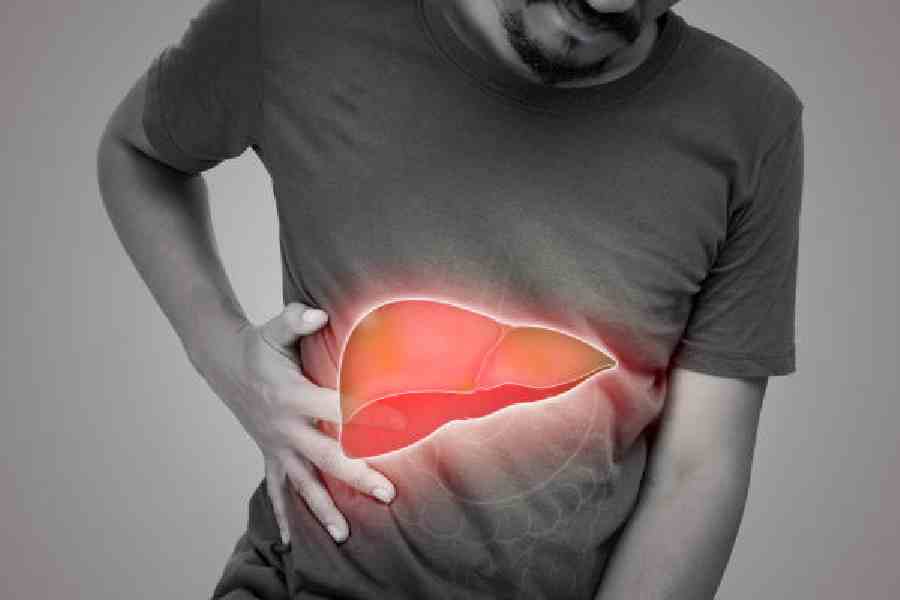
The World Health Organization calls it “one of the fastest-growing causes of chronic liver disease”. It is said to affect about 1.7 billion people worldwide with substantial prevalence across age groups. India is no exception. The Telegraph interviewed Professor Chandrima Das of the Biophysical Science Division of SINP and her student Atanu Mondal about their study on the subject, which was published recently in the journal Nature Communications. The study highlights how the liver adapts to stress caused by modern lifestyles and fat-rich diets. Here are excerpts.
Q What exactly is MAFLD?
Metabolic dysfunction associated fatty liver disease or MAFLD is a condition in which excess fat accumulates in the liver. It is linked to conditions such as obesity, diabetes, insulin resistance, hypertension or other metabolic abnormalities. Unlike liver diseases caused by viral infections or excessive alcohol consumption, MAFLD is fundamentally a metabolic disease.
Q Why is it becoming a major health concern in India?
A large meta-analysis of over 23,000 Indian adults estimated that approximately 38.6 per cent of them have fatty liver disease, meaning one in every three Indians may be affected. The Phenome India-CSIR cohort, involving participants from 27 Indian cities, reported that approximately 36 per cent to 48 per cent of adults met the criteria for MAFLD.
Q Tell us about your research.
Our research uncovered an unexpected paradox in fatty liver disease. Traditionally, fat accumulation in the liver has been viewed as harmful. However, we found that the liver actively increases the production of triglycerides, a relatively safe form of fat, to protect itself from more toxic lipid molecules that can damage liver cells. At the centre of this process is a protein called TCF19, which acts as a key molecular regulator of the liver’s stress response. When liver cells are exposed to excess saturated fats, TCF19 helps convert toxic lipid species into triglycerides, thereby reducing cellular damage and delaying progression to more severe stages of disease such as inflammation and fibrosis.
Paradoxically, while this protective mechanism shields the liver from immediate injury, it also promotes the accumulation of fat within the organ, contributing to the earliest stages of MAFLD, as further validated in an animal model in collaboration with Professor Siddhesh Kamat of IISER Pune. In essence, TCF19 functions as a double-edged sword; it protects the liver from severe damage while simultaneously facilitating the development of fatty liver. This discovery highlights the remarkable complexity of the liver’s defence mechanisms and provides new insights into how metabolic diseases develop and progress.
Q If fat accumulates in the liver, why doesn’t everyone develop severe liver disease?
Simple accumulation of fat in the liver, known as steatosis, is often considered the earliest stage of MAFLD. However, fat alone is not necessarily harmful. In many cases, triglyceride storage may actually serve as a protective mechanism that helps liver cells safely store excess nutrients. Problems arise when metabolic stress overwhelms the liver’s adaptive capacity. Excess saturated fatty acids, insulin resistance, mitochondrial dysfunction, oxidative stress, endoplasmic reticulum stress, chronic inflammation and genetic susceptibility can trigger progressive liver injury. Over time, this may lead to metabolic dysfunction-associated steatohepatitis (MASH), fibrosis, cirrhosis and even hepatocellular carcinoma.
Q What is the difference between simple fatty liver and MASH?
Simple fatty liver (steatosis) refers to excess fat accumulation in liver cells without substantial inflammation or tissue damage. MASH is a more severe condition in which fat accumulation is accompanied by inflammation, hepatocyte injury and activation of fibrotic pathways. Patients with MASH are at significantly greater risk of developing advanced fibrosis, cirrhosis, liver cancer and liver failure.
Q What is fibrosis, and why do doctors worry about it?
Fibrosis is the accumulation of scar tissue in the liver following repeated injury and inflammation. When liver cells are damaged over time, specialised cells called hepatic stellate cells become activated and begin depositing collagen and other extracellular matrix proteins. Initially, fibrosis may be reversible but if the process continues, it can progress to cirrhosis, liver failure and cancer. Doctors are concerned about fibrosis because it is the strongest predictor of liver-related complications and mortality in MAFLD patients. The degree of fibrosis often predicts clinical outcomes more accurately than the amount of fat present. Recent large-scale studies in India indicate that fibrosis has become common.
Q Can people have MAFLD even if they are not obese?
Yes. An important and often overlooked aspect of MAFLD is that it can occur in individuals who appear lean or have normal body weight. This condition, often referred to as “lean MAFLD”, is particularly common among South Asians, including Indians. Indians tend to accumulate fat around internal organs, especially in the abdominal cavity, even at relatively low body mass indices (BMI). This visceral fat contributes to insulin resistance, inflammation and abnormal lipid metabolism, all of which increase the risk of fatty liver disease.
Q What are the symptoms?
Fat accumulation can persist for years without causing noticeable discomfort. When symptoms do develop, they are often nonspecific and may include fatigue, reduced physical endurance, mild abdominal discomfort, sleep disturbances or a feeling of heaviness in the abdomen. As fibrosis advances, symptoms such as muscle loss, fluid accumulation, jaundice and gastrointestinal bleeding may occur.