There is a strange kind of inconsonance that marks our existence on social media. Scrolling through one’s feed brings visuals of war and famine interspersed with memes and personal commemorations that lead to jarring emotions coexisting in an uneasy truce. A similar splitness would strike the viewer who visits Sohrab Hura’s twin showings in the city — The Forest at Experimenter, Ballygunge Place and A Winter Summer at the Alipore Museum. The mind attempts, almost reflexively, to put in order the images that it sees. But the attempt fails. This is not unfamiliar though; it mirrors the way life is lived. A day carries grief and frivolous distraction in equal measure. What Hura offers is not commentary on this condition but a choreographed montage of it.
The Forest (featuring oil paintings, drawings, and a video) is like a threshold, a waiting room to pause between stimuli, a place where ideas and memories gather without declaring their purpose. These works draw from television memories, internet detritus, jokes that age badly, familial tenderness and political absurdity. A painting of rest carries the same gravity as a drawing shaped by grief. Humour sits uncomfortably close to violence. Melancholy arrives without warning and leaves without ceremony. This refusal to rank experiences mirrors the logic of contemporary consciousness where a meme and a massacre can inhabit successive seconds without pause for moral recalibration.
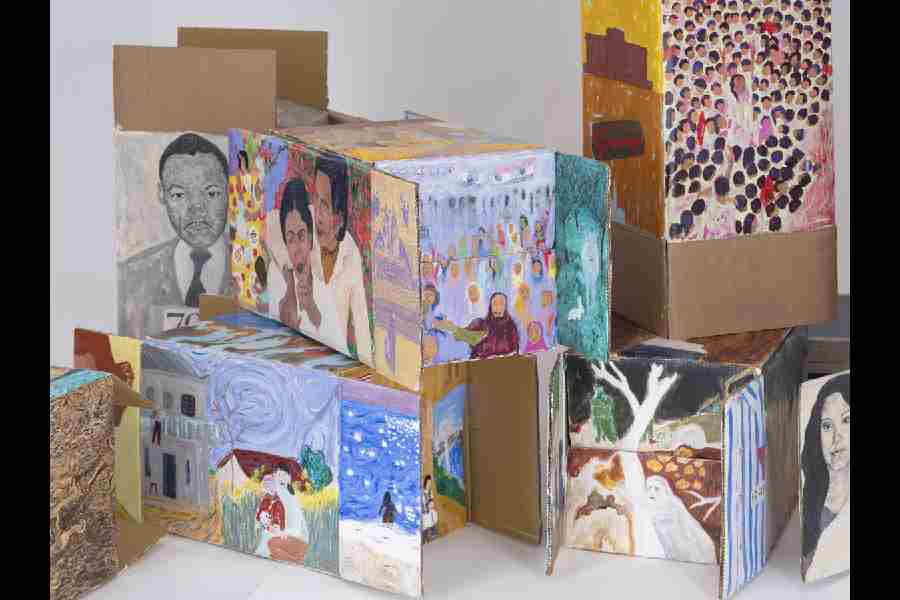
The installation titled Timelines crystallises this condition with particular clarity. Painted cardboard boxes are transformed into mutable carriers of story. Each surface of the boxes bears an image and each configuration of their placement alters meaning. The viewer understands quickly that history here is not fixed but assembled, rearranged, quietly manipulated. Major events lose their dominance when placed beside minor ones. The hierarchy collapses. The boxes insist that the manner in which stories are ordered determines what they come to mean.
A Winter Summer performs a different register of splitness. Here, photography takes the lead, bringing together two bodies of work shaped by climate and politics: winter in Kashmir and summer in Barwani, Madhya Pradesh. Extremes of cold and heat become structural devices through which social realities are observed, rather than explained.
In the Kashmir series, snow is neither scenic nor symbolic in any comforting sense. It obscures, delays, and isolates. It melts slowly, laying bare what had been held under cover rather than offering any promise of rebirth. The photographs carry the residue of interruption, of a place caught between visibility and erasure. The political context is present without spectacle, embedded in absence, in unease, in images that resist easy consumption. Beauty appears only to be complicated, and is never allowed to settle into romance.
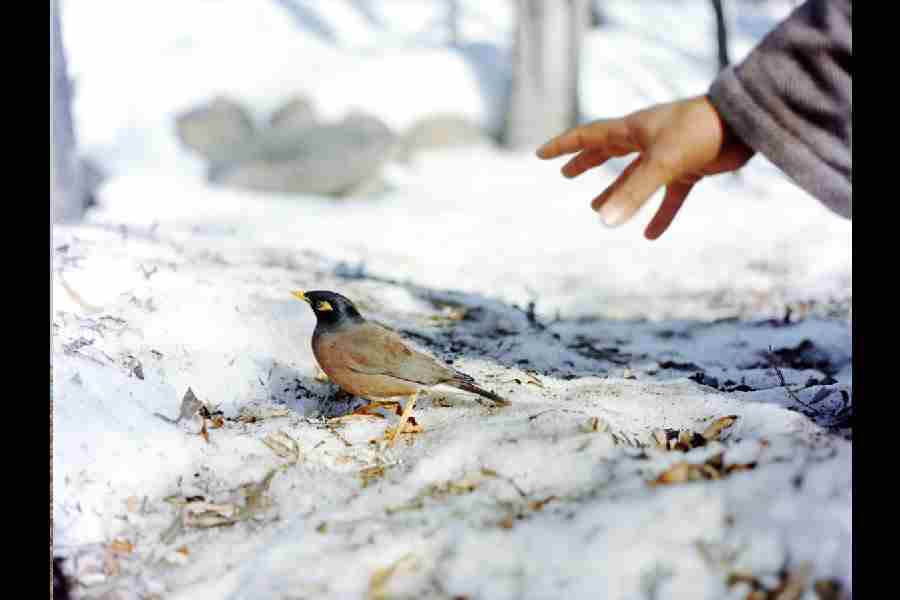
Snow by Sohrab Hura. Source: Alipore Museum
The Barwani photographs operate through a different pressure. Heat flattens time. Days stretch and repeat. The camera attends to gestures of endurance rather than drama. People rest, wait, adapt. The landscape offers little relief, yet life persists with stubborn regularity. The sun is not symbolic; it is present, relentless, structuring how time is felt. Barwani also introduces a different political grammar. Unlike Kashmir, where absence and interruption dominate, Barwani speaks through continuity. The politics here are embedded in infrastructure, in access to water, in labour patterns, in how seasons dictate possibility.
What links the two bodies of work in different media is that they both challenge the velocity of looking — the speed at which images are consumed, processed, and discarded. When images of violence, intimacy, humour, and catastrophe appear within a continuous stream, they begin to occupy the same emotional register. The eye adapts by skimming. But the uneasy juxtaposition of these images as artwork forces the viewer to pause, to look without immediately understanding, to stay with discomfort. In doing so, Hura positions slowness as resistance to the emotional inertness of contemporary existence.