Newton County in Georgia, US, and Tusyana in Uttar Pradesh’s Greater Noida have nothing in common, except that they have both seen the future – the effects artificial intelligence (AI) data centres have on water.
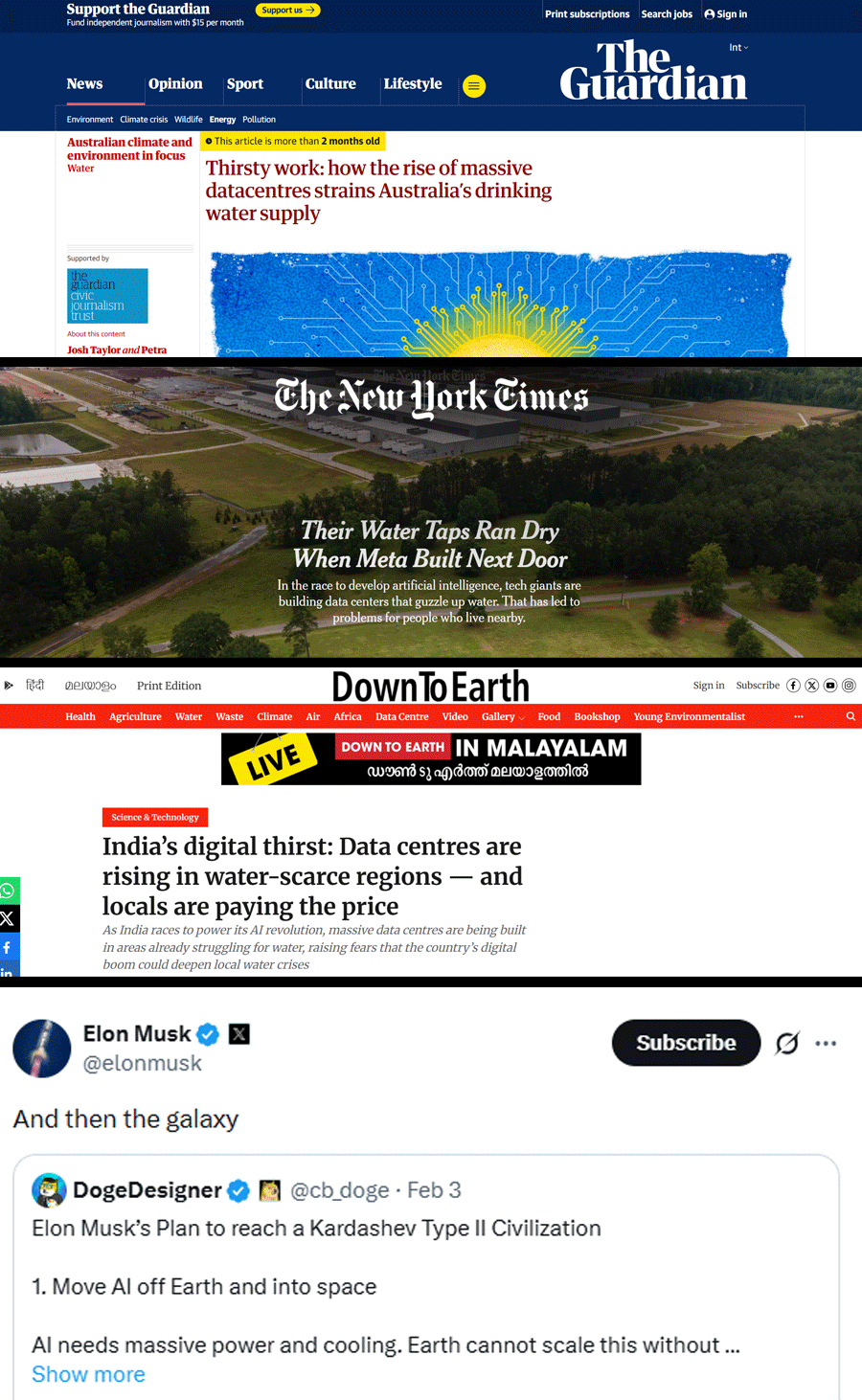
In 2018, after Meta started building a $750-million data centre on the edge of Newton County, people in a nearby town of 1,20,000 saw taps trickling to a halt, wells running dry and groundwater being clogged with sediment.
In July last year, The New York Times reported on it, highlighting that these data centres guzzle approximately 5,00,000 gallons (18,92,705.89 litres) of water a day – roughly 10 per cent of the surrounding community’s total usage – to cool the massive hardware required for AI.
Last year, Down to Earth reported how water was becoming scarcer for the people in a 2,000-strong village in Tusiyana, next to the 820,000-square-foot Yotta Data Centre Park inaugurated by Uttar Pradesh chief minister Yogi Adityanath in 2022.
The people of Tusiyana told the magazine they have to dig at least 80 feet to access water, which was available at 20 to 30 feet two decades ago. Groundwater is the village’s primary water source.
Uttar Pradesh has signed a Rs 39,000-crore MoU with Yotta to construct six such data centres over the next seven years.
TTO Graphics
India’s hunger for data centres is not restricted to UP.
The country is betting big on data centres in the age of AI. The Union Budget this year has provided tax holidays till 2047 to foreign cloud service providers leveraging Indian data centre infrastructure.
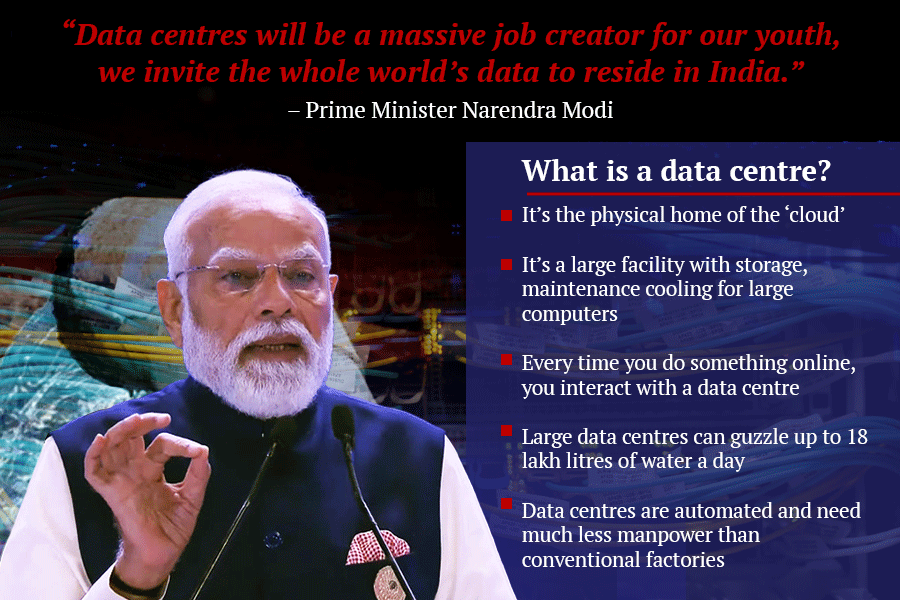
“Data centres will be a massive job creator for our youth, we invite the whole world’s data to reside in India,” Prime Minister Narendra Modi said on Sunday inaugurating the AI Impact Summit expo.
Other experts pointed out that data centres are automated so they employ much fewer people than conventional factories.
India has 132 existing data centres, 84 upcoming projects by 2029 across 17 cities, according to a September 2025 report by market research and business intelligence firm Arizton Advisory & Intelligence,
Maharashtra accounts for approximately 45 per cent of India’s upcoming data centre power capacity, with Mumbai emerging as the largest hub in the country. Cities with tech clusters like Bengaluru, Hyderabad, Chennai, Pune and Noida are other popular destinations.
India has three to five major operational AI-specialised hubs. In the pipeline are a dozen "Gigawatt-scale" campuses.
The Adani Group on Tuesday unveiled a $100-billion investment to develop renewable-energy-powered, hyperscale AI-ready data centres by 2035, one of the world's largest integrated energy-compute commitments. KPMG has recently projected a fivefold growth of data centres in India by 2030.
On Monday, AI giant Anthropic opened a new office in Bengaluru, having announced multiple new partnerships across India, the US company’s second largest market for its AI assistant, Claude.
This is an addition to the over-600 AI firms in the city, and over 1,000 AI start-ups.
Data centres need fresh water
Data centres need fresh water. The reason, as pointed out by US-based AI-focused podcaster and newsletter writer Aakash Gupta in a social media post, is chemistry. See the embedded tweet below for the explanation.
What does that spell for a country where taps already run dry in most major cities?
“Data centres require a huge amount of water to prevent the systems from overheating,”
groundwater specialist and IIT Kharagpur professor Abhijit Mukherjee told The Telegraph Online. “South Indian cities will be worst affected by the rapid expansion of data centres, as south India has less accessible ground water compared to the rest of the country.”
According to the Environmental and Energy Study Institute (EESI), a medium-sized data centre can consume around 3,00,000 gallons (11,35,623.5 litres) of water in a day.
“Most of India is water deficient,” Himanshu Thakkar, coordinator, South Asian Network on Dams, Rivers and People (SANDRP), told The Telegraph Online.
“Bengaluru’s water is pumped uphill from the Kaveri, covering 100 km, involving massive infrastructure. Data centres have to take accountability for better water management. Sustainable usage like rainwater harvesting or desalination of sea water, backed by strong government regulation, will still have consequences on the water supply chain.”
What is a data centre?
The ‘cloud’ in cloud computing actually lives in massive, high-security buildings filled with powerful computers. A data centre is a facility used to house these computer systems and associated components, such as telecommunications and storage systems.
Every time you do something online, you are interacting with a data centre. For example, when you hit play on an online video, a server in a nearby data centre sends those files to your device.
Classified by size and use, data centres are largely of four types: Enterprise (Owned and operated by large companies, like, say, Goldman Sachs, for internal use); colocation (small-to-mid businesses renting space and cooling and bringing their own equipment); hyperscale (massive facilities of tech giants like Google or Amazon); and edge (smaller facilities placed closer to cities).
How much water do data centres need
Like many things about AI, no one really knows just how thirsty it can get.
A 2023 University of California Riverside study found that 500 ml water is consumed by 20 to 30 prompts to ChatGPT.
Some data centres, like Yotta’s in the Down to Earth report, claim to rely less on water and more on air-cooled systems or close-loop cooling systems in which water is continuously recycled rather than discharged.
But activists, researchers and industry experts are all raising alarms about the transparency of AI’s water consumption, warning that the absence of reliable data makes it difficult to quantify usage or design effective regulations.
AI specialist and IIT Kanpur professor Arnab Bhattacharya proposed large-scale implementation of a dual pipeline system, with one supplying fresh water and the other supplying recycled water, in data centres.
“This practice has been followed in our institute in Kanpur,” Bhattacharya told The Telegraph Online. “The sprawling lawns we have are mostly watered by this recycled water. It would be difficult to implement and regulate extra pipes of recirculated water in all facilities because of the high costs involved.”
The relation between AI and water is cropping up across the world. In California, the global epicentre of AI, annual wildfires require vast volumes of water, with over 10 million gallons consumed in one week alone in 2020. Elon Musk, the world’s richest man, is reportedly considering building data centres on the Moon to get over the heating up problem. Strain on water has also worried experts in Australia with dozens of new investments in datacentres in Sydney and Melbourne.
However, scholars stress that the Global South will be disproportionately affected because of the massive opportunity cost of water in regions already strained by climate change.
TTO Graphics
Can India provide water for thirsty data centres
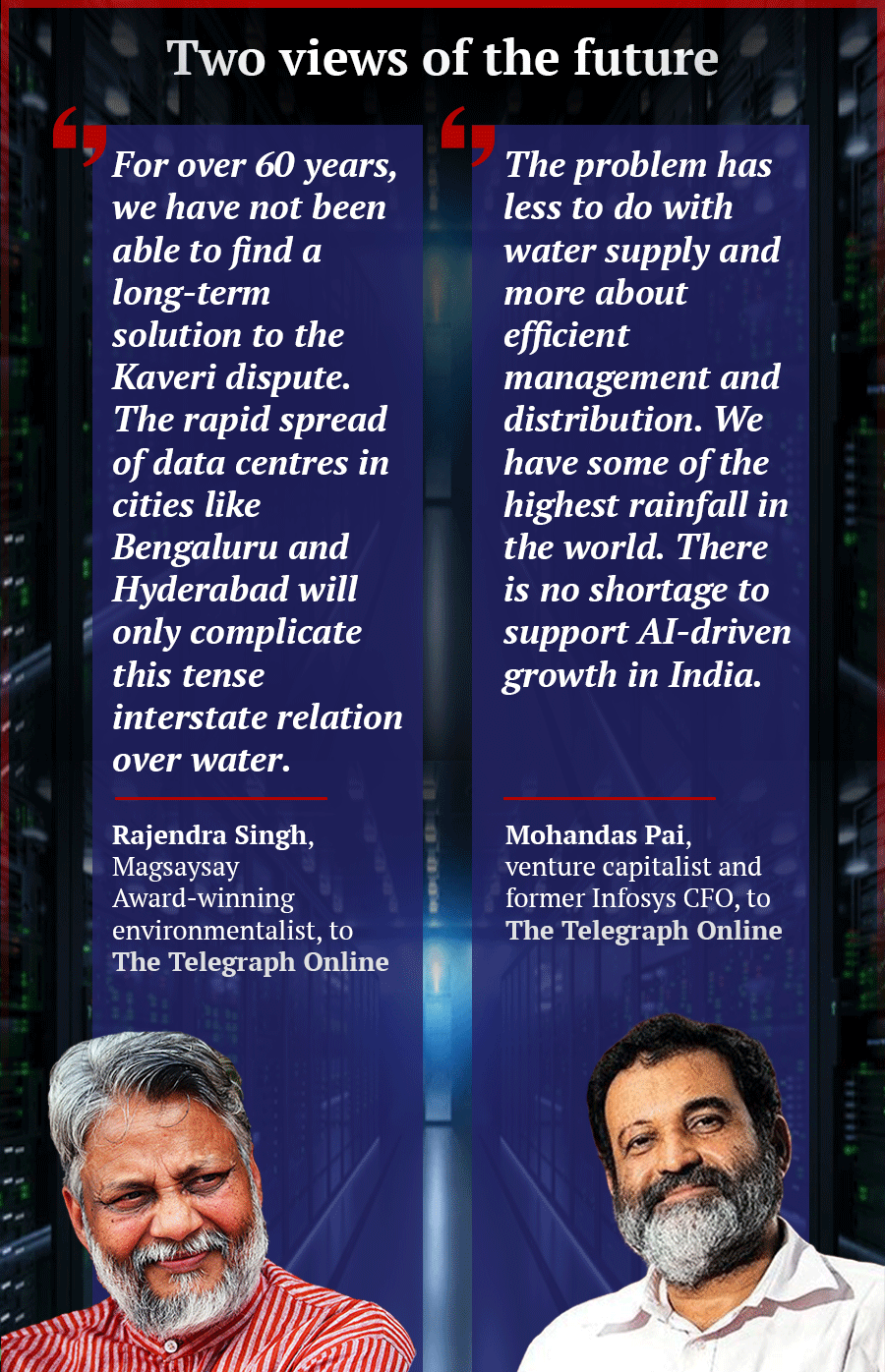
“For over 30 years, I have been urging the world to understand that water scarcity may be the springboard for the next biggest global conflict. The introduction of AI is expediting these tensions at an alarming speed,” conservationist and Ramon Magsaysay Award winner Rajendra Singh told The Telegraph Online.
“For over 60 years, we have not been able to find a long-term solution to the Kaveri dispute. The rapid spread of data centres in cities like Bengaluru and Hyderabad will only complicate this tense interstate relation over water distribution,” he said.
Not everyone agrees that AI-driven infrastructure will lead to water depletion in India.
“The problem has less to do with water supply and more about efficient management and distribution.” Mohandas Pai, partner at Bengaluru-based venture fund Aarin Capital and former CFO of Infosys, told The Telegraph Online.
“India has invested less in AI compared to the US and our per capita consumption of water is also much less than that of the US. We have some of the highest rainfall in the world. There is no shortage to support AI-driven growth in India. We need to tackle and regulate storage and distribution measures,” he said.
India is not the only one betting on AI, the world is.
In November last year, The New York Times said in a headline that the AI boom was driving the US economy. The second part of the headline was: “What Happens if It Falters?”