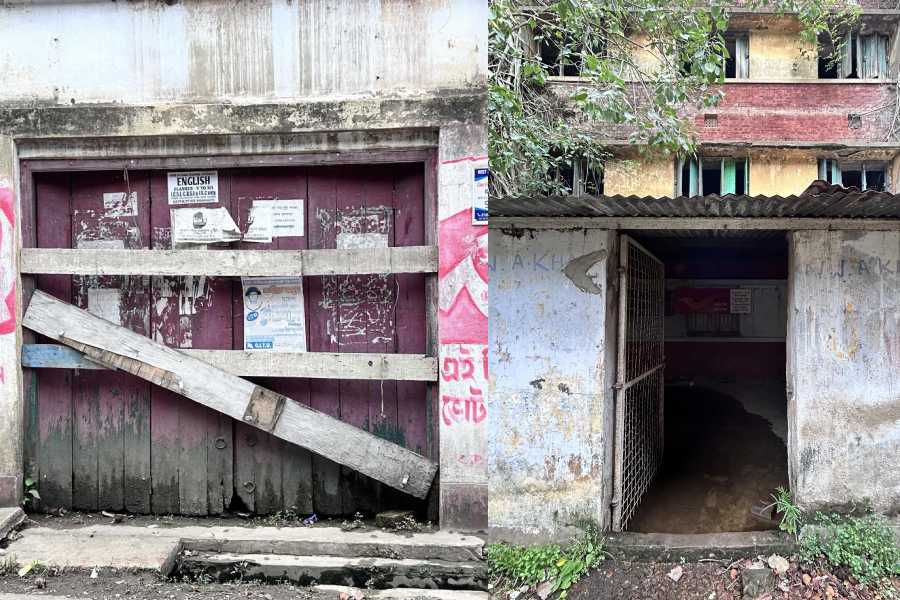
In July, when it came to be known that the East Belghoria Sub Post Office was to be merged with the Udaypur Sub Post Office, there was an uproar. Belghoria is on the outskirts of Calcutta. One of the protesters Pradip Choudhury, 70, told The Telegraph, “They are going to merge this 70-year-old post office with a smaller one. This one has 40,000 accounts and serves a huge catchment area.” His complaint: the post office in Udaypur is poorly maintained and poorly staffed. What is worse, come monsoon and the area routinely gets waterlogged.
The process of shutting down and merging post offices in tier 2 and tier 3 cities has been initiated by the Centre as part of a “comprehensive post office network rationalisation and redistribution exercise” post 2023. Calcutta is a tier 1 city, but according to news reports from May and June, at least 25 post offices across the city and Howrah were to be merged.

According to the various rules that are in place, a post office should give a month’s prior notice before closure. However, when The Telegraph visited some of these post offices in Calcutta and Howrah that had been closed or merged, the general complaint seemed to be that there had been no clear communication. The post office staff refused to comment on the matter.
Among the inconvenienced citizenry were people from the middle and working classes. For many, the post office is the only financial services point they access. Also, the ready availability of agents makes transactions smooth.
Ramchandra Rajak, a washerman who runs a shop in south Calcutta, has had a savings account in the post office for years. He uses the postal network to transfer money to his family in Bihar. He says, “Since I can’t read or write, it’s much easier for me to use the post office. I cannot leave my shop at will either. My agent takes care of all the paperwork.” Rajak’s agent doubles as his financial advisor. He alerts Rajak whenever the rate of interest goes up and gets him to invest in an MIS or monthly income scheme.
Pratibha Dutta, who is an agent, says, “The post office is more for the poor than the rich. The rickshaw pullers, domestic help, daily wagers...” The post office in Salt Lake, where agent Swapna Chakraborty works, will soon merge with another post office. Chakraborty says, “It will shift to another block. This is going to inconvenience the senior citizens. The monthly instalment schemes require depositors to visit the post office.”
India Post, as India’s post office network is now known, was founded in the late 18th century to serve as a communication network. British civil servant Geoffrey Clarke writes in his 1918 book The Post Office of India and Its Story how the post office gradually took on an enormous amount of non-postal work.
According to Chinmay Tumbe, who is associate professor of economics at the Indian Institute of Management, Ahmedabad, the post office in India evolved from an institution of communication to an important financial institution. He cites the example of the money order. Eventually, the post office became a vehicle for the government to sell its schemes.
“It became an agent of the government in selling National Savings Certificates, Kisan Vikas Patra and Indira Vikas Patra,” says Sarit Chakrabarti, retired chief postmaster general. The returns or the rate of interest on postal savings schemes were high, the investment was tax-free and safe, unlike the share market-based schemes of recent times.
In 2013, India Post generated 60 per cent of its revenues from financial services offered through the largest postal network in the world, comprising over 1,60,000 offices, 90 per cent of which were located in rural areas.
Chakrabarti says, “It was an institution where everyone kept their money. While ₹100 was enough to open an account, the rich could keep up to ₹30 lakh.” But a quick Internet search reveals that by 2019, there were news reports screaming “India Post now biggest loss-making PSU, loses ₹15,000 crore in FY19”.
Vishwas Utagi, who is a Congress leader based in Mumbai and currently the chairman of the Unit Trust Officers’ Association, puts it all down to the BJP government’s step-motherly attitude. He rattles off, “Reduced rate of interest on savings, increased lock-in period of term deposits... The KVP, which used to double in five years, now doubles in 10 years.”
He continues, “In the last two decades, ₹50 lakh crore has shifted from postal schemes to the share market. And in the last 10 years, ₹28 lakh crore has gone out of the ambit of postal savings schemes. Now, there are 11 crore demat accounts in the banks. This only proves that the economically stronger class is shifting from the post office to the banking sector. And that is what the government also seems to prefer, because the post office schemes, wherein it has to pay back the money to the depositor at a high rate of interest, are a liability. The share market is not like that.”
Arundhati Ghosh, retired director general of Indian postal services, agrees that post offices have been providing banking services to the unbanked population, but also concedes it is not possible to maintain hundreds of them if it is not profitable.
Try explaining that to the Ramchandra Rajaks.
Animesh Naskar, professor of economics at Hansraj College, Delhi, says, “The post office is a secure financial institution and it is accessible to a large demographic. If post offices are phased out and banks remain inaccessible to a certain section of this demographic, their consumption pattern will be affected in the long run.”
He adds, “In the absence of the post office, these people would still need to save their money — be it for their daughter’s wedding or children’s education, and maybe just some precautionary savings. So, they will use informal, risky and insecure channels to save their money, namely, chit funds.”